
Consolidating the Crowd: How Optimization Redefines Baggage Delivery Logistics
5359_Consolidating Orders in a Crowdsourcing Delivery Network.
This study investigates the integration of order consolidation into a crowdsourcing baggage delivery network in Hong Kong. By combining empirical surveys, benchmarking of pricing models, and vehicle routing optimization, the researchers demonstrate that consolidating orders significantly improves network efficiency and competitive advantage.
TL;DR
Crowdsourcing has disrupted logistics, but point-to-point delivery remains inefficient. This research explores a hybrid model that introduces order consolidation into a crowdsourced baggage delivery network. By moving from a simple matching platform to an optimization-driven consolidator, the study demonstrates a potential 42% reduction in total travel time and a 50%+ reduction in vehicle requirements, creating a more sustainable and cost-competitive business model.
The "Matching" Trap: Why Current Crowdsourcing Struggles
Most crowdsourcing platforms act as passive intermediaries. A customer requests a delivery, and a driver accepts it. While this "on-demand" model is flexible, it creates a massive amount of "idle capacity." In the context of baggage delivery—where tourists often travel from the same hub (the airport) to similar clusters (popular hotels)—sending a single vehicle for every single bag is economically and environmentally wasteful.
The authors identify a critical gap: Centralized Decision-Making. Without a platform that consolidates orders before assigning them, the network remains a collection of inefficient, independent actors rather than a cohesive logistics system.
Methodology: From Surveys to Evolutionary Algorithms
The researchers utilized a three-pronged approach to validate their model:
- Consumer Insights: A survey of 294 tourists at Hong Kong International Airport revealed that "Price" and "Value-Added Services" are the primary drivers for adoption.
- Benchmarking: Comparison with traditional providers (like WFS) showed that crowdsourcing can offer flexibility, but only consolidation can drive prices down to the 200 HKD range tourists expect.
- Route Optimization: Using a "milk-run" approach—historically used for collecting milk from various farms—the authors modeled baggage delivery as a Vehicle Routing Problem (VRP).
The Optimization Architecture
To solve the complex problem of picking up bags from multiple hotels and delivering them to the airport (The "Many-to-One" problem), the team used an evolutionary solution search approach (Genetic Algorithm). They integrated real-world data via Google Maps APIs to ensure travel times were realistic.
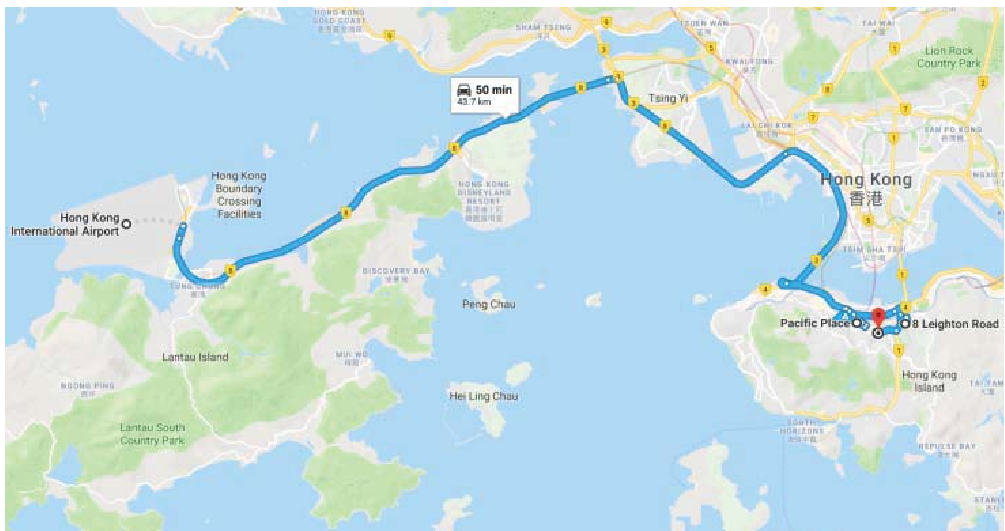 Fig 1. Visualizing a consolidated route: One vehicle serves multiple hotel hubs, drastically reducing redundant trips to the airport.
Proof in the Numbers: Efficiency Gains
The results of the numerical experiments were striking. The study compared a standard "Point-to-Point" (P2P) model against their "Consolidation" model across different scenarios.
1. Airport to Hotel (Distribution)
In a typical 30-minute window with 14 requests:
- P2P Model: Required 14 vehicles.
- Consolidation Model: Required only 6 vehicles.
- Impact: Total travel time dropped from 631 minutes to 363 minutes.
2. Hotel to Airport (Collection)
This is traditionally harder to coordinate. Across 8 different demand scenarios, consolidation outperformed P2P every time.
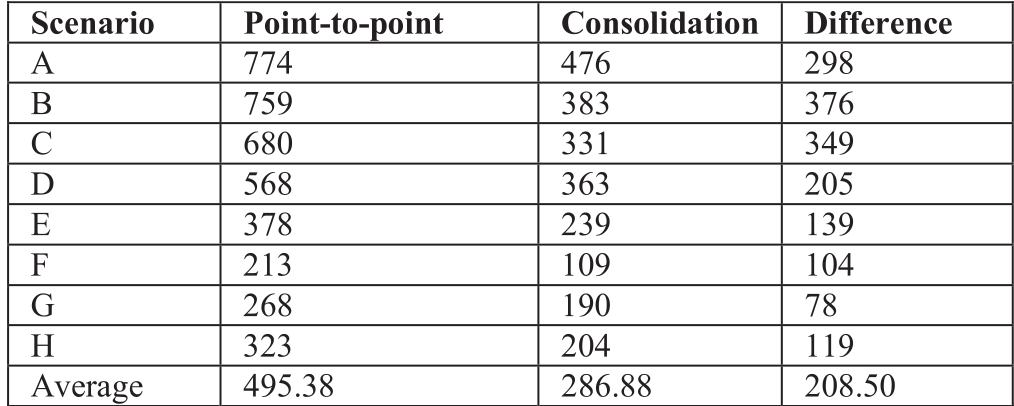 Table 1. The Consolidation model consistently shaved off hundreds of minutes in travel time compared to point-to-point delivery.
Critical Insight: The "Win-Win" Constraint
The study highlights a vital "physical intuition": consolidation only works if the Maximum Travel Time is capped. If a route becomes too long (e.g., over 90 minutes), customer satisfaction drops. However, within that 90-minute window, the platform can:
- Lower prices for customers by sharing the "ride" across multiple orders.
- Increase revenue for drivers by allowing them to earn more per trip than they would on a single delivery.
Conclusion & Future Outlook
This paper serves as a blueprint for the next generation of crowdsourcing apps. The transition from Platform-as-a-Matchmaker to Platform-as-an-Optimizer is the key to surviving in high-density urban markets like Hong Kong.
Limitations: The study assumes the platform has "perfect information" (all orders known in advance). Future research should explore dynamic consolidation, where routes are updated in real-time as new "last-minute" baggage requests appear on the app.
The Bottom Line: Efficiency in crowdsourcing doesn't come from more drivers; it comes from smarter routes.