
Decoding Sextortion: The 5-Stage Architecture of Online Blackmail Against Children
5478_Online blackmail of Czech children focused on so-called sextortion (analysis of culprit and victim behaviors).
This study investigates "sextortion"—a specific form of online blackmail using intimate materials—targeting 6–8% of Czech children. By analyzing 25 serious cases and data from 21,372 respondents, the author establishes a 5-stage behavioral model that predicts attacker-victim communication patterns on social networks.
TL;DR
Sextortion, the blackmailing of minors using sexually explicit materials, has shifted from a taboo subject to a documented digital epidemic affecting nearly 8% of Czech children. This research deconstructs 25 high-stakes cases to reveal a predictable, five-stage "attack pipeline" used by adult predators. The study highlights a chilling reality: 100% of victims suffer in silence for months, and many eventually transition from victims to offenders.
Context: A Growing Threat in the Shadows
In the landscape of cyber-risks, sextortion (a portmanteau of sex and extortion) occupies a uniquely dangerous niche. Unlike general cyberbullying, it is a highly targeted form of psychological warfare. The author, Kamil Kopecký, places this work at the intersection of criminology and digital pedagogy, aiming to strip away the "taboo" that prevents effective intervention.
The Core Motivation: Why Existing Measures Fail
Most current safety programs focus on "stranger danger." However, this research shows that predators don't start with threats; they start with identity verification and validation. Existing research has often missed the relational aspect—how a predator builds a "false confidence" that makes the eventual blackmail more devastating.
The author's intuition is clear: if we can map the stages of the communication, we can provide children with a "script" to recognize the trap before the first intimate photo is even sent.
Methodology: The 5-Stage Blackmail Model
The centerpiece of this study is a chronological model of how an online attack evolves.
1. The Opening Move
Attackers use mundane greetings ("Hello, how are you?") under the guise of an age-appropriate peer. This phase is about establishing a digital presence without raising red flags.
2. Manipulation through Compliments
Predators leverage the adolescent need for validation. By "love-bombing" the victim with compliments on their appearance, they create a social debt.
3. The Identity Check (The Trap)
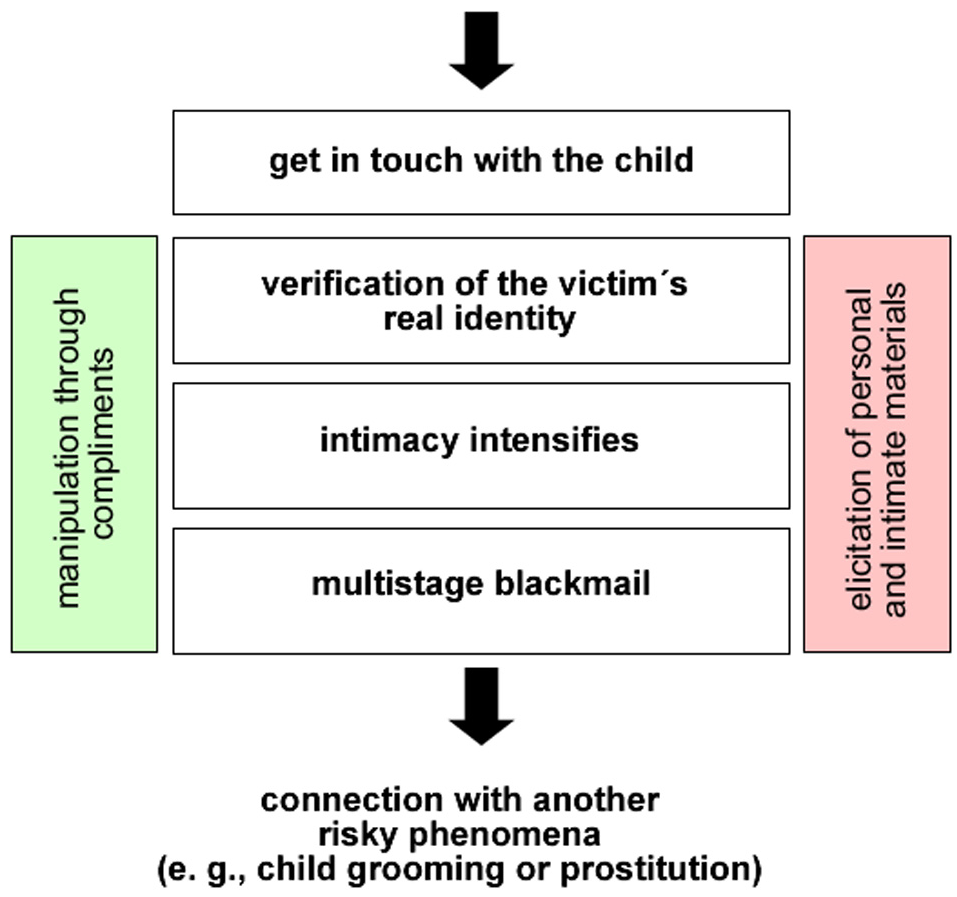 Fig: Examples of attackers requiring children to verify their identity with a handwritten note.
Interestingly, attackers often ask the child to take a photo of themselves holding a note with a specific date or name. This isn't for sexual gratification yet; it is to test compliance and verify the "authenticity" of the victim.
4. Intimacy Intensifying
The "Normalizing" phase. The attacker sends adult content (often sourced from porn sites) to encourage the child to reciprocate. This relies on the psychological principle of reciprocity.
5. Multistage Blackmail
Once intimate material is secured, the mask drops. The attacker uses two primary leverage points:
- Peer Exposure: Threatening to blast photos to the victim's social network friends.
- Family Exposure: Threatening to send photos to the victim's parents (specifically fathers).
Experimental Insights: Trends and Demographics
The quantitative data from over 21,000 respondents reveals a clear upward trend in blackmail incidents over a three-year window.
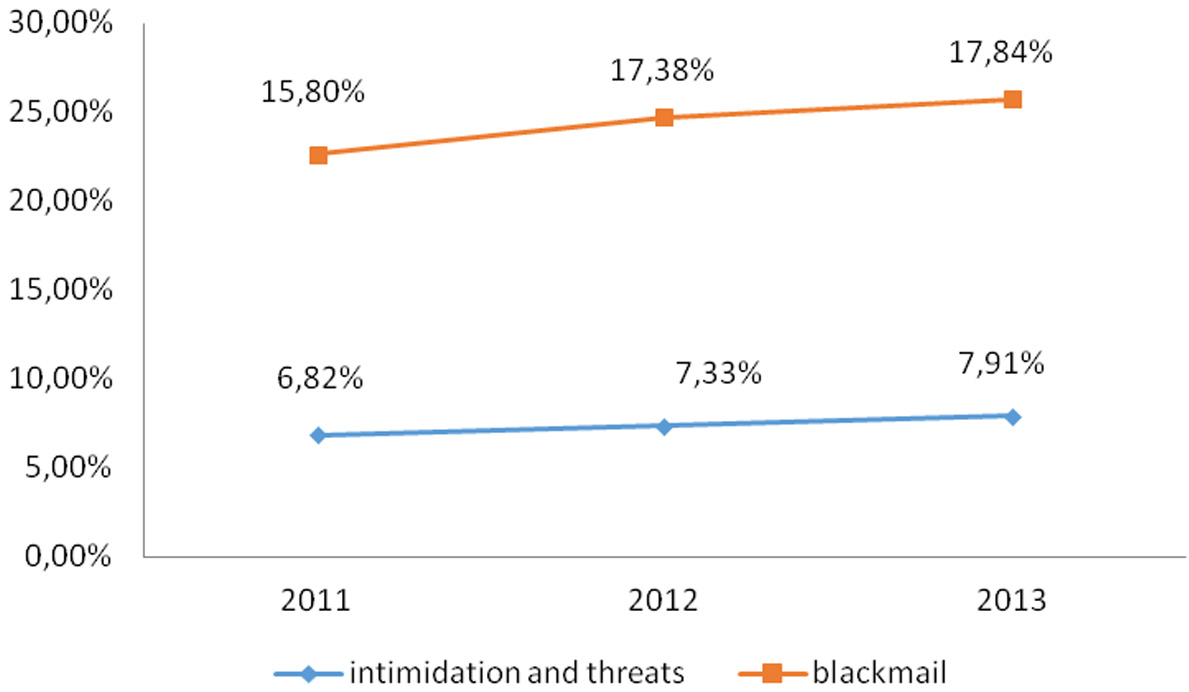 Fig: Increasing occurrence of blackmail using ICT among Czech children (2011–2013).
Key Findings:
- Gender Bias: Girls significantly more likely to be targeted.
- Age Vulnerability: Surprisingly, 15–17 year olds are at higher risk than younger children, likely due to increased sexual exploration and higher social media activity.
- The Vicious Cycle: Victims often "rebound" by becoming offenders themselves, perhaps as a maladaptive coping mechanism to regain a sense of power.
Critical Analysis & Takeaways
The study’s most profound insight is the "Silicon Silence": the fact that not a single child in the qualitative study sought help from a parent or teacher. This suggests that current "open door" policies in schools are failing.
Limitations: The study focuses on the Czech Republic; cultural nuances regarding nudity and family dynamics may differ in other regions. Additionally, as platforms like Snapchat (ephemeral messaging) become more popular, the "evidence" for researchers to analyze becomes harder to capture.
Future Work: We need to explore the intersection of Artificial Intelligence and Digital Forensics to develop automated systems that can detect Stage 3 (Identity Verification) behavior in messaging apps to warn children before they move to Stage 4.
Final Summary: Sextortion is not a random act of digital violence; it is a calculated, stage-based process. By teaching children the architecture of the attack, we empower them to disconnect the moment the "verification" or "compliment" phase begins.