
SIGIR: Decoding Group Choices through Social Influence and Graph Embeddings
552_Social Influence-Based Group Representation Learni
The paper introduces SIGIR, a Social Influence-based Group Recommender system designed for occasional groups. It combines Bipartite Graph Embedding (BiGE) with an attention mechanism and a Stacked Denoising Autoencoder (SDAE) to model personalized and collective preferences, achieving SOTA performance on Yelp and Douban-Event datasets.
TL;DR
Choosing a restaurant with friends is a complex social negotiation, yet most AI recommenders use primitive "average" logic. SIGIR (Social Influence-based Group Recommender) moves beyond heuristics by treating group choice as a weighted result of individual social influence. By leveraging bipartite graph embeddings and social network priors, it solves the "Occasional Group" problem—where a group has no historical data—outperforming state-of-the-art baselines on real-world datasets like Yelp and Douban.
The Problem: The "Occasional Group" Paradox
Most group recommendation research assumes a stable, persistent group (e.g., a family household). However, in reality, most groups are ad-hoc or occasional: a random mix of friends meeting for a one-off dinner.
- Extreme Sparsity: These groups have zero historical interaction data ( matrix).
- Dynamic Influence: In a group of five, maybe only two members drive the decision. A "least misery" or "average preference" model fails to capture this power dynamic.
- The Context Trap: An individual’s preference changes depending on who they are with.
Methodology: Mapping Influence via Social Networks
The authors suggest that a group’s preference is a weighted sum of its members' preferences, where the weights are defined by Social Influence.
1. Bipartite Graph Embedding (BiGE)
The foundation of SIGIR is learning robust embeddings for users () and items () using a bipartite graph structure. They use a method called BiGE to capture high-order proximity in the user-item interaction space.
2. The Social Influence Mechanism
To determine how much weight a user carries in group , the model uses an attention mechanism. But where does the "initial" influence come from if the group is new? SIGIR introduces Stacked Denoising Autoencoders (SDAE) to process the user's external social network. By looking at centralities (PageRank, Degree) and local neighborhoods (DeepWalk), the model initializes a "Global Social Influence" prior for every user.
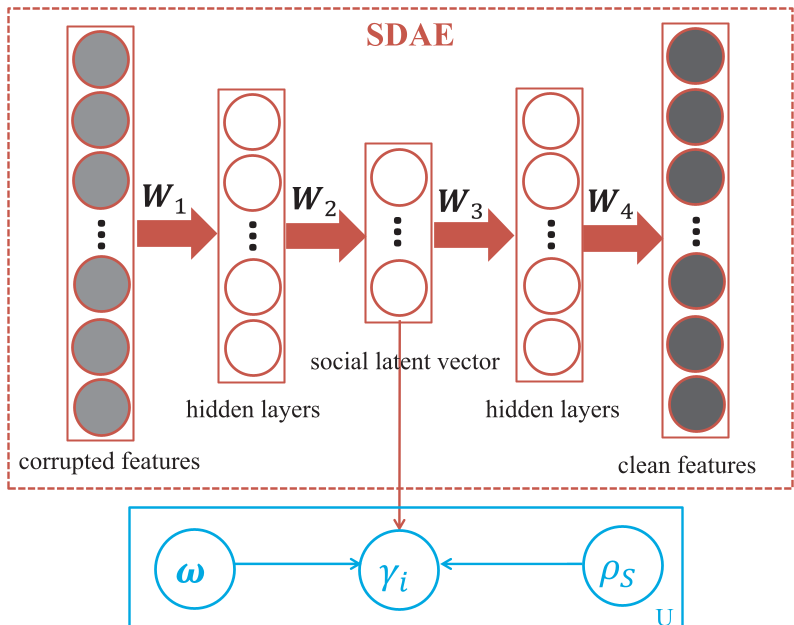 Figure 1: The SDAE architecture used to fuse social network features into the recommendation framework.
3. Joint Optimization Strategy
Since group data is sparse, SIGIR doesn't train on group-item data in isolation. It uses Joint Training, alternating between:
- User-Item interactions: Learning what individuals like.
- Group-Item interactions: Learning how individuals influence the group.
Experimental Battleground
The researchers built two massive benchmarks from Yelp (LA area) and Douban-Event.
SOTA Comparison
SIGIR was tested against standard Collaborative Filtering (NCF, BPR) and specialized group recommenders (AGREE, PIT).
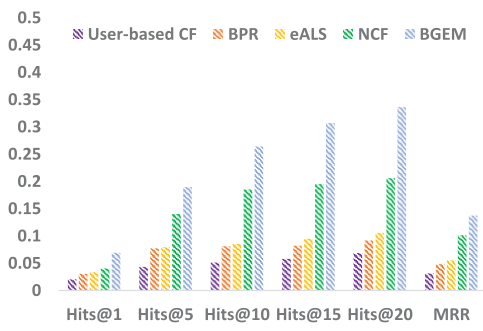 Figure 2: Performance comparison across different Hit@n and MRR metrics.
Key Findings:
- Superiority in Sparsity: SIGIR outperformed AGREE because it didn't just rely on group data; it pulled intelligence from the social graph.
- Heuristics vs. Learning: Simple aggregation (Avg/Least Misery) performed poorly, proving that "Social Influence" is a learned feature, not a fixed formula.
- Ablation Success: Removing the social graph features (SDAE) led to a significant drop in accuracy, confirming that one's position in a social network is a strong proxy for their influence in a group setting.
Deep Insight: Why It Works
The "magic" of SIGIR lies in its recognition that Social Influence is a transferable prior. If you are a social hub in your general network (high PageRank), you are likely a decision-maker in your lunch group. By mathematically linking graph centrality to attention weights, the authors bridged the gap between social structure and consumer behavior.
Limitations & Future Work
While SIGIR is powerful, it treats social influence as a "global" trait. In reality, a friend might be an "influencer" for movie choices but a "follower" for restaurant choices. Future iterations could explore topic-specific influence to add another layer of granularity.
Conclusion
SIGIR represents a shift from "preference aggregation" to "influence modeling." By treating the social graph as a primary data source rather than an afterthought, it provides a viable path for building recommendation engines that actually understand the social dynamics of the real world.