
TAPE: Quantifying the Social Cost of Gossip via Reliability Engineering
6147_A Study of Online Social Network Privacy Via the TAPE Framework.
The paper introduces the TAPE (Trust-Aware Privacy Evaluation) framework, a quantitative system for assessing privacy risks in Online Social Networks (OSNs). By mapping OSN information diffusion to reliability graph analysis used in wireless sensor networks (WSN), it employs Binary Decision Diagrams (BDD) to calculate the probability of data leakage to undesirable destinations.
TL;DR
Researchers have developed the TAPE (Trust-Aware Privacy Evaluation) framework, which treats Online Social Network (OSN) privacy as a reliability problem. By quantifying user behavior through Privacy Awareness and Privacy Trust, and applying mathematical tools like Binary Decision Diagrams, the framework identifies exactly which "friend" is your biggest privacy liability.
The Core Challenge: Privacy as a Stochastic Leak
In an OSN, risk is unavoidable. You share a photo with a friend; that friend might "leal" it by showing it to a colleague, who then shows it to your boss. Existing privacy tools usually tell you "who can see what," but they don't tell you the probability of that information reaching an Undesirable Destination (UD).
The authors argue that privacy isn't just about settings; it’s about the "Information Spreading Probability" (ISP) of the people and connections in your network.
Methodology: From Sensor Networks to Social Circles
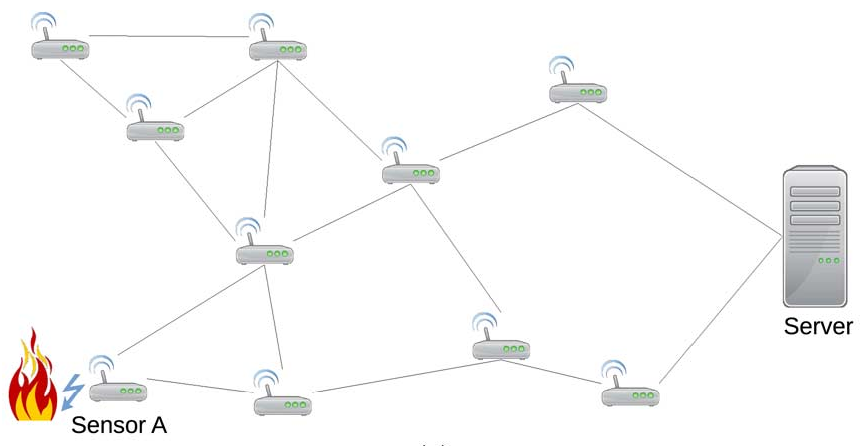
The most striking innovation of this paper is the bridge it builds between System Reliability Analysis (typically used in Wireless Sensor Networks) and Social Science.
1. Mapping the Framework
The authors map social graphs into reliability graphs:
- Nodes/Links: Users and Friendships.
- Failure Probability: The inverse of the probability that a node/link will "leak" or spread information.
- Source/Sink: The Personal Information Owner (PIO) and the Undesirable Destination (UD).
2. Quantifying the Human Element
How do you turn a "friend" into a mathematical probability? TAPE introduces two key variables:
- Privacy Awareness (PA): Calculated by comparing your privacy settings to the global average. If everyone hides their email but you leave it open, your PA is low.
- Privacy Trust (PT): This is "implicit trust." If a high-PA user (someone who is very careful) trusts you with their data, your PT score increases. It’s essentially a "Gossip Reputation" score.
3. The Math: Binary Decision Diagrams (BDD)
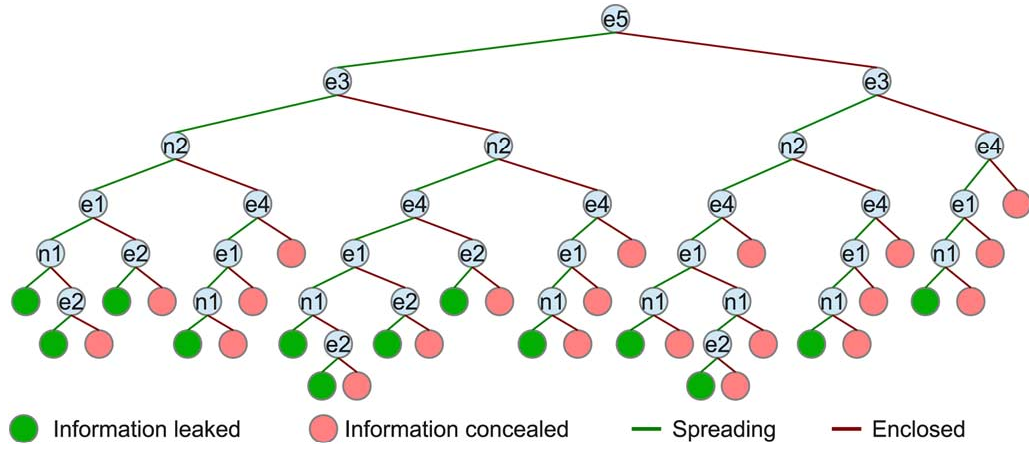
To calculate the total probability of all possible paths from you to a "stalker" or undesirable viewer, the paper uses BDDs to compress the complexity of millions of possible social paths into a solvable boolean expression.
Experimental Insights: Distance Does Not Guarantee Safety
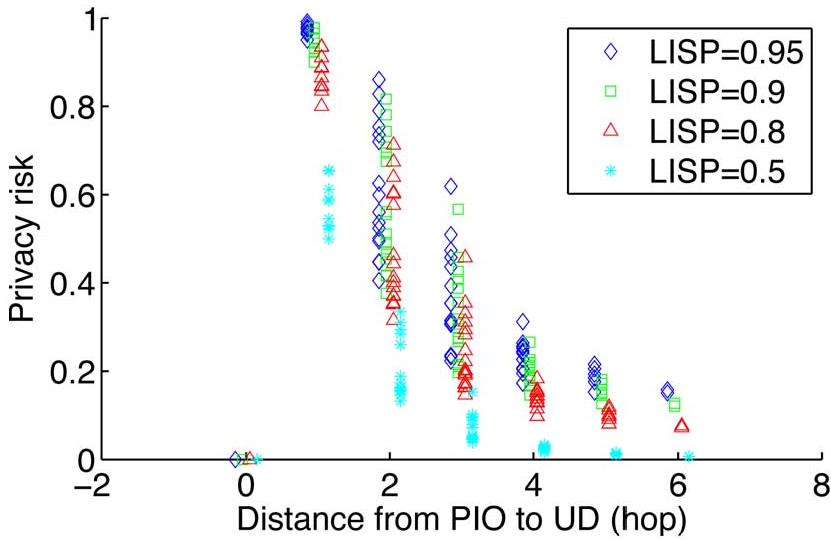
Using real-world Facebook data, the authors uncovered several non-intuitive findings:
- The 3-Hop Danger: Contrary to popular belief, a person three hops away can sometimes be higher risk than a person two hops away, depending on the network topology and the "Trust" levels of the intermediaries.
- Topology isn't Everything: Pure network-graph analysis (ignoring PA and PT) miscalculates privacy risk by as much as 25%.
Practical Application: The "Smart" Unfriending Strategy
Most people unfriend based on "who am I not talking to?" TAPE proposes an Unfriending Strategy based on Birnbaum's Measure (BM). By calculating the partial derivative of your leakage probability with respect to a specific link, TAPE identifies the friend who acts as the primary gateway to your "Undesirable Group."
In tests, removing the "TAPE-suggested" friend reduced privacy risk significantly more than removing the person with the most friends or the person with the worst privacy settings (V-Index).
Critical Analysis & Conclusion
TAPE is a rigorous first step toward making OSN privacy a quantifiable engineering discipline. However, its accuracy is currently limited by the availability of "Ground Truth"—we don't actually know if someone gossiped in real life, only what their settings imply.
The Takeaway: Privacy is not a static wall; it is a dynamic filtration system. As we move toward 2026, frameworks like TAPE will likely be integrated directly into social platforms, providing users with a "Risk Score" for every post they make.