
Selfish Mules: Maximizing Social Profit in Sparse Networks via Rationally-Selfish Relays
6196_Selfish Mules Social Profit Maximization in Sparse Sensornets using Rationally-Selfish Human Relays.
This paper introduces OBSEA (Opportunistic Backpressure with Social/Economic Awareness), a distributed algorithm for sparse sensor networks that leverages human mobility and "rationally-selfish" relays. By integrating network science with Lyapunov optimization, the system maximizes global social profit while ensuring efficient data forwarding in intermittently connected environments.
TL;DR
In sparse urban sensor networks, connectivity is often the "Achilles' heel." This paper introduces OBSEA, an algorithm that turns human mobility into a reliable data muling infrastructure. By treating mobile phone owners as "rationally-selfish" agents who trade sensor data for virtual credits, the authors achieve SOTA performance in social profit and data throughput without needing to predict human movement.
Motivation: The Challenge of Sparse Urban Sensing
Deploying a fixed infrastructure for smart cities (e.g., air quality or traffic monitoring) is prohibitively expensive. While mobile phones are ubiquitous, why would a citizen use their battery and memory to relay sensor data for free?
The authors identify two critical gaps in current SOTA:
- Social Neglect: Failing to exploit the inherent community structures of human movement.
- Incentive Deficiency: Not accounting for the "selfish" nature of human participants who require compensation for resource usage.
Methodology: The OBSEA Framework
The core innovation lies in the Opportunistic Backpressure with Social/Economic Awareness (OBSEA) algorithm. It operates on three distinct layers:
1. Sink-Aware (SA) Centrality
Unlike standard centrality metrics (like degree or betweenness), SA Centrality measures a relay's potential to reach a specific sink node. It recognizes that a postman who visits a sink location daily is more valuable than a popular socialite who never goes near a data gateway.
2. Virtual Economic Network
The system functions like a stock market for data. Sensors "produce" data and sell it to relays. Relays trade with each other, profiting from the price differential governed by local queue backlogs and social value.
3. Distributed Optimization
Using Lyapunov drift-plus-penalty theory, the algorithm makes local routing decisions: The price balances current congestion () with social utility ().
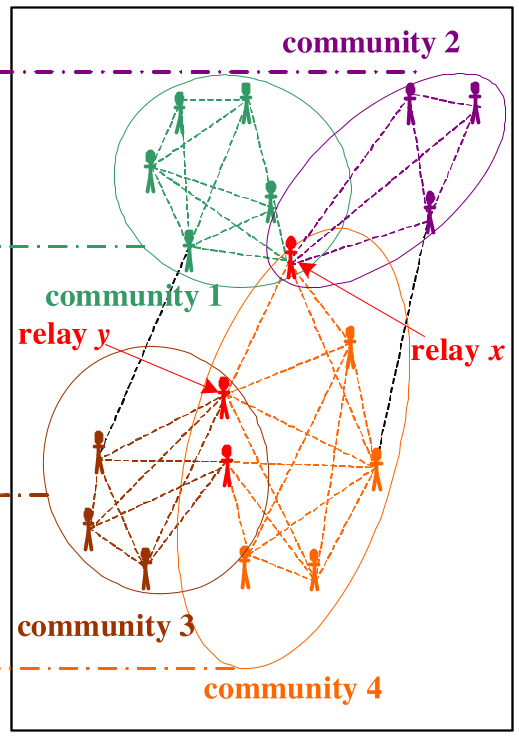 Figure 1: Illustration of the WSN-HR architecture where static sensors (S) interact with mobile relays (R) and sinks (D) based on social community overlaps.
Performance & Results
The authors validated OBSEA using the Castalia simulator with a realistic Heterogeneous Human Walk (HHW) mobility model.
- Near-Optimal Efficiency: Theoretical proofs show that OBSEA performs within a bound of an "oracle" algorithm that has perfect future knowledge.
- The Win-Win Proof: Simulations confirm that both the sensor owners and the phone relays maintain non-negative profit, proving the economic sustainability of the model.
- Adaptability: By tuning the weighting parameter , the system can pivot between being purely "congestion-aware" or purely "social-aware," consistently outperforming baseline backpressure methods.
 Figure 2: Performance metrics showing global social profit and packet delay across different buffer sizes and weighting parameters.
Critical Insight: Why Rationally-Selfishness Works
The "Selfish Mule" concept is a powerful departure from "social altruism." By assuming phone owners are rational and selfish, the authors design a system that is robust against user dropouts. If the price isn't right, the data doesn't move. This market-driven approach naturally regulates network congestion and ensures that high-priority data (priced higher) reaches the sink faster.
Conclusion & Future Outlook
OBSEA proves it is possible to build resilient, large-scale sensing infrastructures on top of existing human social patterns. While the paper focuses on data muling, the framework of "Social-Economic Backpressure" could easily be extended to privacy-preserving sensing or multi-tenant smart city applications.
Takeaway: Future IoT infrastructure won't just be about wires and waves; it will be about the economic and social alignment of the humans carrying the devices.