
Disruptive Event Detection: Mining the Signal of Chaos in Social Media
6309_Feature Extraction and Analysis for Identifying Disruptive Events from Social Media.
The paper proposes a specialized framework for identifying "disruptive events" (threats to public safety/order) from Twitter streams. It introduces a refined feature selection methodology using the Maximal Information Compression Index (MICI) and demonstrates that combining optimized temporal and textual features significantly outperforms standard event detection baselines.
TL;DR
Researchers from Cardiff University have developed a framework to filter the "noise" of Twitter to find "disruptive events"—incidents like factory fires, terror attacks, or riots that threaten social safety. By optimizing a 1-hour temporal window and focusing on high-impact textual features (like retweet velocity and negative sentiment), the system can rapidly identify real-world emergencies with high accuracy and low computational overhead.
Problem & Motivation: The Needle in the Digital Haystack
Twitter is a goldmine for real-time information, but for public safety officials, it is also a swamp of mundane updates. The challenge is twofold:
- Semantic Ambiguity: How do you distinguish a tweet about a "fire" in a video game from a literal factory fire?
- Velocity: With hundreds of millions of tweets daily, algorithms must be lean. Heavy natural language processing (NLP) is often too slow for the "golden hour" of crisis management.
The authors argue that disruptive events have a specific digital footprint: they propagate faster, use specific "trigger" verbs, and typically carry a distinct negative emotional weight.
Methodology: The Core Engine
The heart of the paper lies in its Feature Selection Algorithm, which aims to reduce dimensionality without losing the "signal" of a crisis.
1. The 1-Hour Sweet Spot (Temporal)
The researchers tested windows ranging from 1 minute to 24 hours. They discovered that while 30 minutes is the most accurate, a 1-hour window significantly reduces the computational burden while maintaining high precision. Disruptive events like car accidents are "bursty"—they appear quickly and are discussed intensely within that first hour.
2. High-Impact Textual Features
The study identifies five "High-Value" features that act as the strongest indicators of a disruptive event:
- Retweet Ratio: Indicates the urgency and perceived importance of the information.
- Dictionary-based (Trigger words): Use of present-tense verbs (witnessing, noticing) and adjectives (urgent, horrifying).
- Hashtag & URL Ratios: Providing evidence and creating a "discoverable" index for the event.
- Negative Sentiment: Unlike general events (sports, entertainment), disruptive events are almost exclusively associated with negative sentiment polarity.
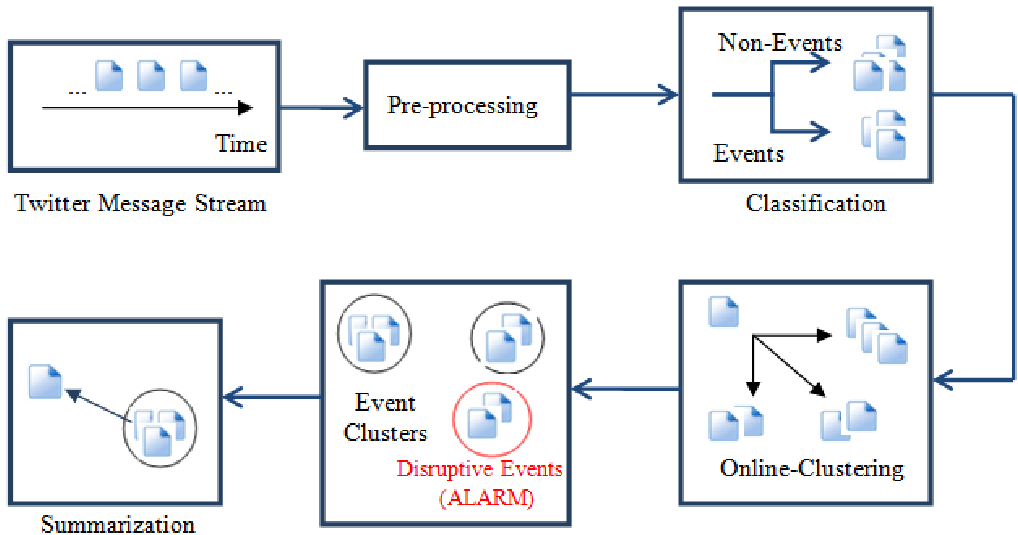 Figure 1: The proposed five-step framework: Collection, Pre-processing, Classification, Online Clustering, and Summarization.
Experimental Results
The framework was tested against a massive dataset of 1.6M tweets, including data from the 2013 Abu Dhabi Grand Prix.
Key Findings:
- Baseline Comparison: The "Temporal + Optimal Textual" model outperformed the standard unigram (bag-of-words) baseline significantly.
- The Sentiment Paradox: While general "polarity" (positive or negative) didn't help much, specifically isolating negative sentiment improved the F-measure by 1.69% over the baseline.
- Efficiency: By pruning irrelevant features (like "Favorite ratio" or "Near-duplicate measures"), the system maintains a linear computational complexity——making it viable for real-time streams.
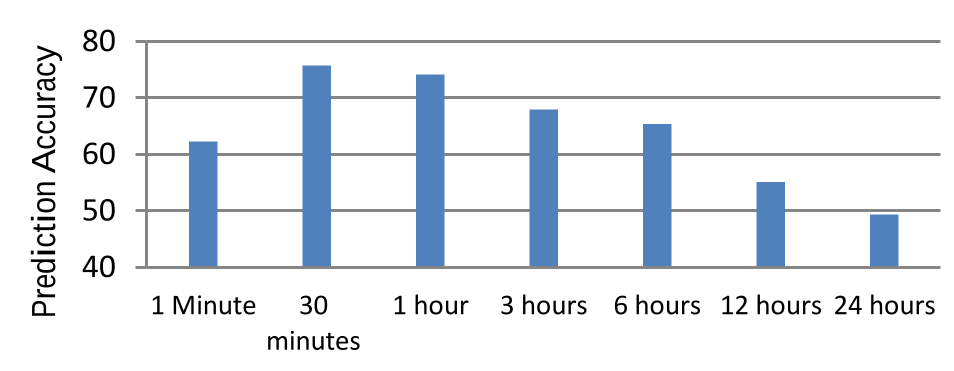 Figure 2: Performance peaks at shorter windows, showing that "recent" tweets are the best predictors of real-world impact.
Critical Analysis & Future Outlook
Takeaway: This work proves that we don't need "influencers" to identify a crisis. Disruptive events are identifiable by their inherent nature—the speed of their spread and the specific language used by eye-witnesses.
Limitations:
- Sarcasm: The sentiment analysis still struggles with sarcastic comments, which are frequent on Twitter.
- Spatial Blindness: The current model focuses on what and when, but not necessarily where. Future iterations would benefit from heavier integration of geotagging or "spatial features."
Conclusion: For organizations involved in crisis management, this research provides a lean, mathematically grounded roadmap for building situational awareness tools that can act as an early warning system before a situation escalates.