
Beyond the Joystick: Building "Natural" Gestural Bridges to the Past
6336_NICH A preliminary theoretical study on natural interaction applied to cultural heritage contexts.
This paper explores the design and implementation of gesture-based interaction in cultural heritage applications, introducing a methodology for "natural" interaction. It demonstrates two SOTA-level virtual museum installations, "The Apparition of the Franciscan Rule" and "The Etruscanning Project," achieving high user engagement through controller-free skeletal tracking.
TL;DR
This research tackles the "last mile" of digital cultural heritage: how to let a museum visitor walk through a 2,000-year-old tomb without touching a single button. By shifting from device-heavy interfaces to Natural Interaction (NI) using skeletal tracking, the authors demonstrate that cultural context is as important as sensor precision in making technology "invisible."
The "Physicality" Bottleneck in Museums
For decades, virtual museums were constrained by the hardware of their time. Joysticks break, mice get dirty, and for an elderly visitor or a young child, the "mental map" required to translate a plastic button press into a forward step in a virtual world is a significant hurdle. The authors identify a core paradox: we want to immerse people in history, yet we force them to hold the most modern (and often distracting) tools to get there.
Methodology: Mapping the Human "Grammar" of Movement
The authors didn't just pick gestures at random. They analyzed the "Vincenzo taxonomy" and others to categorize how we move. A key contribution is their cross-cultural study.
For example, when asked to "show an object," participants from different countries showed surprising variance:
- Italians: 100% used a single hand with an index finger.
- Egyptians: Preferred using two open hands.
- Swedes: Used a mix of single-hand pointing and open-palm gestures.
These insights prove that "natural" isn't a universal constant; it’s a cultural variable.
The Two-Pillar Architecture
The work showcases two major implementations using the Unity 3D engine and the Kinect sensor:
- The Franciscan Rule (2010): A floor-projection system where users "step" into a fresco. It used an infrared camera to track simple X-Y movement, effectively turning the museum floor into a giant touchpad.
- The Etruscanning Project (2012): A more complex 3D reconstruction of an Etruscan tomb. This utilized full skeletal tracking.
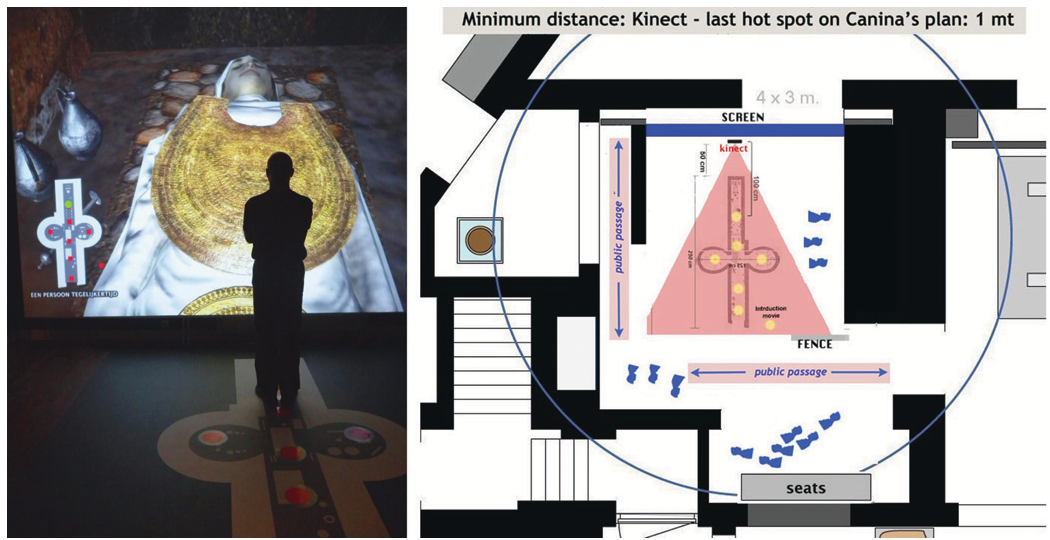 Fig 1: The dual-phase interaction setup, showing the physical space (a) and the virtual mapping (b).
Solving the "Midas Touch" Problem
One of the biggest technical hurdles in gesture control is distinguishing a "command" from a "natural twitch." If every movement is a command, the world spins out of control—the "Midas Touch." The authors implemented several clever UX fixes:
- Hotspots: Specific physical zones on the floor that trigger different behaviors (Navigation vs. Manipulation).
- Visual Feedback: Using a "blue feet" icon on the screen so users understand their relative position to the sensor.
- Countdown Selection: To select an object, the user points and holds for 3 seconds, a temporal buffer that prevents accidental clicks.
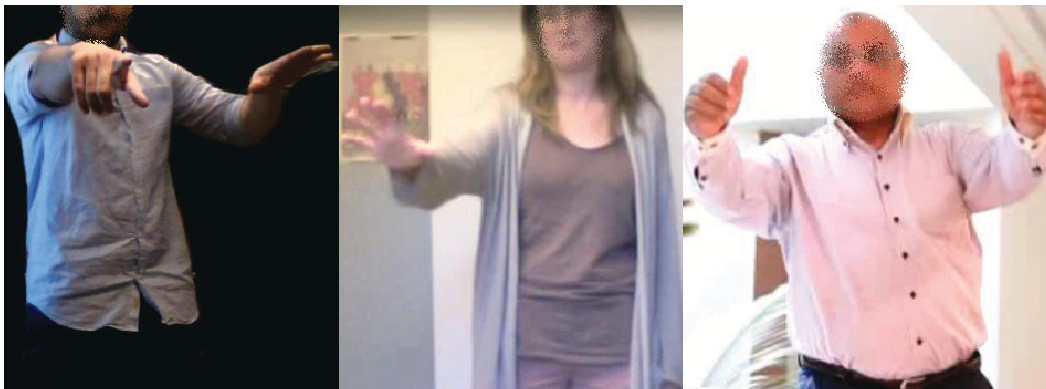 Fig 2: Comparative study of selection gestures: (a) Index pointing, (b) Open hand, (c) Two-hand framing.
Results & Academic Insight
The experiments conducted at the Vatican Museums yielded two profound takeaways:
- Imperfect Tracking is Acceptable: Even when the sensor (Kinect) exhibited "jitter" or noise, users did not feel frustrated. They treated the learning curve as part of the "play," provided the gestures felt physically intuitive.
- Embodiment Over Accuracy: The feeling of "being there" (embodiment) was significantly higher when users moved their whole bodies to look around a tomb versus using a mouse.
Critical Analysis & Conclusion
While the paper successfully proves the viability of controller-free museum exhibits, it also highlights occlusion as a major limitation. If a user crosses their arms or stands too close to the sensor, the skeletal map collapses.
The Takeaway: As we move into an era of AR and spatial computing, this paper serves as a reminder that the most powerful interface is the one the user already knows: their own body. The future of cultural heritage lies in "invisible" technology that respects the cultural and physical grammar of the human form.