
Better Together: Do Children Help Robots That Don’t Look Like People?
690_Better together young children's tendencies to help a non-humanoid robot collaborator.
This study investigates the altruistic tendencies of young children (ages 3-5) toward a non-humanoid, "architectural" robot collaborator. Utilizing a unique robotic bench (LitRobe), the researchers examined whether children would proactively help a robot achieve a shared goal in a collaborative cleanup task.
Executive Summary
TL;DR: This research challenges the long-standing assumption in robotics that social robots must look like humans or animals to be effective. By testing children's reactions to a robotic bench named LitRobe, the study reveals that children as young as three are remarkably willing to assist a "living" piece of furniture, provided it demonstrates goal-oriented behavior.
Academic Positioning: This work is a pivotal study in the field of Child-Robot Interaction (CRI) and Human-Building Interaction. It shifts the focus from "social robots as companions" to "functional robots as collaborators," proving that prosociality is triggered by perceived intent rather than physical appearance.
Problem & Motivation: The "Humanoid Bias"
In the history of CRI, designers have leaned heavily on the Anthropomorphism Hypothesis: the idea that for a child to care about or help a robot, that robot needs big eyes, a voice, or a face. This has led to the development of expensive, complex humanoid robots like NAO or Pepper.
However, the authors of this paper ask a fundamental question: Is the "human shape" necessary? In developmental psychology, children help adult strangers based on their goals, not just their looks. If a robot is just a vibrating, moving surface—an "architectural robot"—will a child still see it as a partner in need?
Methodology: Meet LitRobe
The researchers introduced LitRobe, a non-humanoid, move-able robotic surface designed to help organize play areas.
The Experimental Setup
The experiment involved a "Cleanup Game." Children were told that the robot wanted to put blocks into a bin but couldn't reach certain areas. The robot signaled its "desire" not through speech, but through kinetic movements—shifting its surface or vibrating.
 Figure 1: The LitRobe system in a collaborative play environment.
The core of the methodology rested on Instrumental Helping:
- The robot initiates a goal (moving blocks).
- The robot encounters a "bottleneck" (cannot reach a specific block).
- Observation: Does the child intervene to bridge the gap?
Experiments & Results: Collaboration Beyond Form
The study compared children’s reactions to a "Goal-Directed" robot versus a "Random Movement" robot.
Key Findings:
- High Help Rate: A remarkably high percentage of children successfully identified the robot's "problem" and offered help without being prompted.
- Agency Perception: Children described the robot using intentional language (e.g., "It wants the block"), despite it being a literal box on wheels.
- Speed of Intervention: Children in the intentional condition helped significantly faster than those in the control group.
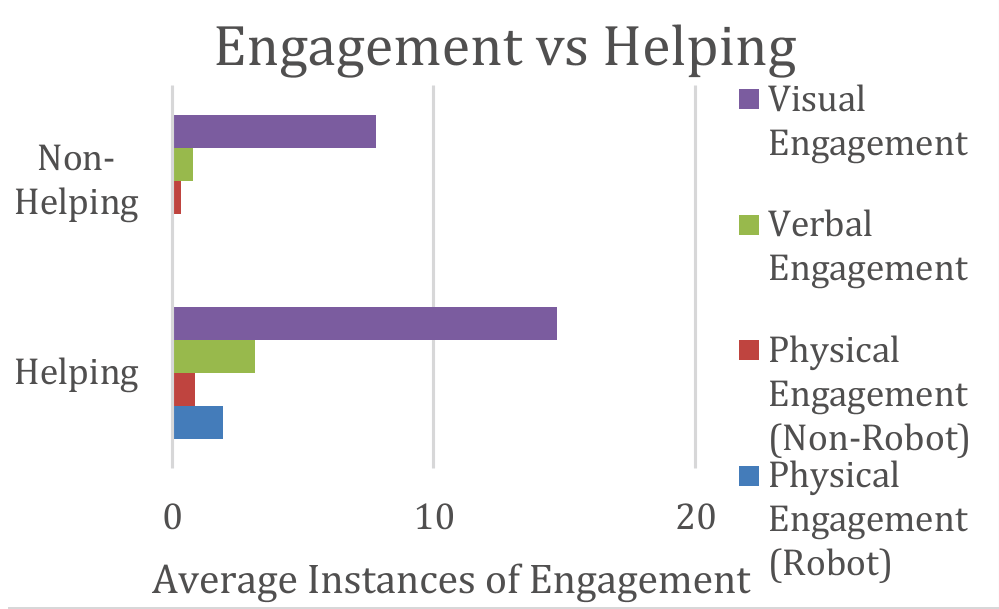 Figure 2: Data visualization showing the frequency and speed of helping behaviors across different age groups.
Identifying Intent
The researchers found that contingent movement—where the robot reacts specifically to a block’s position—is the "Social Glue." This movement serves as a non-verbal communicative cue that children are hard-wired to interpret as a request for assistance.
Critical Analysis & Conclusion
Summary
The LitRobe study demonstrates that prosocial Child-Robot Interaction is morphology-independent. Children operate on a "logic of interaction" rather than a "logic of appearance." If an object moves as if it has a goal, children will treat it as a social agent.
Limitations
- The Novelty Effect: It is unclear if children would continue to help LitRobe over multiple months, or if the "magic" of a moving bench wears off.
- Communication Nuance: Without speech, the robot's needs must be very simple. Complex tasks would likely require more sophisticated signaling.
Future Outlook
This research paves the way for Interactive Architecture. Imagine classrooms or hospitals where the furniture isn't just static, but "collaborative." By understanding that children naturally want to help, we can design environments that foster empathy and cooperation without needing more "humanoid" distractions in the room.
Final Takeaway: To build a robot that children love and help, don't focus on the face—focus on the movement and the mission.