
Structuring Discourse: A Formal Model for Socio-Argumentative Networks
6960_Toward Mobile Application of Cyber Argumentation with Social Networking.
This paper introduces a formal socio-argumentative network framework that integrates structured argumentation with social networking dynamics to facilitate online deliberation. By mapping relationships between Users (), Issues (), Positions (), and Arguments (), the authors provide a mathematical foundation for modeling discourse and social influence.
TL;DR
Online deliberation is currently broken, plagued by unstructured "flame wars" and echo chambers. This paper proposes a formal mathematical framework that merges Social Networking with Structured Argumentation, treating users, issues, and arguments as interconnected nodes in a single, measurable graph.
Problem & Motivation: The Social-Logic Gap
Most social media platforms prioritize the "Social" (who are you?) but ignore the "Logic" (why do you believe that?). Conversely, academic argumentation frameworks are often "Socially Deaf"—they analyze the logic of a claim but ignore the reputation or social context of the claimant.
The authors argue that to fix online deliberation, we must bridge this gap. They identify a need for a system where:
- Issues are clearly defined.
- Positions are explicitly linked to those issues.
- Arguments support or attack those positions.
- Users interact with all the above through social actions.
Methodology: The Socio-Argumentative Architecture
The core of the proposal is the definition of a comprehensive vertex set , which represents the union of all entities in the discourse ecosystem.
1. The Mapping Functions
The paper formalizes interaction through a series of mathematical mappings:
- : A position addresses a specific issue.
- : An argument reacts to a position.
- : A user generates or adopts an argument.
2. Network Topology
The framework allows for sophisticated relationship modeling, as seen in the system's ability to track how a user's position might be influenced by their "Follows" or "Friends" list within the same argumentative context.
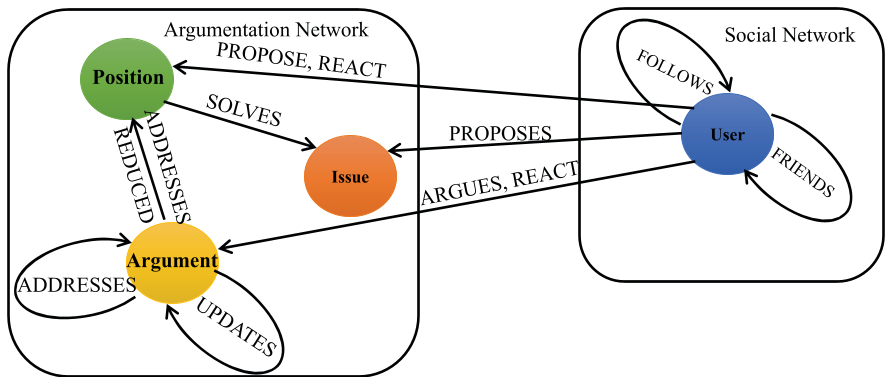 Figure 1: Conceptual overview of the interaction between Users and the Argumentative layers.
Experiments: Quantifying the Debate
The authors applied their model to real-world controversial topics, such as "Guns on Campus" and "Healthcare mandates." By structuring these debates into clear Issue/Position/Argument hierarchies, they moved beyond simple "Likes" to calculate more nuanced metrics.
Sentiment and Attack Formulas
The paper introduces formulas to calculate the intensity of a debate:
This allows researchers to identify if a particular issue is reaching a "consensus" or is becoming a "battleground."
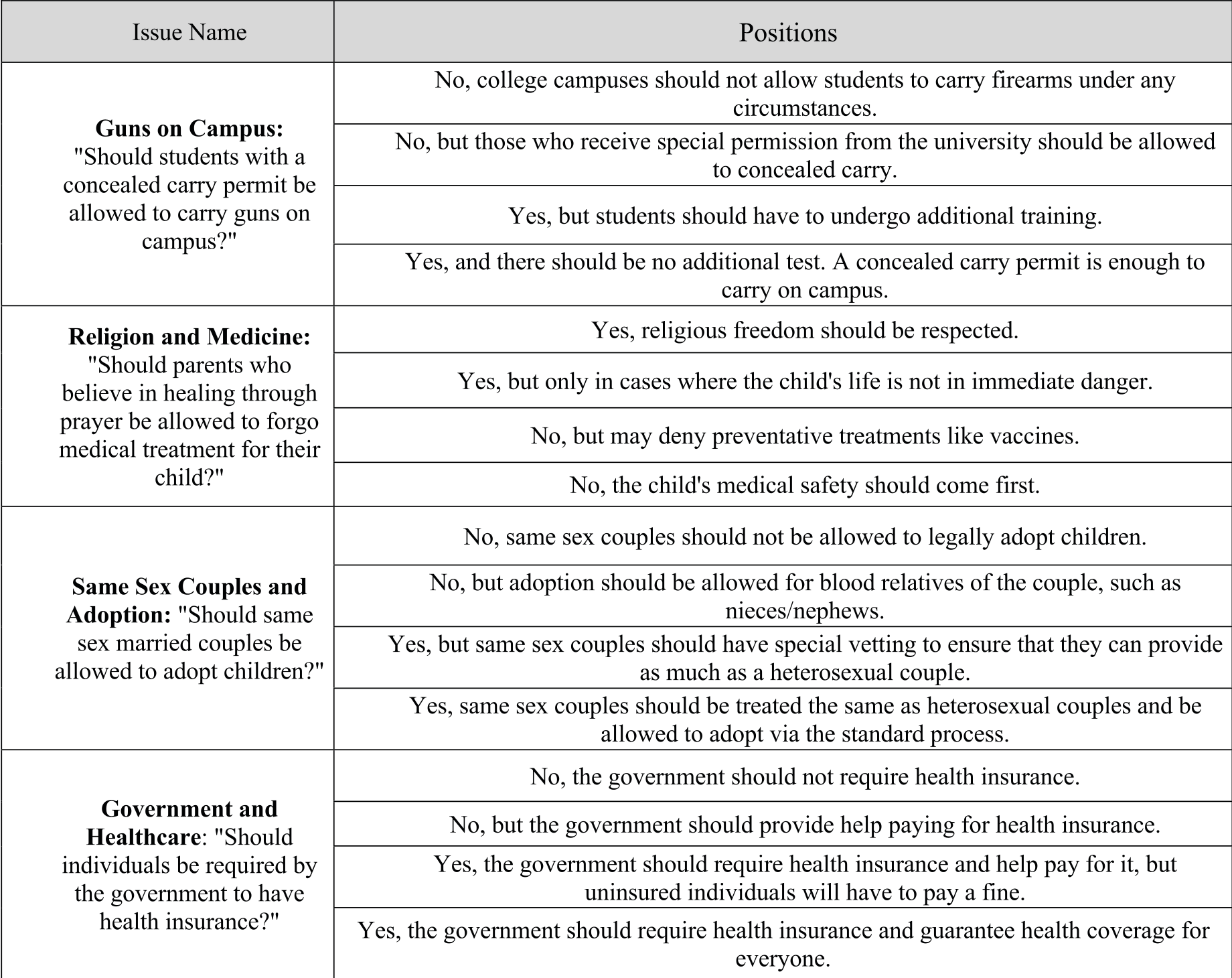 Table 1: Example of how diverse opinions on religion, guns, and healthcare are structured into discrete positions.
Critical Insight: Why This Matters
The most profound takeaway from this work is the shift from Unstructured Interaction to Relational Discourse. By transforming a comment section into a directed graph of supporting and attacking nodes, we can:
- Detect Echo Chambers: See if certain users only interact with a subset of arguments.
- Improve Summarization: Instead of reading 1,000 comments, a user can see the 4 main positions and the top 3 arguments for each.
- Verify Logic: The structure forces participants to link their reactions to specific points, reducing "ad hominem" noise.
Conclusion & Limitations
While the formal model is robust, the challenge remains in User Adoption. Users in the wild are accustomed to the low friction of "retweeting" or "liking." Forcing users into a socio-argumentative structure requires a UX revolution. However, as AI-driven moderation and summarization become standard, this framework provides the essential "grammar" that these AI systems will need to organize human thoughts effectively.