
6G as if People Mattered: Shifting from Industry 4.0 to Society 5.0
6G as if People Mattered: From Industry 4.0 toward Society 5.0
This paper outlines a visionary shift for 6G networks, moving from the machine-centric Industry 4.0 toward a human-centered Society 5.0. It introduces Cyber-Physical-Social Systems (CPSS) as the foundational framework, integrating the Tactile Internet and the "Internet of No Things" through AI-enhanced edge intelligence and blockchain-based robonomics.
TL;DR
The transition to 6G is more than just a leap in frequency and speed; it is a paradigm shift from the machine-centric Industry 4.0 to the human-centric Society 5.0. This paper argues that 6G will be defined by Cyber-Physical-Social Systems (CPSS), where the Internet becomes "invisible" (Internet of No Things), human touch is transmitted globally (Tactile Internet), and robots are integrated into our social fabric through blockchain-based Robonomics.
Problem & Motivation: Beyond the "Lights-Out" Factory
While 5G was a triumph for the Internet of Things (IoT), its industrial vision—Industry 4.0—often leaned toward "lights-out manufacturing," where automation removes the human element entirely. The author identifies a critical gap: as we move toward 2030, technology must evolve to augment rather than replace humans.
The challenge is twofold:
- Hardware Friction: We are currently in a "gadget-based" era (bearables like smartphones). 6G must usher in the "post-smartphone" era where computing disappears into the environment.
- Trust in Autonomy: As robots become social agents, how do we ensure reciprocal trust and social efficiency in human-robot interactions?
Methodology: The Core of CPSS
The paper introduces Cyber-Physical-Social Systems (CPSS) as the evolution of CPS. By adding a "Social" layer, the network considers human cognition and behavior as integral components.
1. The Tactile Internet & Haptic Intelligence
To enable a "Sixth Sense," 6G must support haptic communications. The author utilizes Weber’s Law to implement "deadband coding." Since humans cannot perceive tiny stimulus changes, the system only transmits data when a change exceeds a "Just Noticeable Difference" (JND), drastically reducing packet rates while maintaining a sense of touch.
 Fig. 1: Teleoperation system utilizing bidirectional haptic communications between a Human Operator and a Remote Robot.
2. The Internet of No Things
Instead of "Internet of Everything," the author proposes the Internet of No Things. Services appear when needed and disappear when not, progressing from Wearables to Nearables (compute-enabled surroundings). This is supported by the "Multiverse" architecture, which blends reality and virtuality into "Third Spaces."
Experiments & Results: Trust and Speed
The paper validates these concepts through two distinct experimental lenses: network performance and behavioral economics.
Low-Latency Performance
In local teleoperation scenarios using Fiber-Wireless (FiWi) enhanced 4G/5G/6G architectures, the system achieved sub-2ms end-to-end delays, critical for the perception of real-time touch.
Robonomics and the Trust Game
The author used an Ethereum-based "Trust Game" to test how smart contracts and robots can facilitate social capital. By introducing On-chaining Oracles (human observers who input trust data into the blockchain), social efficiency reached a perfect 100%.
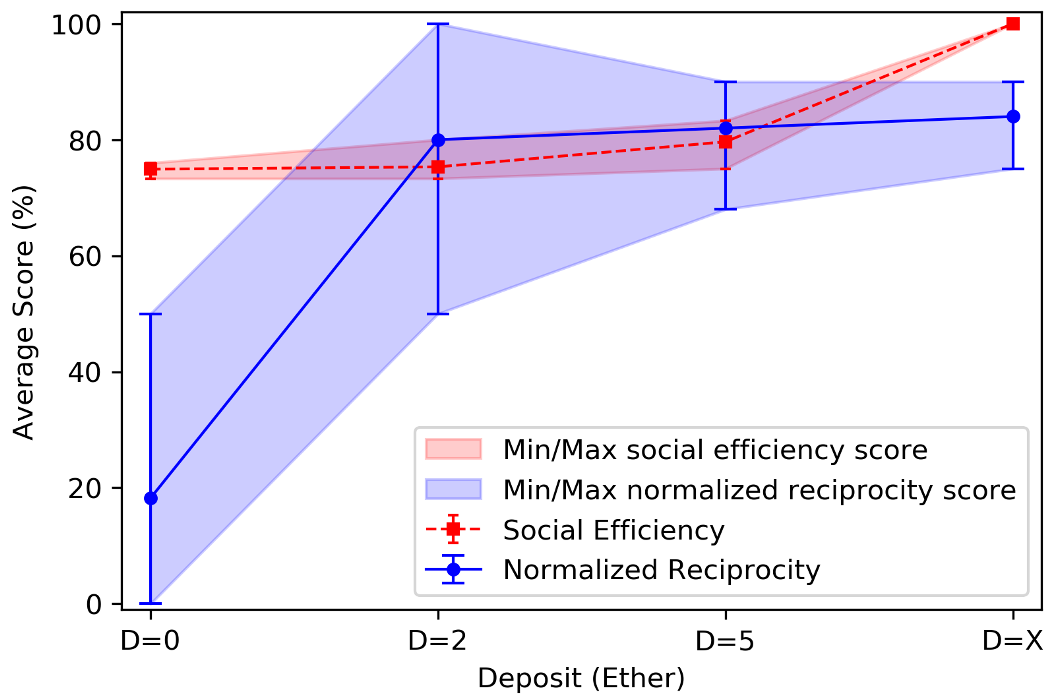 Fig. 2: Impact of blockchain deposit and oracles on social efficiency and reciprocity.
Key findings include:
- Normalized Reciprocity (fairness) jumped from 18% in traditional settings to over 80% with blockchain-based "deposits."
- Social Robots using "Mixed Logical-Affective" strategies were found to be more persuasive than mere monetary incentives.
Critical Analysis & Conclusion
The core takeaway of this work is that 6G is not merely a technical upgrade but a philosophical one. By building Cyber-Physical-Social Systems, 6G provides an "Experience Design Canvas" for the human potential.
Limitations: While the vision is grand, the paper acknowledges that "Nearables" and the "Internet of No Things" require a level of ubiquitous infrastructure (and energy efficiency) that is currently in its infancy. Furthermore, the privacy implications of a network that monitors human emotions (via AI tone analyzers) remain a significant hurdle.
Future Outlook: The integration of Robonomics suggests that our future economy will involve peer-to-peer financial transactions directly between humans and robots, mediated by neutral, transparent blockchain smart contracts.
Senior Editor's Note: This paper elevates 6G from a spectral efficiency discussion to a socio-technical roadmap, echoing Marshall McLuhan's sentiment: "We shape our tools and then our tools shape us."