
Empowering Network Security: A Lightweight, Semi-Automatic Framework for Intrusion Detection Ontology
7040_Semantic-based lightweight ontology learning framework a case study of intrusion detection ontology.
The paper introduces a semi-automatic, lightweight ontology learning framework specifically for wireless network intrusion detection. By combining Natural Language Processing (NLP) with Crowdsourcing, the authors construct a solution-oriented knowledge map using metadata and specific sections from high-quality academic papers (Scopus).
TL;DR
Researchers have developed a semi-automatic framework that uses NLP and Crowdsourcing to build an "Intrusion Detection Ontology." By focusing on the structural components of academic papers (Titles, Abstracts, and Conclusions) rather than exhaustive full-text parsing, this model creates a solution-oriented knowledge map that links specific network attacks to their state-of-the-art countermeasures with minimal human intervention.
Background & Motivation: Moving Beyond Static Defense
In the rapidly evolving landscape of wireless networks, traditional Intrusion Detection Systems (IDS) often fail to keep pace with "Zero-day" attacks or integrate intelligence from diverse research sources.
While Ontologies—explicit specifications of conceptualizations—offer a way to share and reuse knowledge, they suffer from two major bottlenecks:
- Manual Labor: Traditional ontologies are built by hand, making them slow to update and limited in scope.
- Computational Overload: Previous automated systems (like Text-To-Onto) often used full-text parsing, which introduces noise, redundancy, and high latency.
The authors argue for a lightweight approach: why parse an entire 15-page paper when the core contribution (the "Solution") and the problem (the "Attack") are usually summarized in the Title and Abstract?
Methodology: The "Step-by-Step" Extraction Model
The core innovation is a hierarchical extraction logic that maximizes efficiency by reducing the search space progressively.
1. Information Exploration
The system targets academic papers from Scopus, prioritizing high-citation works. Using Python's NLTK, it extracts:
- Intrusion Types: Noun phrases preceding the word "attack."
- Solutions: Sentences containing trigger verbs like "propose," "present," or "develop."
2. The Step-by-Step Logic
The framework follows a sequence of four axioms to establish relationships ( = Intrusion, = Technique):
- Axiom 1 & 2: If and appear in the Title, a strong relationship is established immediately.
- Axiom 3: If not in the Title, check the Abstract.
- Axiom 4: If still ambiguous, analyze the Introduction and Conclusion.
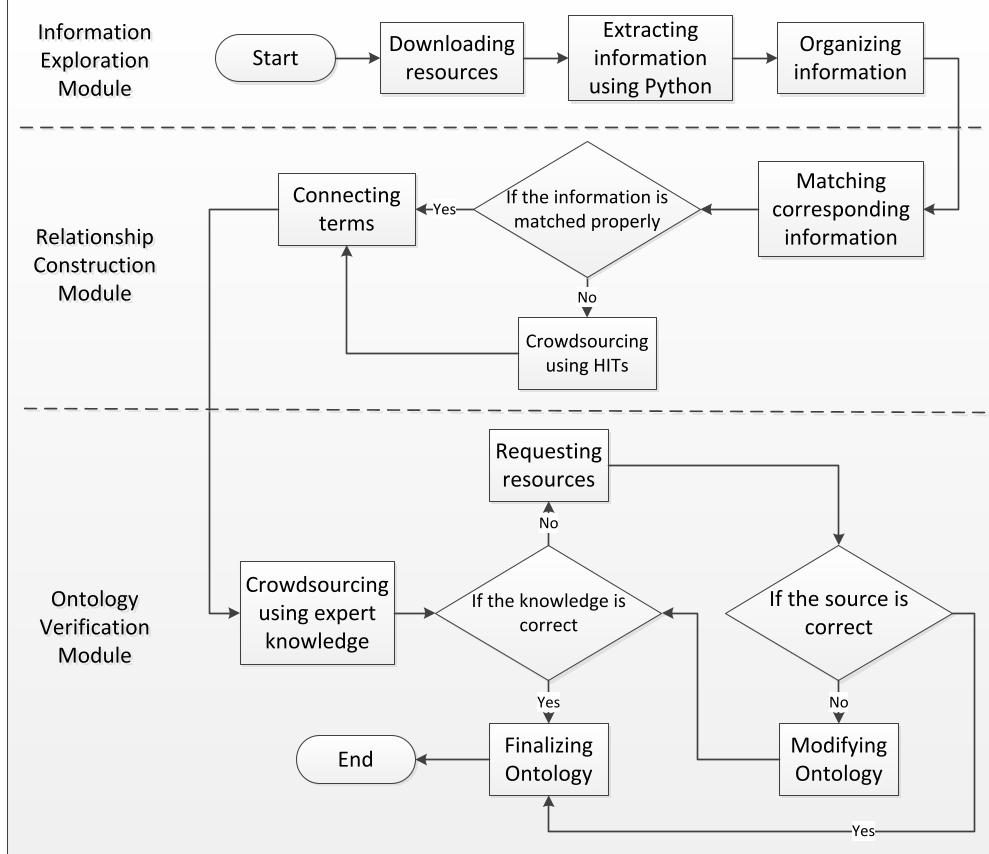 Figure 1: The workflow showing the integration of NLP and Crowdsourcing verification.
3. Crowdsourcing as the "Human-in-the-Loop"
In cases where multiple attacks are mentioned with similar frequencies, the system generates a Human Intelligence Task (HIT). Experts or students resolve the ambiguity, ensuring the ontology remains accurate.
Experiments and Key Results
The authors tested the framework on 168 papers related to DOS, Flooding, and Sinkhole attacks.
| Metric | Title | Title & Abstract | Intro & Conclusion |
|---|---|---|---|
| I-T Relations Found | 38 | 26 | 22 |
| General Solutions | - | 12 | 32 |
| Discarded/Redundant | - | - | 36 |
Key Findings:
- High Automation: Only 2 out of 168 papers (approx. 1%) required manual clarification during the extraction phase.
- Accuracy: Expert verification found only 3 errors in the constructed relationships, which were easily corrected via the feedback loop.
- Practical Value: Unlike generic ontologies, this provides a Solution-Oriented map, allowing a security professional to look up an attack (e.g., "Sinkhole") and immediately find the specific mathematical or protocol-based detection techniques proposed in the literature.
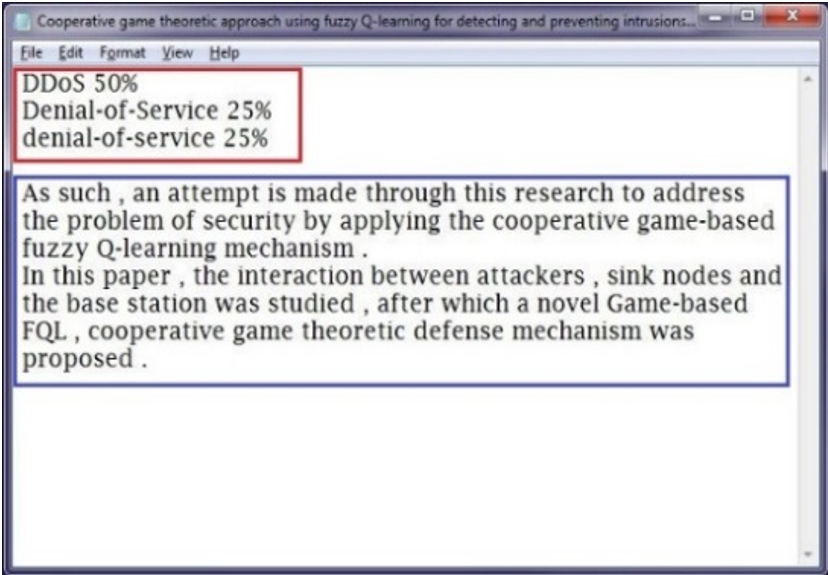 Figure 2: Sample NLP output identifying the frequency of attack types and the proposed solution text.
Critical Insight: The Value of Semantic Sparsity
The true brilliance of this work lies in its Inductive Bias: the assumption that academic writing follows a predictable structure. By treating the paper as a structured data object rather than a raw text blob, the authors achieved "Lightweight" performance.
However, there are Limitations:
- Text Conversion: 12 papers were lost due to PDF-to-Text conversion errors—a common "garbage-in-garbage-out" bottleneck in NLP.
- Static Definitions: The relations between different types of attacks are still manually defined.
Future Outlook
The authors plan to integrate a Threshold mechanism to further reduce the margin of error in autonomous relation seeking. As we move into the era of LLMs, this framework serves as a vital reminder that structural knowledge extraction is often more reliable and cost-effective than brute-force generative modeling for domain-specific tasks.
Takeaway: This framework bridges the gap between the vast ocean of academic research and the practical needs of network security engineers, turning "papers" into "actionable intelligence."