
DANA: Revolutionizing Anthropology Through Federated 3D Digital Archiving
732_DANA (Digital Archive Network for Anthropology) a model for digital archiving.
The paper introduces DANA (Digital Archive Network for Anthropology), a federated, internet-based digital library system designed to archive and share anthropological data. Its core innovation is the integration of accurate, measurable 3D laser-scanned models of artifacts within an interoperable network of distributed databases.
Executive Summary
TL;DR: The Digital Archive Network for Anthropology (DANA) is a pioneering framework that moves beyond simple digital catalogs to create a global, interoperable network of 3D artifact data. By leveraging laser scanning and a multi-tiered Java architecture, DANA allows researchers to virtually "handle" and measure rare specimens from anywhere in the world, effectively solving the "Crisis in Curation" through technology.
Background Positioning: Published in 2002, this work is a foundational "system-building" paper. It transitioned the field from localized, 2D digital image repositories to a distributed, 3D-oriented "federation of databases" that prioritized scientific measurement over simple visual representation.
The "Crisis in Curation": Motivation for DANA
Anthropology has long struggled with a fundamental paradox: the more we discover, the less space we have to store and share it. The "Crisis in Curation" identified by the authors stems from:
- Geographic Inequality: The world's heritage is unevenly distributed, making research expensive and inaccessible for scholars in developing regions.
- Fragility: Frequent handling of fossils and artifacts leads to degradation.
- Limited Exhibit Space: Only a tiny fraction of physical collections is ever viewed by the public or researchers.
The authors' insight was that digital models shouldn't just be "pictures"—they must be surrogates. By providing sub-millimeter accuracy, a digital model can replace the physical object for the majority of morphometric research tasks.
Methodology: The Architecture of Interoperability
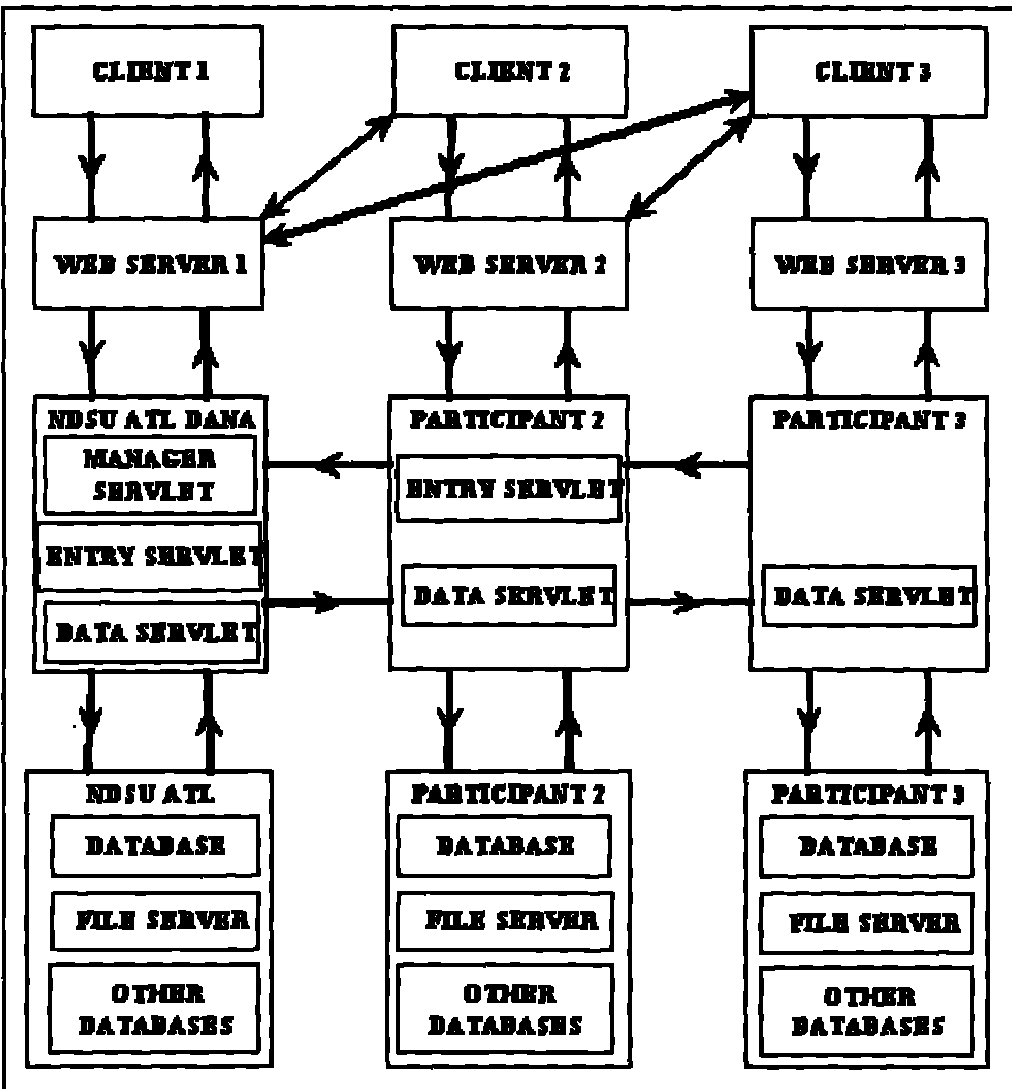
DANA's core is built on a federated model rather than a single monolithic database. This ensures that institutions maintain ownership of their data while contributing to a global network.
1. Multi-Tiered Servlet System
The system utilizes three specialized Java servlets:
- Manager Servlets: Coordinate large regional systems and perform crash detection/load balancing.
- Entry Servlets: Manage user sessions and persistent personal data (the virtual "notebook").
- Data Servlets: Provide direct access to various Relational Database Management Systems (RDBMS) like Oracle or PostgreSQL using generic SQL and XML for data exchange.
2. High-Precision 3D Modeling
Unlike simple 3D meshes, DANA models are created via non-contact laser digitizers. This enables Virtual Calipers, allowing researchers to measure:
- Cord distances (through the body of the object).
- Contour distances (along the surface).
- Circumferences and calculated indices for pottery or cranial endocasts.
3. Spatial Data Mining (SMILEY & P-Tree)
A unique component of DANA is its ability to find hidden relationships in artifact data. Using the SMILEY suite and a spatial structure called the P-tree, the system can automate "Knowledge Discovery," identifying patterns across different artifact types and geographic locations that a human researcher might miss.
Experiments and Interface Results
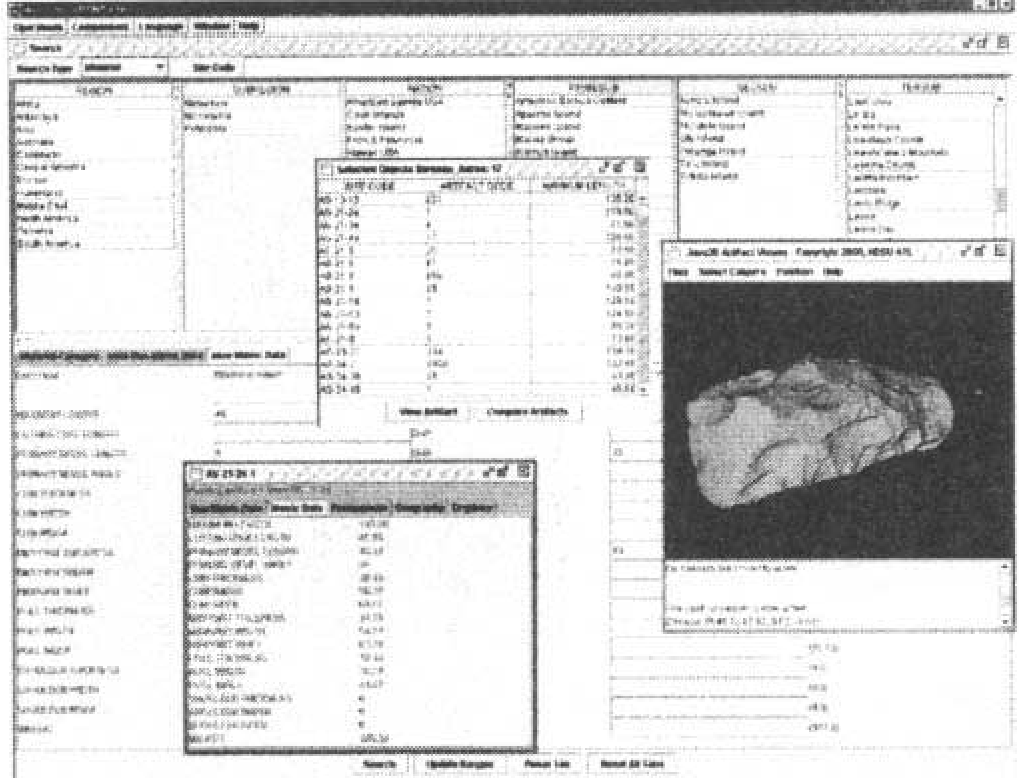
The authors successfully tested the prototype across several case studies, including Samoan stone tools and North Dakota Native American artifacts.
Key Performance Metrics:
- Precision: Achieved sub-millimeter resolution, sufficient for professional evolutionary biology and archaeology research.
- Sustainability: The distributed cost model ensures that no single institution bears the financial burden of the entire network.
- Accessibility: The system provides scalable data delivery, offering decimated models for users on slower dial-up connections and full-resolution 30MB+ models for those on Internet2/Ethernet.
Critical Insight & Conclusion
Takeaway: DANA's real value lies in its Inductive Bias toward Open Standards. By refusing to use vendor-specific commands and prioritizing XML/Java, the authors built a system designed to outlast the hardware of its era.
Limitations: While revolutionary for its time, the reliance on Java Web Start and Applets has become a technical debt in the modern web era (where browsers have deprecated these technologies). Furthermore, the high cost of 3D laser scanners in 2002 was a significant barrier to entry for smaller museums.
Future Outlook: DANA paved the way for modern "Digital Twins" in archeology. Today’s researchers are evolving this vision by integrating photogrammetry (which is cheaper than laser scanning) and WebGL-based viewers to fulfill the "anytime, anywhere" promise the DANA team envisioned over two decades ago.