
Decoding the Living Network: Online Learning for Predicting Neuronal Spike Activity
801_Predicting Spike Activity in Neuronal Cultures.
This paper presents a point process-based framework for modeling functional connectivity in neuronal cultures using Multi-Electrode Array (MEA) data. It introduces an online gradient descent learning algorithm that maps time-dependent interactions between electrodes to predict upcoming spike activity with high accuracy (AUC typically > 0.75).
TL;DR
Researchers have developed a machine learning framework to "read" the functional language of living brain cells grown in a dish. By treating spike trains as stochastic point processes and applying an online gradient descent algorithm, the system can predict when and where a neuron will fire next. This work moves beyond static mapping, offering a way to track the ever-changing (plastic) connections in biological networks.
The Challenge: Modeling Chaos and Plasticity
Neuronal cultures—networks of mammalian cortical cells dissociated and regrown on glass—are tiny, self-contained biological computers. While they lack the complex anatomy of a whole brain, they exhibit "spontaneous bursts" of activity that are neither purely random nor strictly periodic.
Existing attempts to map these networks often hit two walls:
- Complexity: The relationship between a history of spikes and a future firing event is non-linear and noisy.
- Plasticity: Biological networks change. A connection that exists now might strengthen or weaken in minutes. Standard "batch" learning (like maximum likelihood estimation) is too rigid to track these drifts.
Methodology: High-Dimensional Point Processes
The authors treat each of the 60 electrodes in a Multi-Electrode Array (MEA) as a node in a functional graph.
The Mathematical Core
Instead of simple regression, the firing rate of electrode is modeled as a conditional intensity function: where represents the "weight" or influence of electrode on electrode with a specific time delay .
Architecture & Learning
The system utilizes an online gradient descent algorithm. By optimizing the instantaneous log-likelihood of the spike train, the model updates its weights in real-time as new spikes are recorded. This allows the "map" to evolve alongside the living culture.
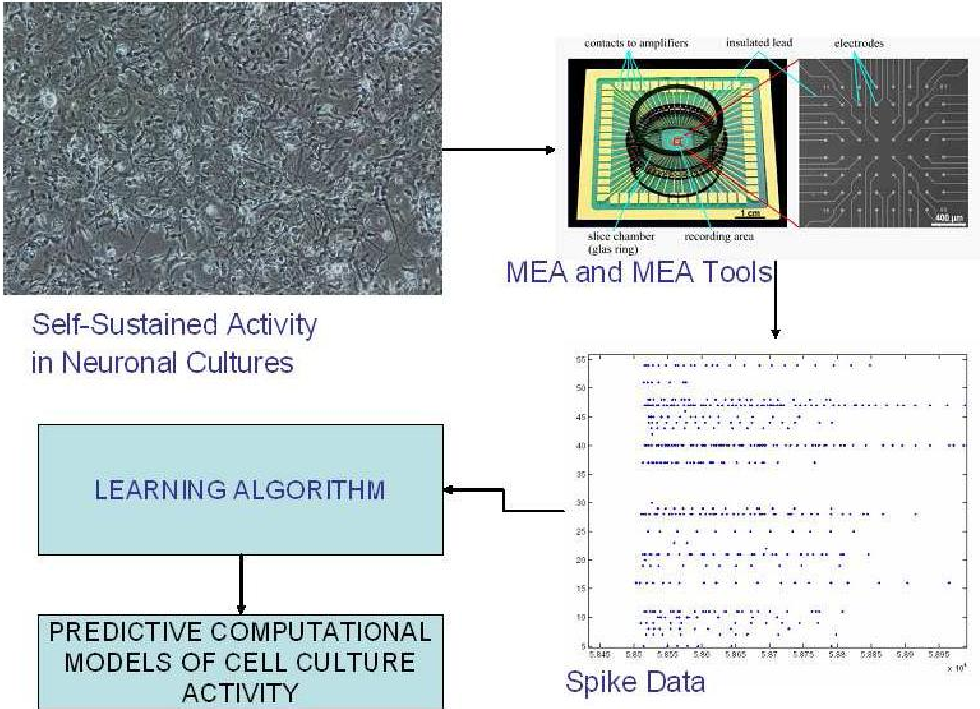 Fig 1: The experimental pipeline from MEA recording to the predictive computational model.
Experiments: Can We Predict the Future?
The researchers tested their model on five different cultures, focusing on "burst" periods where activity is densest.
Performance Metrics
Using ROC Analysis, the authors demonstrated that the model is highly effective at distinguishing between firing and non-firing states.
- AUC Scores: Most active electrodes achieved AUCs near 0.80, with some reaching as high as 0.90.
- Comparison: The point-process approach consistently outperformed a Perceptron baseline, particularly in "Recall" and "Precision," indicating that the temporal history and point-process framework are essential for capturing biological truth.
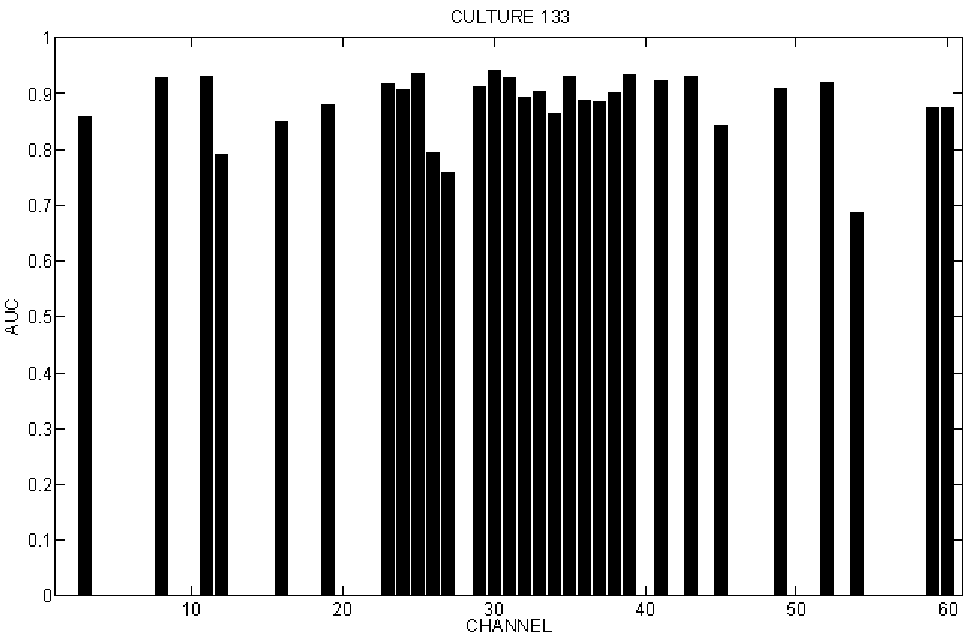 Fig 2: Area Under ROC Curves (AUC) for different electrodes in Culture 133, showing high predictive accuracy across the network.
Weight Dynamics
One fascinating insight from the study is that the "functional connectivity" changes depending on the prediction window. Short windows (1ms) capture immediate synaptic-like effects, while longer windows (30ms) reflect broader network reverberations.
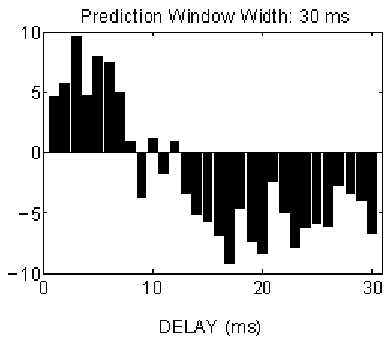 Fig 3: How influence weights between two electrodes vary across different time delays and prediction windows.
Critical Insight & Future Outlook
The success of this online learning approach proves that neuronal cultures are not just "noisy sensors"—they are structured, predictable information processors.
The Takeaway: The ability to predict spikes in real-time opens the door to Adaptive Stimulation. Imagine a system that predicts an upcoming pathological burst (like an epileptic seizure in a brain slice) and delivers a precise counter-pulse to cancel it out before it happens.
Limitations: The model is limited by the spatial resolution of MEAs (recording groups of neurons rather than single synapses) and still relies on a linear summation of inputs which may oversimplify complex dendritic integration.
Conclusion
By blending point process theory with online machine learning, Gurel et al. have provided a robust tool for neuroscientists to bridge the gap between structure and function in biological networks.