
Designing to Distract: Why Your Hospital Needs a Digital Fish Pond
833_Designing to Distract Can Interactive Technologies Reduce Visitor Anxiety in a Children's Hospital Setting
This research investigates the use of "positive distraction" via interactive technologies to mitigate visitor anxiety in a children’s hospital. The study evaluates the deployment of an interactive floor display (virtual fish pond) at Great Ormond Street Hospital (GOSH), demonstrating its superiority over passive TV monitors and information kiosks in engaging families.
TL;DR
Hospital waiting rooms are breeding grounds for anxiety. Traditionally, we’ve tried to fix this with magazines or silent TVs, but these are passive and often ignored. A landmark study at Great Ormond Street Hospital (GOSH) reveals that interactive floor displays act as powerful "positive distractions," turning a stressful transition into an engaging social experience that reduces the psychological burden on sick children and their families.
The Problem: The "Psychologically Hard" Hospital
Hospitals are paradoxical spaces. They are built to heal, yet their design is often "hard"—prioritizing sterile surfaces and functional efficiency over emotional well-being. Visitors arrive in a state of "heightened arousal," waiting for potentially life-altering news.
The traditional solution? Passive distraction. A TV in the corner or a few outdated magazines. However, this study points out two major flaws:
- Hygiene Constraints: Touch-based interfaces (tablets/kiosks) are cross-contamination risks.
- Passive Boredom: TV monitors are "one-directional." Without sound (to keep the area quiet), they fail to hold the attention of anxious children.
The Insight: Movement as Medicine
The researchers proposed a shift from passive observation to interactive distraction. They deployed an interactive floor projection—a virtual fish pond that ripples and reacts as people walk over it.
The physical intuition here is simple: Floor displays bypass "display blindness." People naturally look down to navigate space. By turning the floor into a reactive medium, the building itself begins to communicate "play" rather than "pathology."
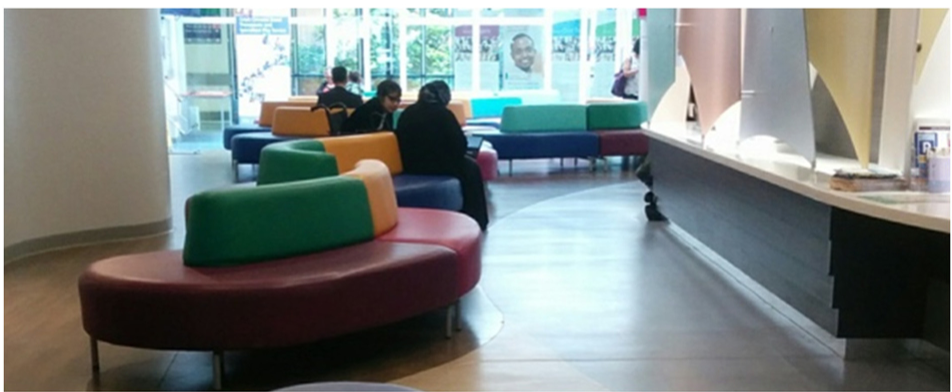 Figure: The final design featuring the marine mural and the central interactive pond.
Methodology: The Ethnography of Waiting
Through a two-month ethnographic study involving 358 visitors, the team analyzed how people actually moved through the space. They categorized interactions into a spectrum of engagement:
- Subtle Interaction: A parent "dipping their toe" into the pond while sitting nearby.
- Performative Acts: Children jumping into the pond to trigger dramatic ripples.
- Discreet Use: Stressed adults or "too cool" teenagers sneaking a step on the fish when they thought no one was looking.
Key Findings: Why Floor Beats Wall
The results were stark. While the pharmacy area (equipped with a TV) remained a site of boredom and "blank staring," the pond area became a social hub.
- The Honey Pot Effect: Once one child started playing, a crowd gathered. 40% of children engaged in "performative" jumping.
- Social Ice-Breaking: The circular seating around the pond forced visitors to face one another. This led to strangers talking—not about illness, but about the technology and their children’s play.
- Universal Accessibility: Even children in wheelchairs or with braces found ways to interact, either by driving over the pond or having parents demonstrate for them.
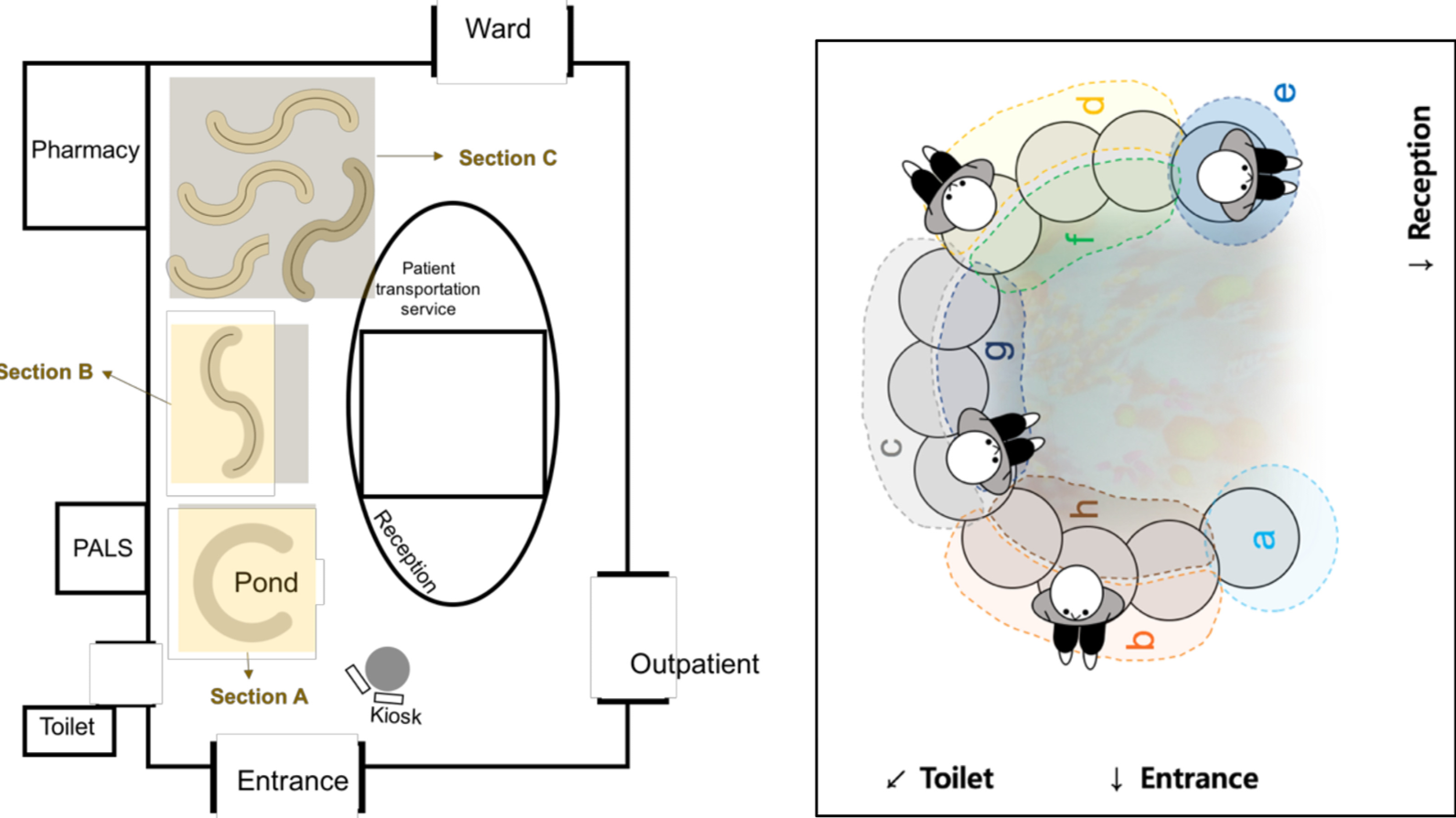 Figure: Mapping visitor seating and trajectories around the interactive focal point.
Critical Insights for Future HBI
The study suggests that Human-Building Interaction (HBI) should prioritize floor displays over wall displays in healthcare settings for three reasons:
- Social Orientation: Wall displays force the user to turn their back on their family; floor displays allow for face-to-face social scaffolding.
- No-Touch Safety: Interaction occurs via footfall, satisfying strict infection-control protocols.
- Low Cognitive Load: Unlike information kiosks (which visitors avoided because they preferred the reassurance of human staff), the pond requires zero training and provides immediate "ludic" (playful) feedback.
Conclusion
"Designing to Distract" is more than just making a room "pretty." It is a strategic architectural intervention to manage human emotion. By creating an "ad hoc stage" in the middle of a hospital, we can temporarily mask the clinical reality with a digital layers of wonder, effectively lowering the barrier of anxiety before a patient even sees a doctor.
Future Outlook: As we move toward "Smart Buildings," the challenge will be to measure these emotional shifts using non-invasive sensors (like heart-rate variations) without further stressing the patient, ensuring the building remains a place of healing, not just surveillance.