
SATR: Bridging Vehicular Gaps with Social Awareness and Trajectory Prediction
9395_SATR Socially-aware trajectory-based routing in vehicular social networks.
This paper introduces Socially-Aware Trajectory-based Routing (SATR), a novel routing protocol for Vehicular Social Networks (VSNs). It leverages historical vehicle trajectories to predict future encounters and incorporates "throwboxes" (static storage nodes) at popular locations to enhance packet delivery ratios and reduce latency.
TL;DR
Vehicular Social Networks (VSNs) are notoriously difficult to manage due to high-speed mobility and frequent disconnections. The Socially-Aware Trajectory-based Routing (SATR) protocol tackles this by analyzing vehicle "social" habits—predicting where they will meet based on historical trajectories—and utilizing static "throwboxes" at hotspots to keep data moving even when vehicles aren't directly connected.
Problem & Motivation: Beyond Random Encounters
Most vehicular routing relies on "opportunistic" encounters: if two cars pass each other, they swap data. However, in a large city, these encounters aren't purely random; they follow social patterns (e.g., commuting routes).
The authors identified two major flaws in current systems:
- Underutilization of Infrastructure: Useful static points (like bus stops or intersections) aren't leveraged as data buffers.
- Short-sighted Forwarding: Decisions are made based on current proximity rather than the likelihood of the car reaching the destination eventually.
Methodology: The Core of SATR
SATR operates through a sophisticated two-stage pipeline.
1. The Encounter Prediction Stage
The system calculates a Support Value () to determine how reliably a vehicle visits certain areas. This isn't just a count of visits; it factorizes the order and frequency of trajectory points.
By identifying "Popularity" (where many vehicles aggregate), the system determines the optimal placement for Throwboxes (TB). These act as stationary relays in a "Vehicle Encounter Graph."
2. The Packet Relay Path Graph
SATR builds a logical graph of potential relay paths. When a source vehicle () wants to send a packet, it doesn't just broadcast it. It calculates a Similarity Score between its trajectory and potential relay nodes, ensuring the packet moves toward the destination () through the most "socially active" nodes.
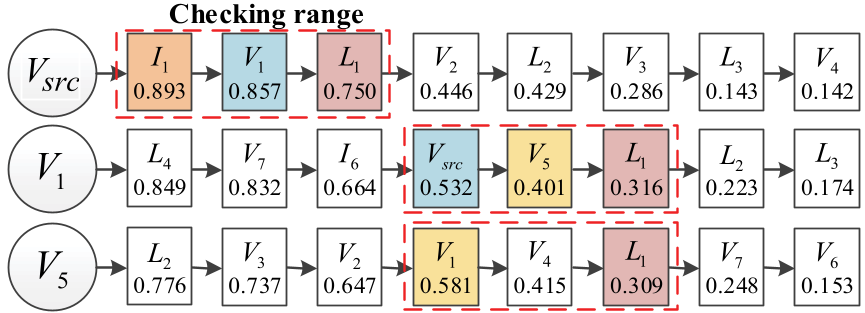 The SATR workflow: From trajectory gathering to social-aware packet forwarding.
Token Distribution: Smart Replication
To prevent the network from being flooded (high overhead), SATR uses a Token-based approach. A packet is assigned a limited number of tokens (). When a vehicle meets a more "capable" relay (determined by the value—a measure of a node's relay potential), it passes a portion of its tokens to that node.
Experiments & Results
The authors evaluated SATR against standard protocols. The results (visualized in the paper's final figures) show a clear trend:
- Delivery Ratio: SATR maintains high delivery rates even when the network is sparse, thanks to the Throwbox buffering.
- Latency: By using trajectory prediction, SATR avoids "dead-end" relays, cutting down the time packets spend sitting in buffers.
- Overhead: The token mechanism ensures that the number of packet copies is kept under control, preventing congestion.
 Performance metrics: Delivery ratio and Latency comparison across different routing protocols.
Critical Insight & Conclusion
The true innovation of SATR is the formalization of "Social Trajectories." By treating a vehicle's path as a social signature, the protocol transforms a chaotic physical environment into a predictable logical network.
Limitations: The reliance on historical trajectory data assumes that vehicle behavior is periodic. Sudden events (accidents, road closures) might temporarily degrade the prediction accuracy.
Future Work: Integrating SATR with real-time traffic data or edge computing resources could further refine the "Hotent" (Hotness/Potential) calculation, making the routing even more resilient to urban volatility.