
Game Theory vs. The Water Army: A Strategic Blueprint for OSN Integrity
9430_Game Theoretic Suppression of Forged Messages in Online Social Networks.
This paper introduces an infinitely repeated game theoretic framework to model the interactions between message publishers and network administrators in Online Social Networks (OSNs). It identifies critical game-equilibrium conditions to suppress forged messages using "risk alerts" rather than blunt blocking.
TL;DR
In the battle against forged messages—spam, rumors, and fake reviews—simply "blocking" users is a blunt instrument that often fails. This paper proposes a sophisticated Infinitely Repeated Game model where the network administrator uses dynamic risk alerts to disincentivize malicious publishers. By treating social media interaction as a long-term economic game, the authors prove that we can suppress forgery by manipulating payoff variables and penalty durations.
The Motivation: Why Blocking Isn't Enough
Online Social Networks (OSNs) are plagued by the "Water Army" (paid posters) and social bots. Current administrative responses often rely on binary classification: Is this message forged? If yes, block the user.
However, this approach faces two fatal flaws:
- The Misclassification Trap: Genuine users make mistakes, and automated filters have "False Alarms." Blocking a genuine user causes massive utility loss.
- Behavioral Adaptation: Malicious publishers aren't static; they adapt their strategies over infinite time horizons to maximize profit while staying just below the detection threshold.
The authors argue we need a system that understands the publisher's incentive structure.
Methodology: The Repeated Game Framework
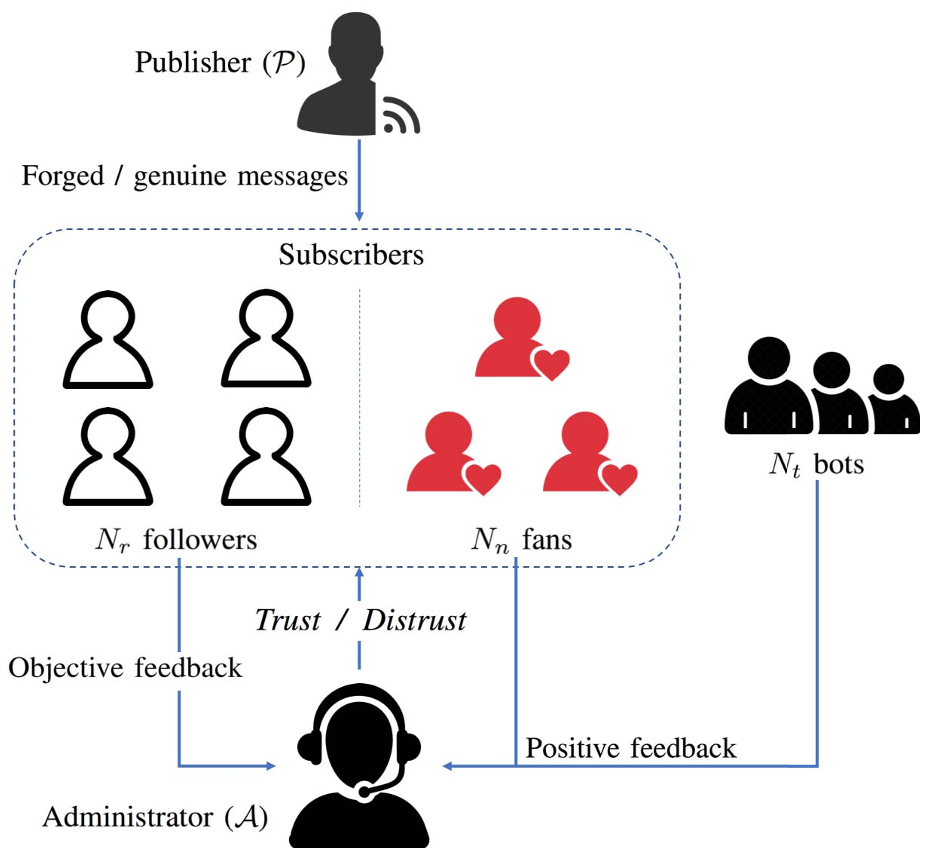
The researchers modeled the OSN ecosystem as a game involving three distinct groups of subscribers:
- Followers: Objective users who react to administrator alerts.
- Fans: Subjective users who trust the publisher regardless of alerts.
- Bots: Controlled by the publisher at a cost () to manipulate feedback.
The Penalty Mechanism: Exponentially Increasing Durations
Instead of a ban, the administrator () uses Risk Alerts. If a forged message is detected, flags the publisher for a period of rounds. During this time, the publisher’s reach is limited because Followers (but not Fans) heed the alert.
Core Insight: The "Extra Payoff" Threshold
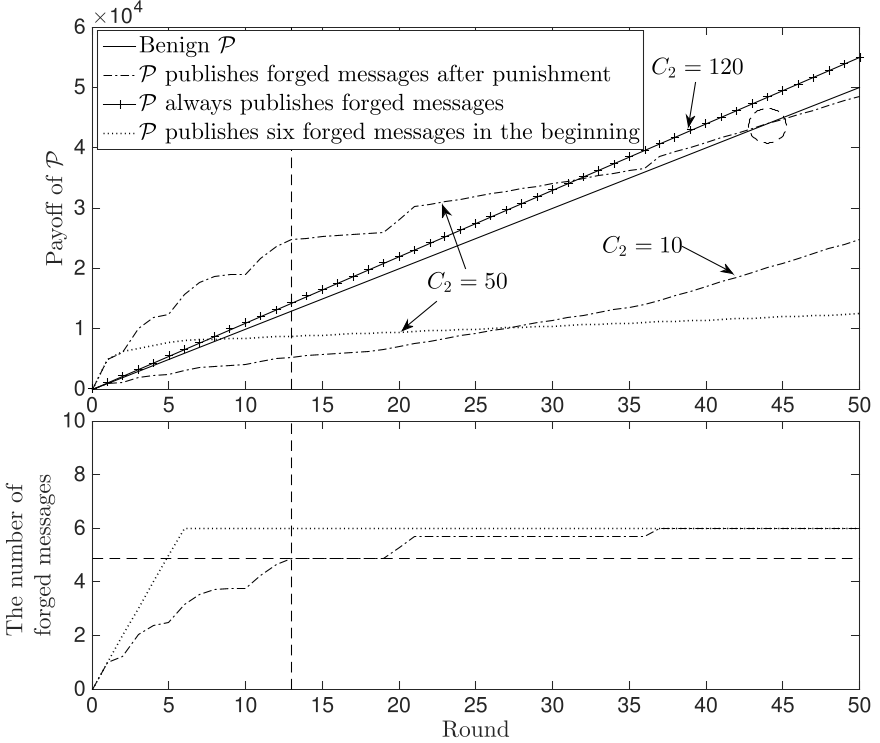
The mathematical core of the paper lies in calculating the Extra Payoff (). This is the difference between the cumulative profit of a malicious strategy (sending forged messages) vs. a purely benign strategy.
Using the Lambert W Function, the authors derived a closed-form expression for the maximum number of forged messages a publisher can send before their "extra payoff" becomes negative. Essentially, they found the point where the cost of being "flagged" by the administrator outweighs the temporary profit from forgery.
Key Performance Curves
The research shows that the "extra payoff" first rises as the publisher tricks the system, but then crashes as the exponential penalties kick in.
Experimental Results & Strategic Takeaways
The numerical simulations validate several intuitive yet critical levers for OSN administrators:
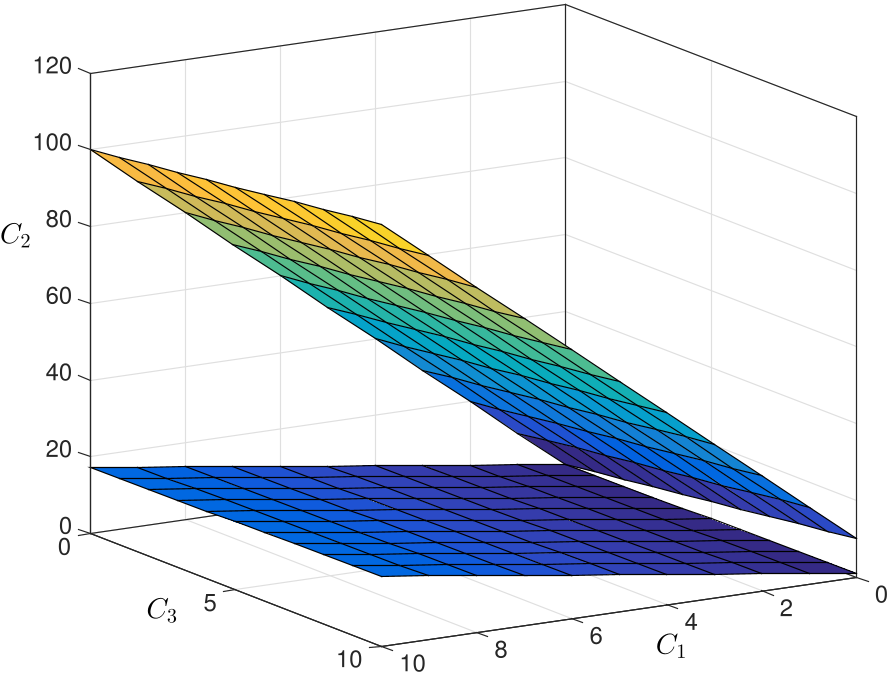
- Incentivize Genuineness: Increasing the payoff for genuine messages () is more effective than just increasing the probability of detection. When it "pays to be honest," even malicious actors flip.
- The Bot Paradox: Bots are only effective up to a point. Because bots have a linear cost (), there is a "sweet spot" of bot quantity. If an administrator makes bots more expensive, the publisher's strategy collapses.
- Fan Ratio: The more "Fans" a publisher has, the more resilient they are to risk alerts, as Fans ignore the administrator’s warnings. This explains why building a "cult-like" following is a primary goal for misinformation spreaders.
Critical Analysis & Conclusion
This work shifts the focus from pure detection to economic suppression. By establishing that there is a finite limit to the number of profitable forged messages, the authors provide a mathematical foundation for Facebook's "Risk Alert" and "Pin to Top" warnings.
Limitations: The model assumes publishers are rational utility-maximizers. It may not fully account for state-sponsored actors whose "payoff" is ideological disruption rather than monetary gain.
Future Outlook: The next frontier is applying these models to decentralized networks (Web3), where "cost of botting" can be hard-coded into smart contracts, creating a digitally enforceable game-theoretic truth layer.