
Securing Web Sessions: A Context-Aware Approach to XSS Mitigation
9613_XSS detection with automatic view isolation on online social network.
This paper presents a robust defense mechanism against Cross-Site Scripting (XSS) attacks by combining session linkage with request authentication and a dynamic "XSS Cheat Sheet" verification engine. The proposed system focuses on tracing remote links and isolating URLs to detect illicit script injections across various web contexts including HTML, CSS, and JavaScript.
TL;DR
This research introduces an integrated authentication and session-linkage framework designed to neutralize Cross-Site Scripting (XSS). By utilizing a sophisticated "URL Isolator" and a context-specific detection engine, the system achieves a detection rate as high as 94% for malicious event handlers, providing a significant upgrade over traditional static filters.
Background and Motivation
Despite being one of the oldest web vulnerabilities, XSS remains a top threat. The core issue is Contextual Ambiguity: a string that is safe in an HTML body might be lethal inside a <script> tag or a CSS url() attribute. Existing solutions often fail because they treat all "untrusted data" equally. The authors of this paper argue that defense must be as dynamic as the attack, proposing a system that traces the lifecycle of a request from the user's session to the target checkpoint.
Methodology: The Anatomy of Detection
The proposed architecture moves beyond simple regex matching. It introduces a multi-layered preprocessing and tracing logic:
- Session Linkage & Authentication: Establishes a secure binding between the User ID and their session, ensuring that request origins are verified before parsing.
- Remote Link Tracing (VURL_list): The system isolates URLs and parameters, creating a "VURL_list" to track where untrusted data enters the application.
- Checkpoint Value Extractor: This is the "brain" of the system. It examines values at specific execution points (Checkpoints) and compares them against a repository of known attack patterns tailored for different contexts (HTML, JS, CSS).
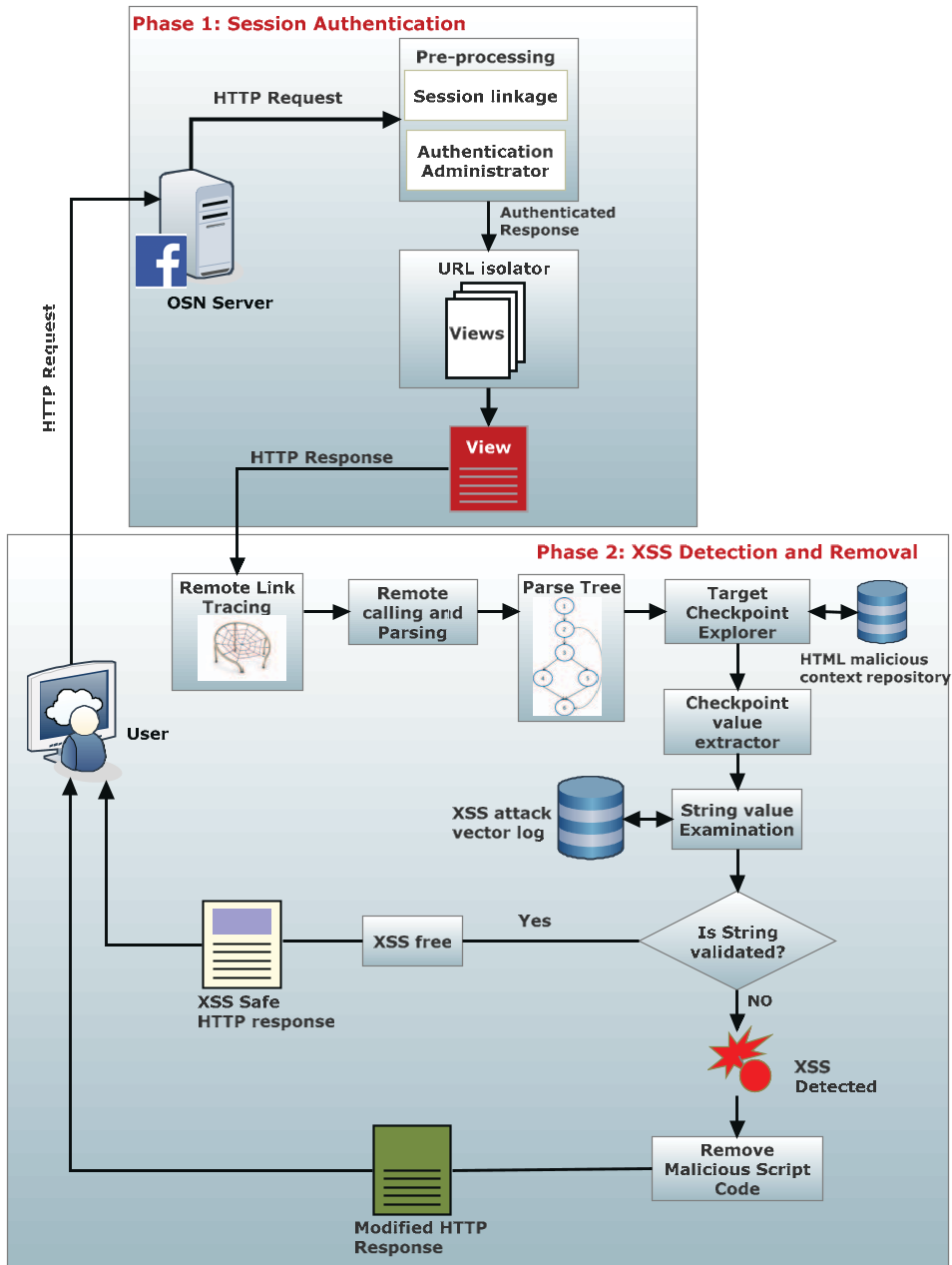
The logic relies on the "String Value Examination" phase, which utilizes a comprehensive XSS Cheat Sheet to identify illicit scripts injected into various contexts, as shown in the table below:
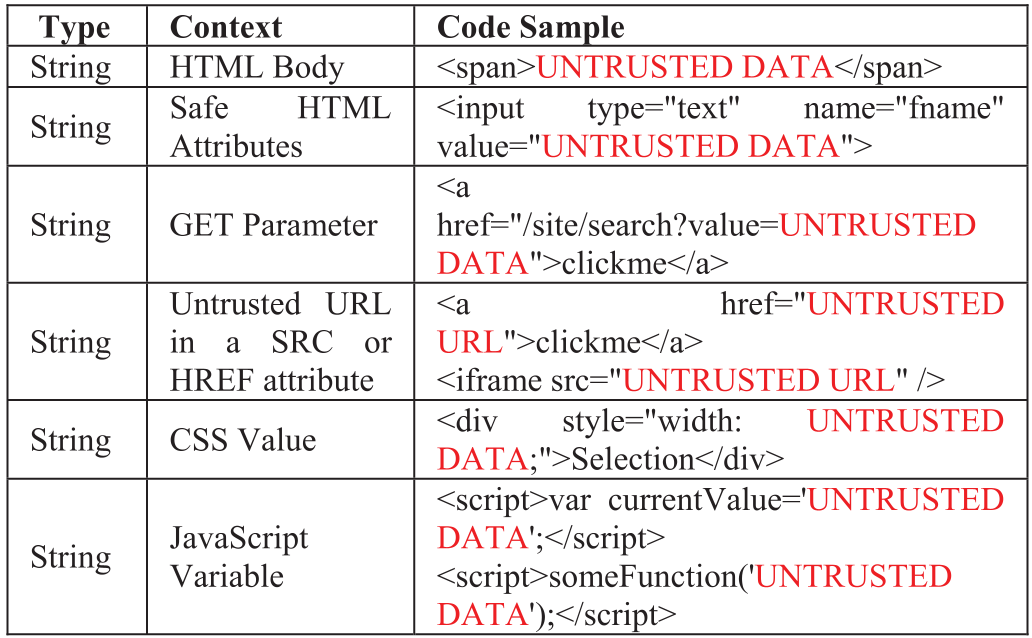
Experimental Analysis
The researchers tested the system against five major categories of attack vectors. The results demonstrate that Event Handlers (e.g., onerror, onload) are the most effectively detected, likely due to their distinct syntax which the "Checkpoint Explorer" identifies with high precision.
Performance Metrics:
- HTML Malicious Event Handlers: 94% Detection Rate.
- HTML Malicious Tags: 89% Detection Rate.
- URL Attack Vectors: 86% Detection Rate.
- CSS/JS Vectors: 80-85% Detection Rate.
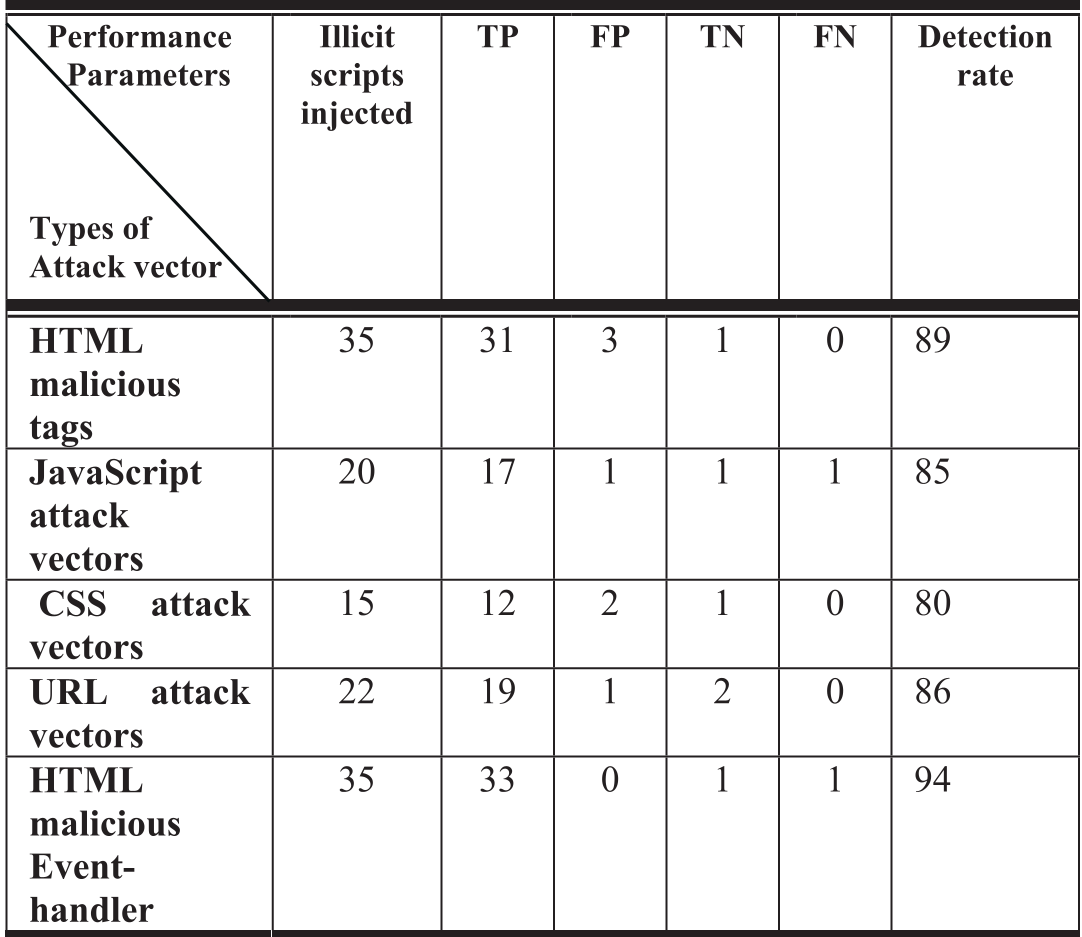
The lower detection rate in CSS (80%) highlights a common industry challenge: CSS-based XSS is often highly obfuscated and can be embedded in subtle ways that bypass even advanced string examination.
Critical Insight & Conclusion
The true value of this work lies in its Session-to-Checkpoint tracing. By linking the user's identity to the specific parameters being passed, the system creates a "chain of custody" for data.
Limitations: While effective, the reliance on an "XSS Cheat Sheet" suggests a heuristic-heavy approach. Future iterations could benefit from integrating Deep Learning (RNN/Transformers) to predict never-before-seen obfuscation techniques that a static cheat sheet might miss.
Future Outlook: As web applications move toward purely client-side rendering (React/Vue), the "URL Isolator" logic proposed here will become even more critical in the DOM-based XSS battlefield.