
Social Diversity: Moving Beyond Simple Like-Counts in Search Ranking
A Priori Relevance Based On Quality and Diversity Of Social Signals
This paper introduces a novel information retrieval (IR) ranking approach that leverages social signal diversity (likes, shares, tweets) as an a priori probability within a Language Model. By integrating the Shannon-Wiener diversity index into document priors, the method outperforms traditional text-only baselines and quantitative-only social signals on the IMDb dataset.
TL;DR
Is a movie with 10,000 Facebook likes more relevant than one with 2,000 likes spread across Facebook, Twitter, and LinkedIn? This paper argues for the latter. By treating "Social Signal Diversity" as a mathematical prior in a Language Model, the authors achieved a 100% improvement in Mean Average Precision (MAP) over traditional text-base search engines.
Problem & Motivation: The Crowd is Lopsided
Traditional search engines often suffer from a "bubble" effect. If we only count the number of actions (likes, shares), a document might rank high simply because it went viral in one specific sub-culture or was boosted by a single platform's algorithm.
The authors' core Insight is that true relevance is reflected by cross-community validation. If multiple users across different social networks (with different demographics and intents) all engage with a resource, that resource possesses a universal quality that transcends a single community.
Methodology: Quantifying the Social Footprint
The research integrates social signals into the Language Modeling (LM) framework for Information Retrieval. The ranking is determined by: Where is the "Document Prior"—the probability of a document being relevant regardless of the query.
The Diversity Multiplier
Instead of just counting signals, the authors use the Shannon-Wiener Diversity Index to calculate how "even" the distribution of those signals is across platforms like Facebook, Twitter, Google+, Delicious, and LinkedIn.

If a document has a high volume of signals but they are all from one source, its "Equitability" score () will be low, tempering its final rank.
Categorization of Signals
The authors categorize actions into two distinct social properties:
- Popularity: Shares, Tweets, Comments.
- Reputation: Likes, Google+ +1s, Delicious Bookmarks.
Experimental Results
The study utilized the IMDb dataset, which is a gold standard for multi-modal metadata search.
| IR Model | P@10 | nDCG | MAP |
|---|---|---|---|
| Lucene (Text Only) | 0.3411 | 0.3919 | 0.1782 |
| Best Social (No Diversity) | 0.4629 | 0.6203 | 0.3557 |
| Best Social + Diversity | 0.4689 | 0.6245 | 0.3571 |
The results show a massive leap from text-only models. Interestingly, even within social-aware models, adding the Diversity factor consistently produced statistically significant gains.
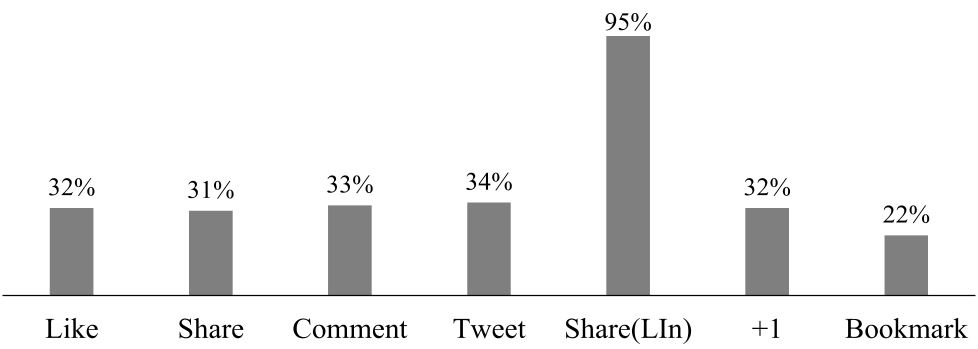 Figure 1: Percentage of specific signals within relevant documents.
Qualitative Insights: Not All Networks are Equal
The study found a fascinating disparity between platforms:
- Facebook: Massive volume, high engagement, but also high "noise" (present in many irrelevant documents).
- LinkedIn: Low volume, but extremely high "Trust" value. If a document has LinkedIn shares, it is almost certainly relevant, regardless of the raw count. This suggests that the origin of a signal should be weighted differently.
Critical Analysis & Conclusion
Takeaway
Diversity acts as a filter for "quality." By rewarding resources that resonate across various digital ecosystems, IR systems can better approximate human value judgments.
Limitations
- Temporal Decay: The paper (published in 2015) uses platforms like Google+ and Delicious, which are now defunct. The logic holds, but the platforms must be updated (e.g., TikTok, Reddit, Discord).
- API Dependency: The method relies on external social APIs, which are increasingly restricted in the modern web (the "walled garden" problem).
Future Work
The next frontier is integrating Social Sentiment Analysis—not just counting that someone talked about a movie, but understanding if the "signal" was positive or a critical warning.