
Inside the Psychopathic Mind: Why "Moral" Brain Circuits Fail During Social Retaliation
Aberrant social and cerebral responding in a competitive reaction time paradigm in criminal psychopaths
This neuroimaging study investigates the aberrant neural and behavioral responses of criminal psychopaths using a modified Taylor Aggression Paradigm. The researchers found that psychopaths exhibit hypoactivity in the medial prefrontal cortex (mPFC) during retaliation and unique hypothalamic activation linked to physical aggression, distinct from healthy control patterns.
TL;DR
A landmark fMRI study on forensic psychopathic inmates reveals that their brains process social aggression and empathy through entirely different circuits than healthy individuals. While normal social retaliation involves the medial Prefrontal Cortex (mPFC) for emotional regulation, psychopaths bypass these "moral" centers, relying instead on subcortical "drive" regions like the hypothalamus.
Problem & Motivation: The Logic of "Cold" vs "Hot" Aggression
Healthy humans usually experience a cocktail of emotions when retaliating against a provoker: a mix of justified anger and a restraining sense of guilt. This balance is maintained by the mPFC. However, criminal psychopaths are known for instrumental aggression (cold, goal-directed) and a lack of empathy.
The authors sought to find where the "social brake" fails. If a psychopath is provoked, does their brain feel the same "guilt" (dorsal mPFC) or "empathy" (ventral mPFC) as a healthy person? Previous work suggested these areas were key, but this study took the research into the high-stakes environment of a forensic psychiatric institution.
Methodology: The "Taylor Aggression Paradigm"
The study used a modified Taylor Aggression Paradigm (TAP). Participants competed in a reaction time task against an alleged opponent.
- Winning: The participant chooses a pain intensity (1 to 5) to deliver to the opponent.
- Losing: The participant receives a mechanical pain stimulus (air pressure projectile).
- Observing: The participant watches a video of the opponent’s facial reaction to the pain they just administered.
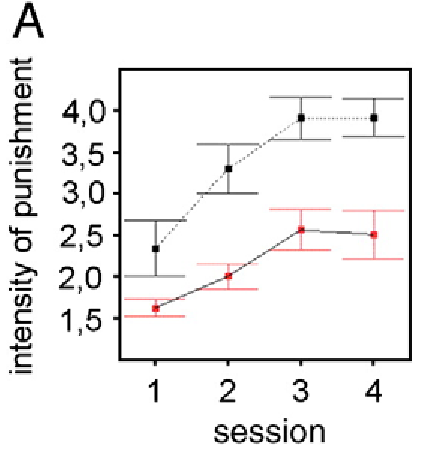 Figure 1: Behavioral data showing the increase in punishment intensity over time and its relationship with psychopathy Factor 1.
Methodology Detail: The Core Neural Shift
The researchers monitored brain activity during two critical phases: Retaliation (the act of choosing punishment) and Observation (witnessing the pain).
In healthy subjects, the mPFC acts as a supervisor. In psychopaths, the authors hypothesized this supervisor would be "off-duty."
Experiments & Results: Hypothalamic Drive vs. Prefrontal Silence
The results were striking. When psychopaths chose to deliver high-intensity pain (retaliation), their mPFC remained silent. Instead, they showed massive activation in the medial hypothalamus.
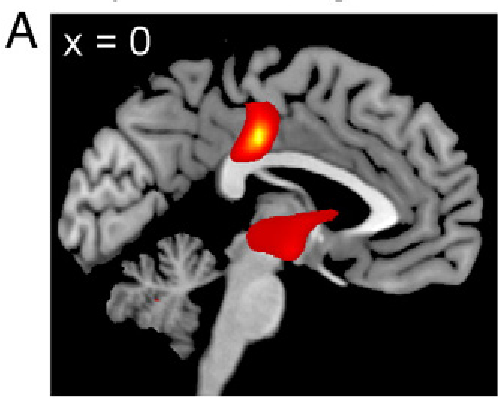 Figure 2: Statistical maps showing high vs. low punishment. Note the specific correlation (r=0.81) between physical aggression scores and hypothalamic activation.
Key Findings:
- Missing Guilt: Unlike healthy controls, psychopaths did not show mPFC activity during retaliation. Their aggression seems driven more by primitive subcortical circuits (Hypothalamus/PAG) rather than sophisticated social-emotional processing.
- Cognitive Empathy without Feeling: When watching others suffer, psychopaths did show activation in Theory of Mind (ToM) areas (STS, Temporal lobes). They can "understand" the opponent is in pain (cognition), but the ventral mPFC—the part that "feels" the emotional weight of that pain—was inversely correlated with their antisocial scores.
- Anticipation Deficit: During the anticipation of pain, psychopaths showed no activation in the Amygdala or Anterior Cingulate (ACC), and no skin conductance (sweat) response. They cognitively knew pain was coming, but their bodies didn't "care."
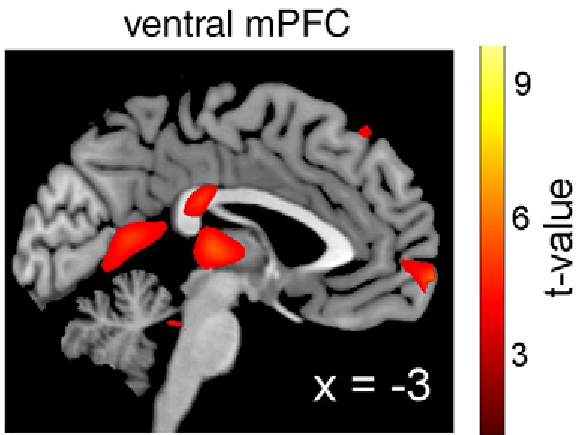 Figure 3: Regression maps showing that as antisocial behavior (Factor 2) increases, ventral mPFC activation during the observation of suffering decreases.
Critical Analysis & Conclusion
This paper provides a biological explanation for why traditional therapy often fails with psychopaths. If the "moral" centers of the brain (ventral mPFC) simply do not engage during social conflict, appealing to a sense of "guilt" or "empathy" is neurologically futile.
Takeaway: The study suggests that Reactive Aggression in psychopaths is primarily linked to Factor 2 (antisocial/impulsive behavior) and is driven by an overactive hypothalamus unchecked by the prefrontal cortex. This shifts the focus for forensic rehabilitation toward controlling impulsive triggers rather than emotional re-education.
Limitations: The sample size (n=10) is small, though common for such difficult-to-access forensic populations. Future research must determine if these patterns are present in "successful" (non-criminal) psychopaths.