
Beyond the Profile: Identifying "Zombie Fans" Through Behavioral Fingerprints
Abnormal user identification in online social networks based on user behavior
This paper introduces a specialized identification framework for abnormal users, specifically "zombie fans" (bots) and "invalid users," in Online Social Networks (OSNs) like Sina Weibo. By shifting focus from static profile features to dynamic behavior patterns—such as posting regularity, interaction timing, and retweet ratios—the method achieves a high identification accuracy of up to 88.4%.
TL;DR
In the evolving arms race of online social networks, "zombie fans" (bot accounts) have become increasingly sophisticated, mimicking human profiles to evade detection. This paper shifts the detection paradigm from what a user is (static profile data) to how a user acts (dynamic behavior patterns). By quantifying posting regularity and interaction anomalies, the researchers achieved an 88.4% accuracy in identifying malicious bots and inactive accounts on Sina Weibo.
The Motivation: Why Static Features Fail
Until recently, spotting a bot was easy: they had gibberish names, no profile pictures, and suspicious follower-to-following ratios. However, modern "zombie fans" are often controlled by sophisticated scripts that simulate human interaction.
The authors argue that the "Behavioral Pattern" is the most fundamental feature of a user. Even if a bot mimics a human bio, its underlying code usually follows a mathematical regularity—or acts at times (like 3:00 AM) when most humans are asleep—that betrays its non-human nature.
Methodology: The Three Pillars of Detection
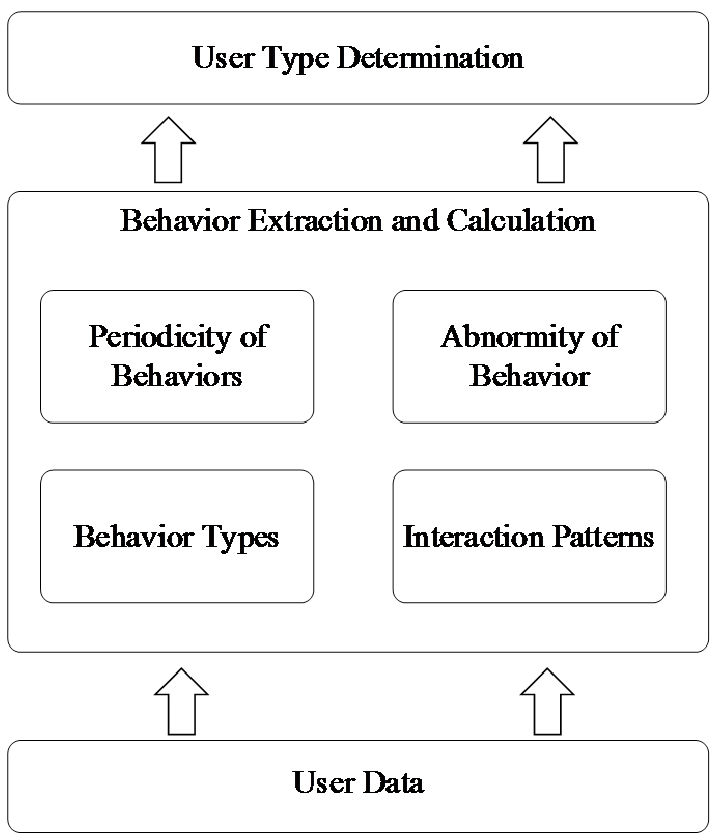
The core contribution of this work is a framework that decomposes user activity into three measurable behavioral metrics:
1. Behavioral Regularity (The "Script" Signature)
A human's posting habit is naturally chaotic. We post when we are inspired. A script, however, often operates on a timer. The authors use a variance-based formula () to measure the time intervals () between posts. A low variance indicates a high degree of robotic regularity.
2. Behavioral Abnormality (The Night Owl Test)
By segmenting the day into 2-hour cycles, the researchers found that normal users peak between 8 AM and 1 PM. Accounts that maintain high activity levels between 1 AM and 8 AM are flagged for "behavioral abnormality."
3. Interaction Patterns
The "water army" effect is real. Bots often retweet other bots without any social connection. The model flags users if the proportion of retweets from non-connected accounts exceeds a specific threshold ().
Dealing with the "Quiet Ones": Invalid Users
While zombie fans are active and malicious, Invalid Users are passive and create noise. The paper distinguishes between:
- Sleep Users: Accounts with zero activity since registration.
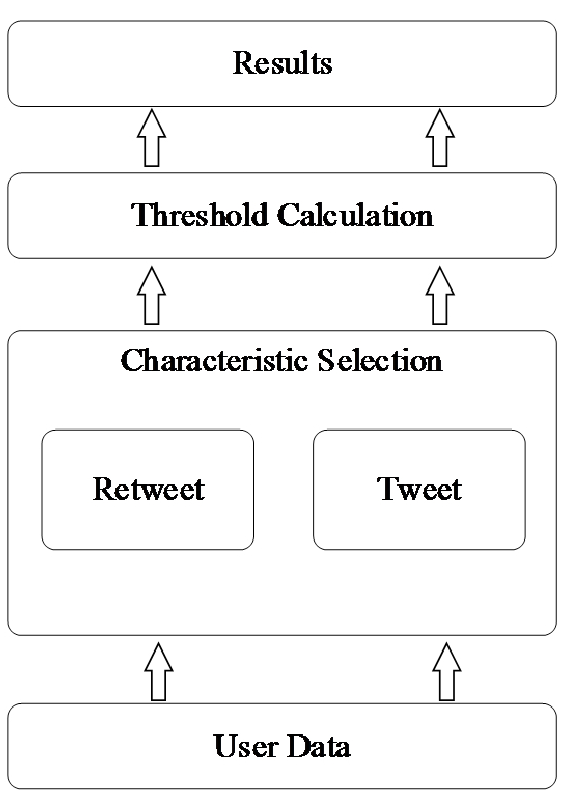
- Inactive Users: Accounts whose activity falls below a calculated threshold ().
Experimental Evidence
The team tested their model against a manually labeled dataset of 2,359 zombie fans and 3,769 normal users, eventually scaling the test to 100,000 real-world Sina Weibo accounts.
| Experimental Scheme | Accuracy (%) | Precision (%) | Recall (%) |
|---|---|---|---|
| Zombie Identification | 88.40 | 86.36 | 89.26 |
The results prove that behavior-based detection is significantly more effective than single-feature analysis, which typically peaks at only 70% accuracy.
Critical Analysis & Future Outlook
The paper successfully demonstrates that temporal and interaction-based features are key to unmasking intelligent bots. However, it also acknowledges a limitation: Misidentification of "Bot-like Humans." Some enthusiasts or professional social media managers exhibit high regularity and night-time activity, occasionally causing the model to flag them as bots.
The Multi-Modal Future: To reach the next level of precision, future iterations must combine these behavioral patterns with content semantics (NLP) to distinguish between a "passionate human" and a "sophisticated script." As AI agents become more prevalent, the definition of a "normal user" will continue to shift, making behavioral forensics more vital than ever.