
Beyond Connectivity: Capturing Social Semantics via Relational Tensors
Abst ing Rec anal type wor be c per, erin sem we p wor gene met Fina tate tion cial
This paper introduces a tensor-based unsupervised framework for analyzing Heterogeneous Social Networks (HSNs). It proposes a 3rd-order Relational Adjacency Tensor (RAT) to model multi-type nodes and relations, enabling three novel tasks: heterogeneous centrality measurement, role-based clustering, and egocentric information abstraction.
TL;DR
Most social network algorithms treat all connections as equal. This paper breaks that mold by introducing a Tensor-based framework that understands the difference between a "spouse," a "director," and a "mentor." By modeling "Relation Sequences," the authors provide new tools for finding central figures, clustering users by their professional roles, and simplifying massive graphs into human-readable "egocentric" summaries.
The "Heterogeneity" Problem
In a standard graph, if Person A has 10 friends and Person B has 10 business partners, a traditional Degree Centrality algorithm sees them as identical. But in reality, their social "roles" and "influence" are worlds apart.
The authors argue that real-world networks are Heterogeneous Information Networks (HINs). Prior works often collapsed these into homogeneous graphs, losing the rich semantic labels. The challenge is: how do we mathematically model these typed links and high-order paths (e.g., "the director of a movie remade by an actor") without needing a manual "schema" or supervised labels?
Methodology: The Logic of Signature Profiles
The core innovation is the Relational Adjacency Tensor (RAT).
- Relation Sequences: Instead of just looking at the next node, the model tracks the labels of the path. A 2-step sequence might be
<directs, has_actor>. - The Tensor: They stack k-step relational matrices into a 3rd-order tensor.
- Signature Profiles: Each node is assigned a vector (profile) based on how many times it engages in specific relation sequences.
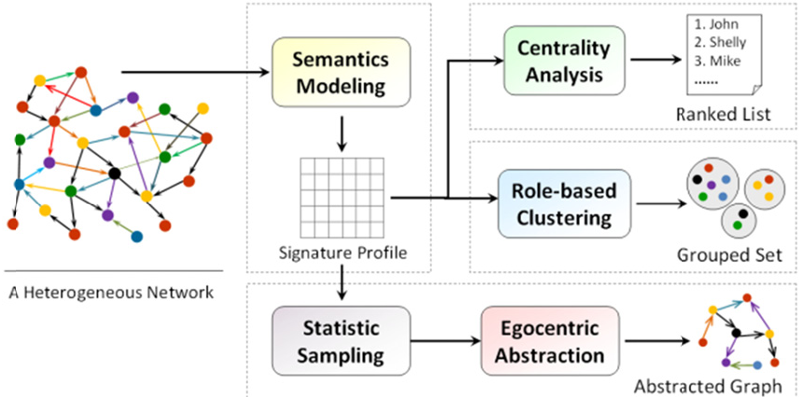 The workflow: from Heterogeneous Network to Modeling, then to Centrality, Clustering, and Abstraction.
Three Pillars of Analysis
1. Heterogeneous Centrality
The paper defines three ways to be "important" in a complex network:
- Contribution-based: How much do you dominate a specific type of event?
- Diversity-based: Do you connect to many different types of groups? (The "Weak Tie" logic).
- Similarity-based: Are you a "hub" for people who behave exactly like you?
2. Role-based Clustering
Unlike "Community Detection" which groups people who are physically close (dense connections), Role-based Clustering groups people who act similarly. An actor in Hollywood and an actor in Bollywood might never meet, but they play the same "role" in their respective subgraphs.
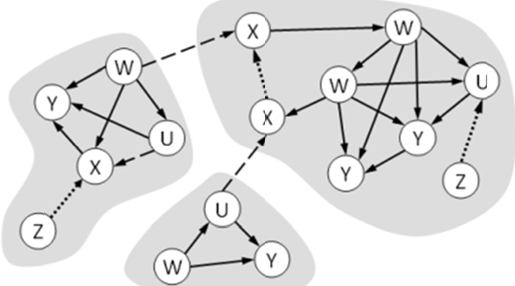 Role-based clustering identifies functional similarities (X, Y, Z) that cut across structural communities.
3. Egocentric Abstraction
Large graphs are overwhelming. The authors propose "Egocentric Abstraction" which filters a graph around a specific "ego" node using three views:
- Local Frequency: "What does this person usually do?"
- Local Rarity: "What unusual events involving this person deserve investigation?"
- Relative Frequency: "What unique behaviors distinguish this person from everyone else?"
Experimental Insights
Analyzing the UCI KDD Movie Dataset, the framework identified figures like Jean Renoir as central. Homogeneous algorithms (like PageRank) missed him because he didn't have the highest volume of links, but he had the highest diversity (actor, director, writer, producer).
In a high-stakes Crime Dataset test, human analysts were asked to find criminals in a sea of nodes. Using the "Relative Frequency" abstraction:
- Accuracy increased by 13.3%.
- Time spent dropped by 70% (from 36.6 mins to 10.9 mins).
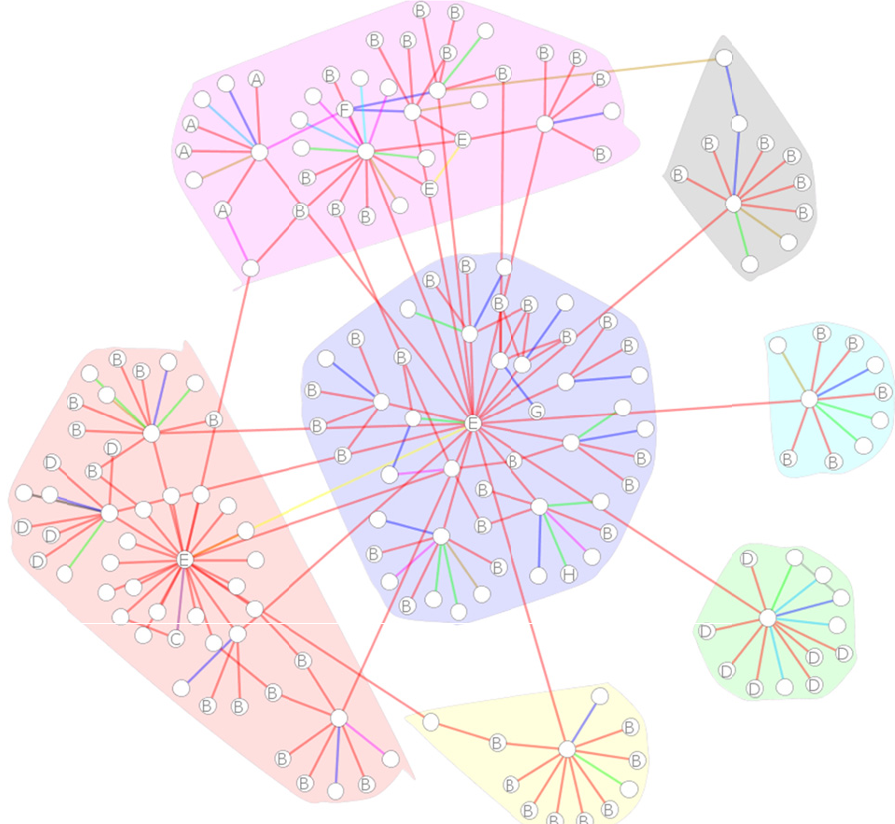 Comparison of the three proposed centrality measures, showing their unique discriminative powers.
Critical Analysis & Future Outlook
The beauty of this work lies in its unsupervised nature. It doesn't need to be told what a "director" is; it learns the importance through the frequency of the sequence label. However, as link types () and step sizes () grow, the tensor can become extremely sparse and high-dimensional. Future work involving Tensor Decomposition or Low-rank Approximations could further optimize the computational footprint.
This paper remains a foundational blueprint for anyone moving beyond simple "Dots and Lines" toward a truly semantic understanding of social structures.