
Beyond Fixed Taxonomies: Detecting Abstract Venue Concepts via Dual-Source Modeling
Abstract Venue Concept Detection from Location-Based Social Networks
The paper introduces a specialized generative probabilistic model for detecting "abstract venue concepts" (e.g., "upscale hotel") from Location-Based Social Networks (LBSNs) like Foursquare. It jointly models two distinct data types—concise tags and descriptive user comments—to discover semantic POI (Point of Interest) categories that surpass the granularity of standard LBSN taxonomies.
TL;DR
Standard location categories like "Restaurant" or "Hotel" are often too broad for effective recommendation. This paper presents a novel probabilistic graphical model that analyzes LBSN data by treating tags and user comments as distinct but related information sources. By filtering out "noise" in comments via a background distribution, the model uncovers fine-grained "Abstract Venue Concepts" (e.g., distinguishing a "Luxury Ritz-Carlton" from a "Business Hyatt") with significantly higher coherence than traditional LDA.
Background: The Granularity Gap
When you search for a place on Foursquare or Yelp, you are often bound by a static category tree. A "Five-star luxury hotel" and a "Roadside motel" might both be tagged simply as "Hotel." To a recommendation engine or an advertiser, this lack of nuance is a major bottleneck.
The authors argue that the information to bridge this gap already exists in Venue Profiles, but it is trapped in two messy formats:
- Tags: High-signal, fixed-lexicon terms (e.g., "WiFi", "Valet").
- Comments: Noisy, natural language sentences (e.g., "Amazing view, but the staff was slow").
Methodology: Tailor-Made Modeling
The core innovation lies in the coordinated generative process. Instead of throwing tags and words into a single "bag-of-words" (the approach taken by prior works), this model treats them as two separate distributions (tags) and (words) tied to a shared latent concept .
Architecture Insight
The model introduces a "Switch" variable for user comments. This acts as a gatekeeper:
- If , the word is drawn from the Abstract Venue Concept.
- If , the word is drawn from a Background Distribution (common English filler words or irrelevant chatter).
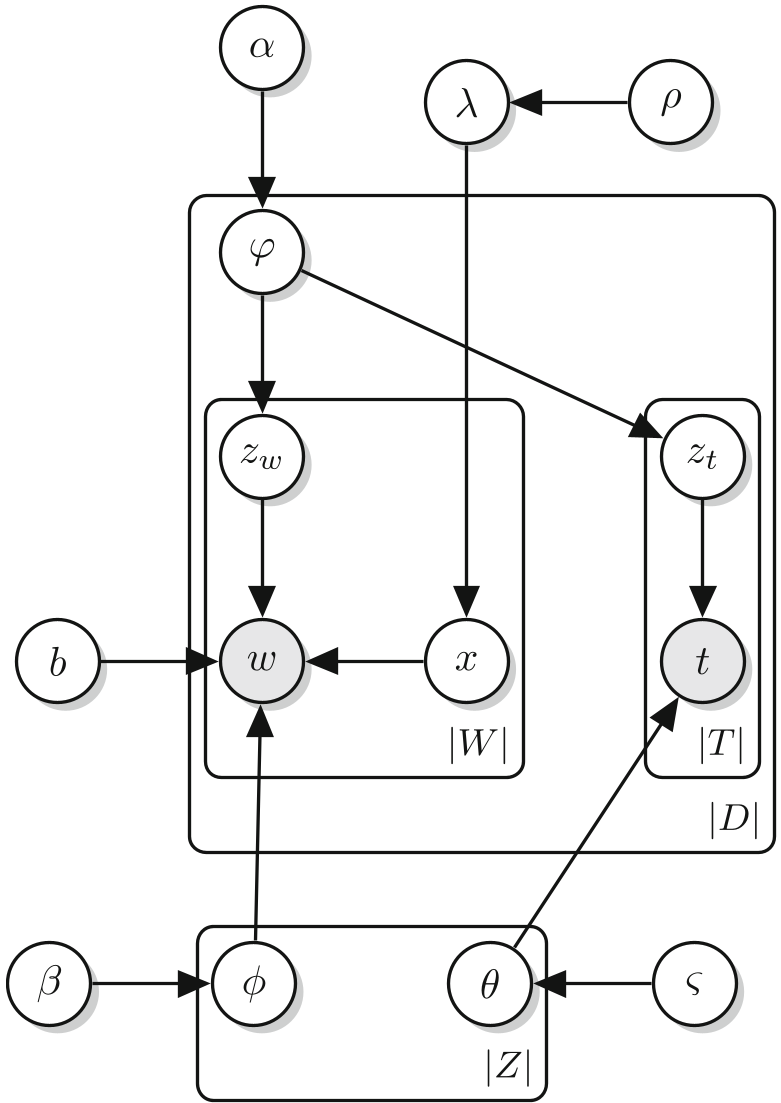
This binary switch ensures that the "Abstract Concept" remains "pure" and isn't diluted by the linguistic noise typical of social media comments.
Performance: Dominating the Baselines
The researchers tested the model against several heavyweights: vLDA, cLDA, Topical N-gram (TNG), Hierarchical Dirichlet Processes (HDP), and Biterm Topic Model (BTM).
1. Coherence Comparison
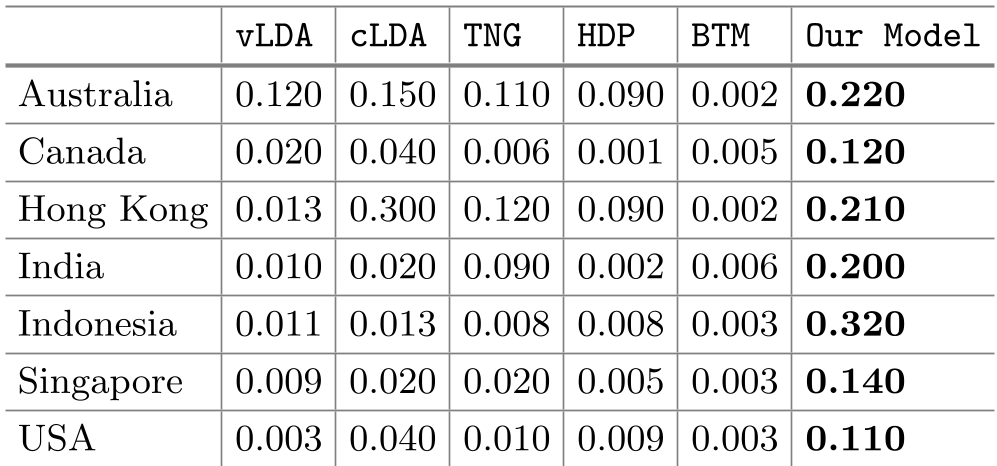
Using an automated coherence metric (Observed Coherence), the model outperformed all competitors across seven global datasets. In the Indonesia dataset, for instance, the improvement over the best LDA variant was nearly 25-fold in terms of coherence score.
2. Human Evaluation
When human annotators were asked to rate the labels generated for these concepts, the proposed model scored an average of 2.40 to 2.80 (on a 0-3 scale), whereas baselines struggled to maintain scores above 1.5. This proves that the concepts discovered are not just mathematically sound but human-interpretable.
Case Study: "The College Concept"
An example from the Australia dataset perfectly illustrates the model's power. One discovered concept clustered terms like university, video games, library, electronics, and college.
- The model correctly identified these as a specific venue profile: a university environment where students live, study, and entertain themselves.
- Traditional models would likely have mixed these with general "education" or "electronics store" categories.
Critical Insight & Conclusion
The success of this work stems from its respect for Data Heterogeneity. By acknowledging that tags and comments follow different linguistic laws, and by explicitly modeling the "noise" in human speech via a background distribution, the authors achieved a semantically richer understanding of urban geography.
Takeaway for Practitioners: When dealing with multi-modal or multi-source text data (like product specs vs. user reviews), do not flatten your data into a single vector. Tailor the model to the specific characteristics of each source to unlock higher-order latent structures.