
Decoding the Digital Ivory Tower: How Google Scholar Citations is Populated
How is an academic social site populated? A demographic study of Google Scholar Citations population
Deep demographic analysis of Google Scholar Citations (GSC) evolution between 2011 and 2012. Using capture-recapture methods and quarterly snapshots, the study reveals the platform's early population growth, reaching an estimated quarter-million profiles.
TL;DR
Is Google Scholar Citations (GSC) a mirror of the global scientific community? According to José Luis Ortega’s demographic study, the answer is a resounding "no." While GSC experienced explosive growth (over 160% in a single year during 2011-2012), it is a landscape dominated by young researchers, computer scientists, and sudden "waves" of institutional colonization from specific countries like Brazil.
The "Colonization" of Academic Social Networks
The primary motivation behind this research is to challenge the reliability of GSC for research evaluation. If evaluators use GSC data to benchmark scientists, they must understand its population dynamics. Ortega argues that academic sites aren't populated uniformly but are "colonized" through specific institutional pushes.
The study Highlights a critical bias: GSC profiles are self-created. This voluntary nature creates a demographic filter that favors those with a digital-first mindset, potentially skewing bibliometric indicators against the "real" scientific population distribution.
Methodology: Capturing the Scientific "Wildlife"
To estimate the total population of a platform where you cannot see the full database, Ortega turned to a classic ecology trick: Capture-Recapture.
By "marking" profiles identified in one quarterly crawl and seeing how many were "recaptured" in the next, the study used the Lincoln–Petersen formula to estimate the platform's total size.
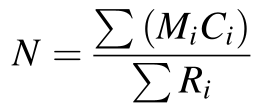
The Lincoln-Petersen formula used to estimate total GSC membership.
Key Findings: Bias in the Data
1. The Youth Movement
Contrary to the image of "distinguished professors" dominating citation counts, GSC is the playground of the young.
- Doctoral Students and Assistant Professors make up over 34% of the profiles.
- Profiles of high-ranking professors are growing at a slower rate compared to their younger counterparts.
2. Disciplinary Skew
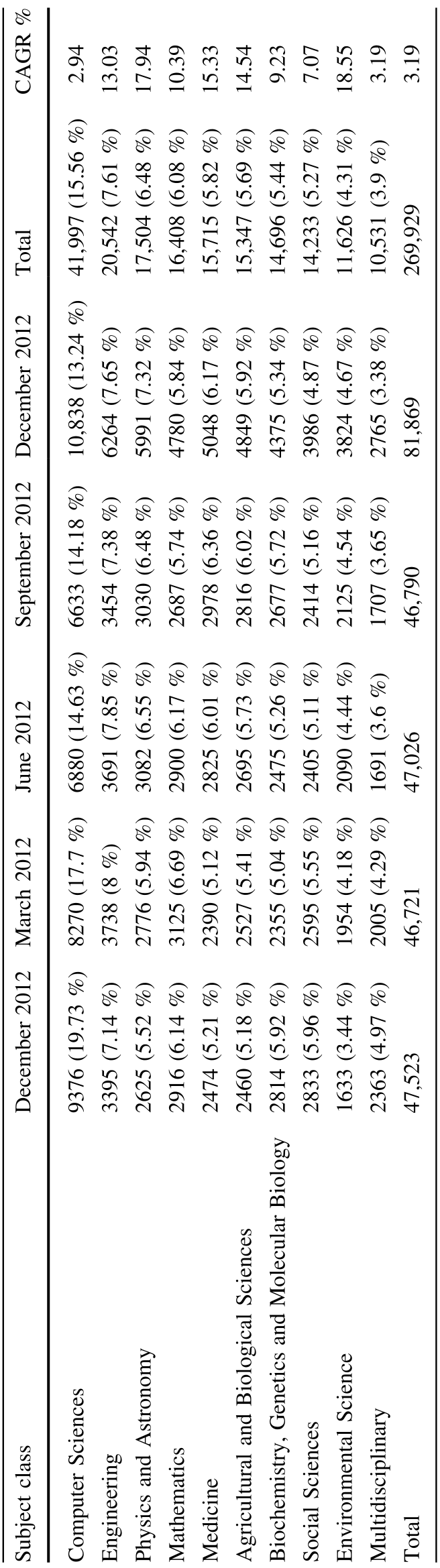
In the early stages, Computer Science held a massive hegemony (nearly 20% of labels). While other fields like Environmental Science and Physics are "catching up" (as shown in the CAGR figures below), the platform remains technically biased.
3. The Brazilian Wave
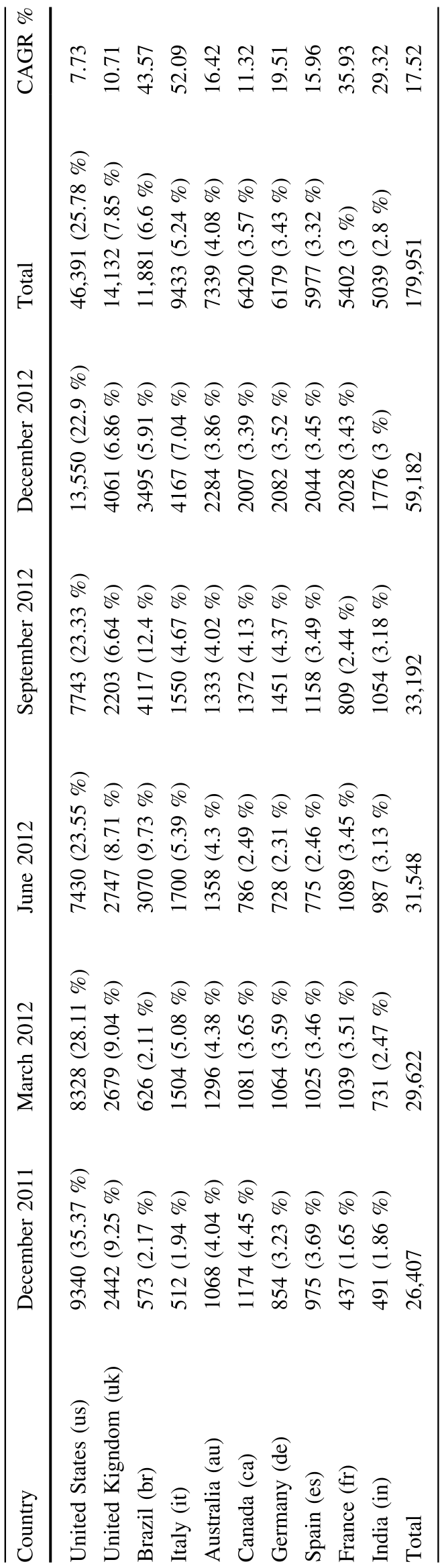
One of the most striking findings is the "wave-like" settlement. While US and UK institutions (Harvard, MIT) led the first wave, there was a sudden explosion from Brazil. The Universidade de São Paulo (USP) grew its profile count by nearly 60% in a single year, highlighting how institutional pressure or cultural adoption can fundamentally shift the platform's geography.
Critical Insight: Why This Matters
The fundamental takeaway for the bibliometric community is Caution. Because GSC is populated by "waves" of specific institutions and young researchers, its median metrics (Median Articles: 26, Median h-index: 6) do not represent the "average scientist."
If a university uses GSC for hiring or promotion without normalizing for these biases, they are comparing candidates against a skewed baseline. Ortega concludes that we should move away from random sampling in these networks and toward stratified approaches that account for these demographic fluctuations.
Conclusion
Google Scholar Citations is more than a search engine; it is a volatile social site subject to rapid demographic shifts. While it provides unprecedented access to individual performance data, its inherent biases regarding age, discipline, and geography mean it should be treated as a subset of the scientific world rather than a complete map.