
History-Embedded AFT: Decoding the Dynamics of Nursing Home Length of Stay
14994_A History Embedded Accelerated Failure Time Model to Estimate Nursing Home Length of Stay.
This paper introduces a parametric Accelerated Failure Time (AFT) survival model to estimate Nursing Home (NH) Length of Stay (LOS) by embedding spatial-temporal transition history and frailty terms. It successfully characterizes complex care transitions within a Long-Term Care (LTC) network, utilizing a large urban elderly cohort from the OATS database.
TL;DR
Researchers have developed a sophisticated survival analysis framework that moves beyond "black-box" cost modeling in Long-Term Care (LTC). By embedding a patient’s recent care history and accounting for "frailty" (individual tendencies for frequent transitions), the History-Embedded Accelerated Failure Time (AFT) model provides a precise tool for predicting how long an elderly patient will stay in a nursing home before moving to their next destination.
Deep Dive into the Motivation
Why is predicting Nursing Home (NH) Length of Stay (LOS) so difficult? Most current research looks at the system through the lens of aggregate Medicaid spending—essentially treating the healthcare journey as a single, opaque block.
The authors argue that to optimize LTC resources, we must understand the granularity of movement. They identify three missing links in previous SOTA (State Of The Art) methods:
- Simulator Incompatibility: Popular Cox-PH models are great for risk ratios but terrible for building simulators because they don't explicitly estimate time.
- Recurrent Event Bias: Patients often cycle between hospitals and nursing homes. Ignoring this correlation leads to "chopped up" data that biases the average stay.
- The Power of History: Where a patient was 30 or 90 days ago is a massive indicator of how long they will stay now.
Methodology: The AFT Framework & History Embedding
The team chose the Accelerated Failure Time (AFT) model over Proportional Hazards. In AFT, covariates act as "accelerants" or "decelerants" of time itself—a concept far more intuitive for clinical practitioners than hazard ratios.
1. Spatial-Temporal Covariates
The model introduces a "lag" variable, , which captures the sequence of care settings (Hospital, Home, etc.) visited within a tunable time window ().
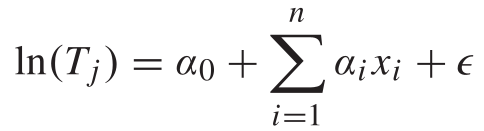 (Formula 1: The log-linear relationship of the AFT model)
2. Frailty Modeling
To handle patients who are "frequent flyers" in the system, the authors added a frailty term (). This term acts as a random effect that accounts for an individual's unobserved tendency to transition faster or slower than the average population, effectively "weighting" recurrent events to prevent bias.
Key Results & Evidence
The model was validated using the OATS database (1,128 patients).
- The History Effect: For the NH-to-Hospital transition, a 90-day history window proved most informative. If a patient came from a hospital recently, their NH stay was significantly shorter (Factor of 0.458).
- Destination Matters: A fascinating finding was that the same disease can have opposite effects. Renal disease shortened stays when the destination was a hospital but doubled them when the destination was Home Health care.
- Distribution Check: The study found that while the Weibull distribution is often the "default" for survival, transitions to death were better modeled by a Log-logistic hazard function.
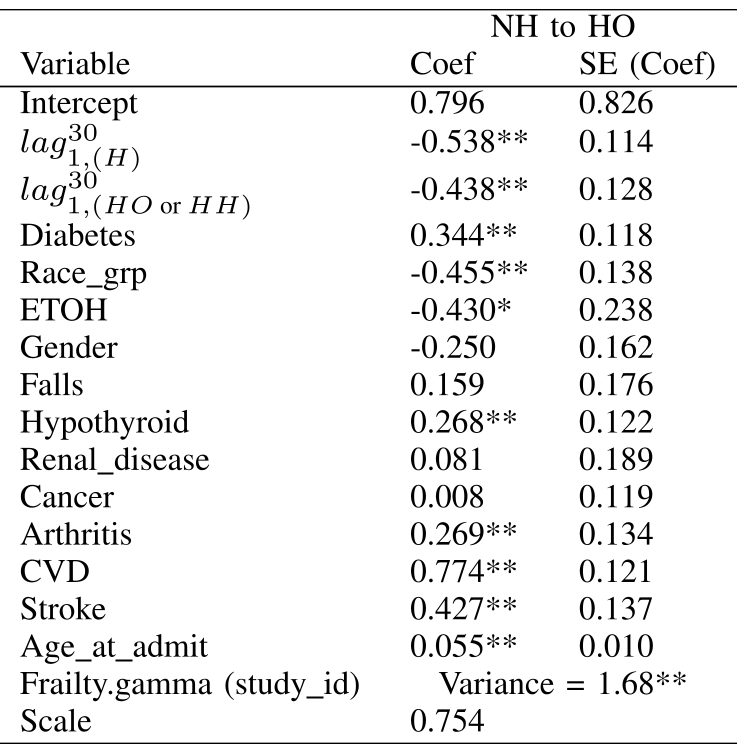 (Table III: Significant predictors for NH to Home transitions)
Critical Insight & Future Outlook
The true value of this work lies in its non-Markovian approach. By proving that the future stay depends on the past history (and not just the current state), the authors challenge simpler transition models.
Limitations
- Data Specificity: The results are based on a Midwestern US urban cohort; generalizability to rural or international systems remains to be tested.
- Predictive Horizon: As noted in the IAUC analysis, the model is highly accurate for the first year but may degrade for long-term multi-year predictions.
Conclusion
This paper sets a new standard for operational LTC modeling. By moving from aggregate costs to individual-level survival time parameterized with history and frailty, it provides the mathematical foundation for "Intelligent Decision Support Systems" in healthcare capacity planning.