
Breaking the Speed Barrier: Optimal Accelerated Gradients for Trace Norm Minimization
An accelerated gradient method for trace norm minimization
2009-06-14
Summary
Problem
Method
Results
Takeaways
Abstract
This paper introduces an accelerated gradient method for minimizing smooth loss functions regularized by the trace norm (nuclear norm). The authors propose two algorithms: an Extended Gradient Method (EGM) with a convergence rate of O(1/k) and an Accelerated Gradient Method (AGM) that achieves the optimal O(1/k²) rate for smooth optimization.
## TL;DR
Trace norm (nuclear norm) regularization is the "gold standard" for inducing low-rank structures in matrices, yet its non-smoothness often leads to sluggish optimization. This paper presents an accelerated proximal gradient framework that pushes the convergence rate from the standard $O(1/\sqrt{k})$ to the optimal $O(1/k^2)$, essentially making trace norm minimization as fast as smooth gradient descent.
## The Motivation: Moving Beyond "Black-Box" Complexity
In tasks like matrix completion (think Netflix prize) or multi-task learning, we want to find a weight matrix $W$ that is low-rank. Since the $rank(W)$ function is combinatorial and NP-hard, we relax it using the **trace norm** $\|W\|_*$ (the sum of singular values).
From an optimization perspective, the trace norm is convex but **non-smooth**. Traditionally, first-order "black-box" methods (which ignore the internal structure of the objective) are limited to a convergence rate of $O(1/\sqrt{k})$. For a high-precision solution, this is painfully slow.
The authors' insight is simple but powerful: **Don't treat the trace norm as a black box.** By exploiting its specific structure through its proximal operator, we can achieve the same convergence rates as smooth functions.
## The Core Mechanism: Proximal Reinforcement
The authors propose moving from a simple subgradient approach to a **Proximal Gradient** approach.
### 1. The Extended Gradient Method (EGM)
Instead of just following the gradient of the loss $f(W)$, EGM solves a linearized sub-problem regularized by a proximal term at each step. The solution to this sub-problem is elegantly found via **Singular Value Thresholding**:
1. Compute the SVD of the current gradient-updated matrix.
2. Apply a soft-thresholding operator to the singular values: $\max(0, \sigma_i - \lambda)$.
3. Reconstruct the matrix.
This provides a convergence rate of $O(1/k)$.
### 2. The Accelerated Gradient Method (AGM)
To reach the theoretical limit of $O(1/k^2)$, the authors adopt Nesterov’s acceleration scheme. Instead of performing the proximal step at the previous iteration $W_k$, they perform it at a **search point** $Z_k$:
$$Z_k = W_k + \beta_k(W_k - W_{k-1})$$
This "momentum-like" term uses information from previous iterates to anticipate the trajectory of the optimization, leading to much faster convergence.

*The convergence proof ensures that the objective gap shrinks quadratically with the number of iterations.*
## Experimental Evidence: Speeding Up Multi-Task Learning
The authors tested their algorithms on several datasets, including handwriting recognition (Letters, Digits) and gene classification (Yeast).
**Key Findings:**
* **Stability:** AGM consistently outperforms even specialized solvers like Multi-task Feature Learning (MFL).
* **Early Convergence:** As shown in the convergence plots, AGM reaches a low objective value in significantly fewer iterations than EGM.
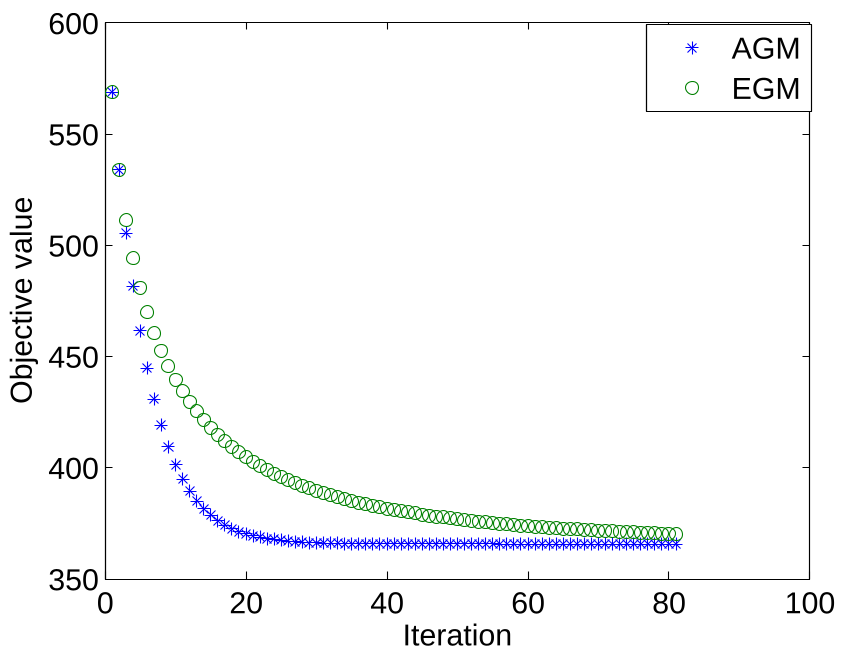
*Figure 1: Objective value vs. Iterations. Note how the Accelerated Method (AGM in blue) drops much faster than the Extended Method (EGM in red).*
## Critical Analysis & Takeaways
This work is a cornerstone in making low-rank matrix optimization practical. By bridging the gap between non-smooth optimization and Nesterov’s optimal rates, it allows researchers to handle much larger matrices than previously possible with interior-point methods.
**Limitations:**
The primary bottleneck remains the **SVD computation** at each iteration. For extremely high-dimensional matrices (e.g., $10^6 imes 10^6$), even a fast proximal method struggles if a full SVD is required. Future developments—some of which the authors foreshadowed—involved randomized SVD and partial decompositions (like Lanczos) to only find singular values above the threshold.
**Conclusion:**
This paper is a masterclass in exploiting mathematical structure to bypass general complexity bounds. It proves that the "non-smoothness" of the trace norm is not a fundamental speed limit, provided you have the right algorithmic tools.