
Graphmania: Bridging the Knowledge Gap in Open Source Social Networks
Accelerating cross-project knowledge collaboration using collaborative filtering and social networks
The paper introduces Graphmania, a visualization tool designed to accelerate cross-project knowledge collaboration in Free/Open Source Software (F/OSS) communities. By combining Collaborative Filtering and Social Network Analysis, it maps relationships between developers and projects on SourceForge to help users identify potential experts and relevant knowledge sources.
TL;DR
Open-source development often suffers from a "lonely island" effect where small projects struggle to find help. Graphmania is a tool that mines SourceForge data to create social graphs of developers and projects. By using Collaborative Filtering, it identifies hidden links between separate groups, helping developers answer two critical questions: "Who should I ask?" and "What can I ask?"
The "Rich-Get-Richer" Dilemma in Open Source
While the F/OSS world is vast, it is surprisingly fragmented. The authors' analysis of 90,000 SourceForge projects revealed a stark reality:
- 66.7% of projects have only one developer.
- 77.3% of developers participate in only one project.
This creates a bottleneck. If you are a solo developer on a niche project and hit a bug, who do you turn to? While elite projects like Apache or Linux have dense networks of experts, the "long tail" of small projects is isolated. The existing infrastructure supports in-project talk but ignores cross-project synergy.
Methodology: Mapping the F/OSS Galaxy
The authors propose a dual-engine approach to solve this isolation.
1. Collaborative Filtering (CF)
Instead of recommending books (like Amazon), the system recommends people and projects.
- Developer Similarity: If Developer A and Developer B both work on Project X and Project Y, they are highly similar.
- Project Similarity: If many developers work on both Project M and Project N, those projects are likely technically related.
2. Social Network Visualization
Using a technique called Hyperbolic Visualization (Focus + Context), Graphmania allows users to zoom into specific clusters while seeing how they connect to the broader ecosystem.
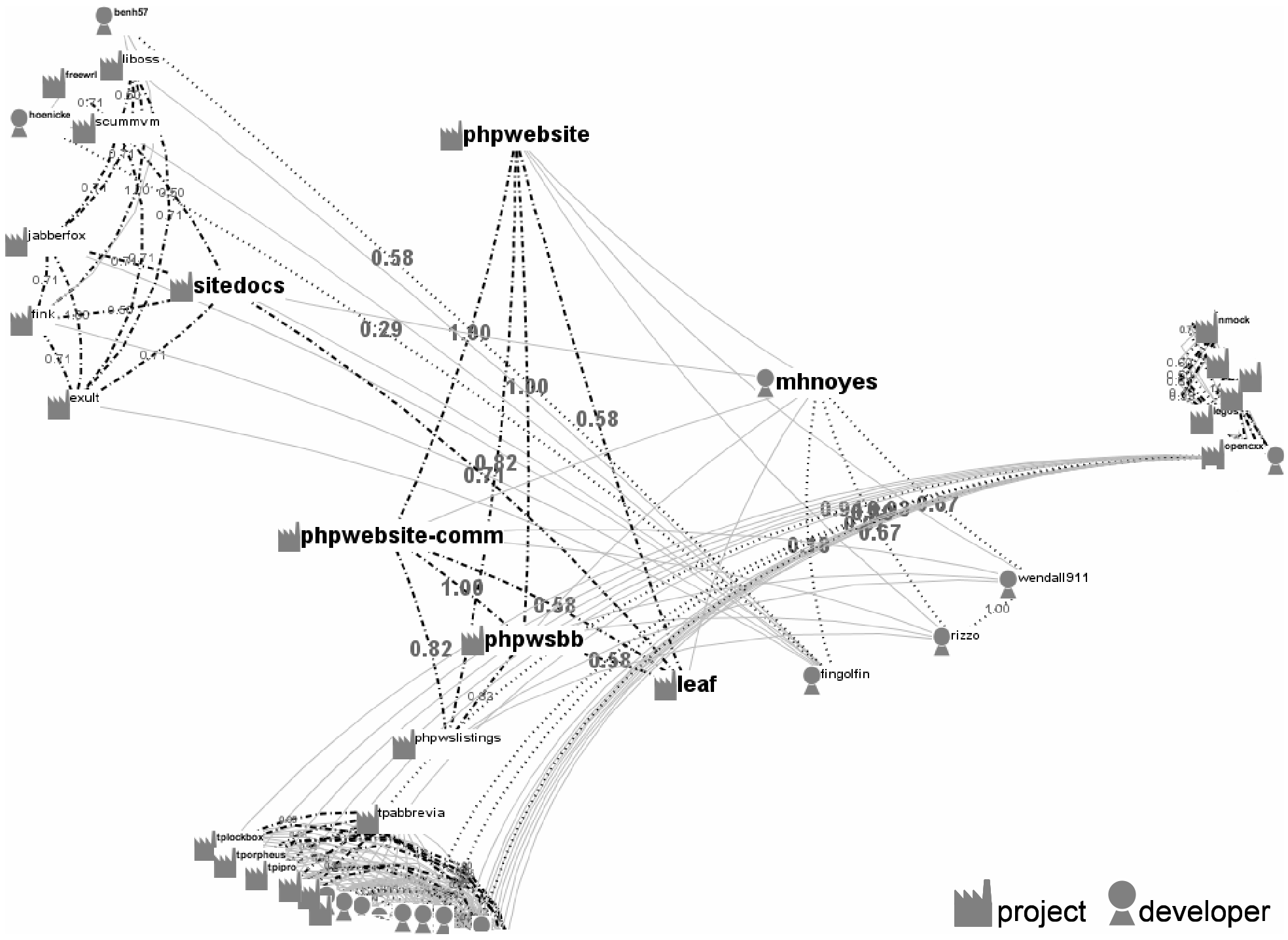 Figure 1: Integrated network showing how developers act as bridges between disparate software projects.
Insights from the Data
The case studies provided by the authors yield fascinating insights into how open-source software is organized:
- The Linchpin Developer: Certain developers act as "nodes of transit." Identifying these individuals (see Figure 2) allows a developer in one community to reach out to a completely different community.
- Functional Clustering: Projects with similar goals naturally cluster together through shared memberships. For instance, the "TurboPower" cluster emerged clearly in the visualization, showing that developers with specific library expertise tend to stick together.
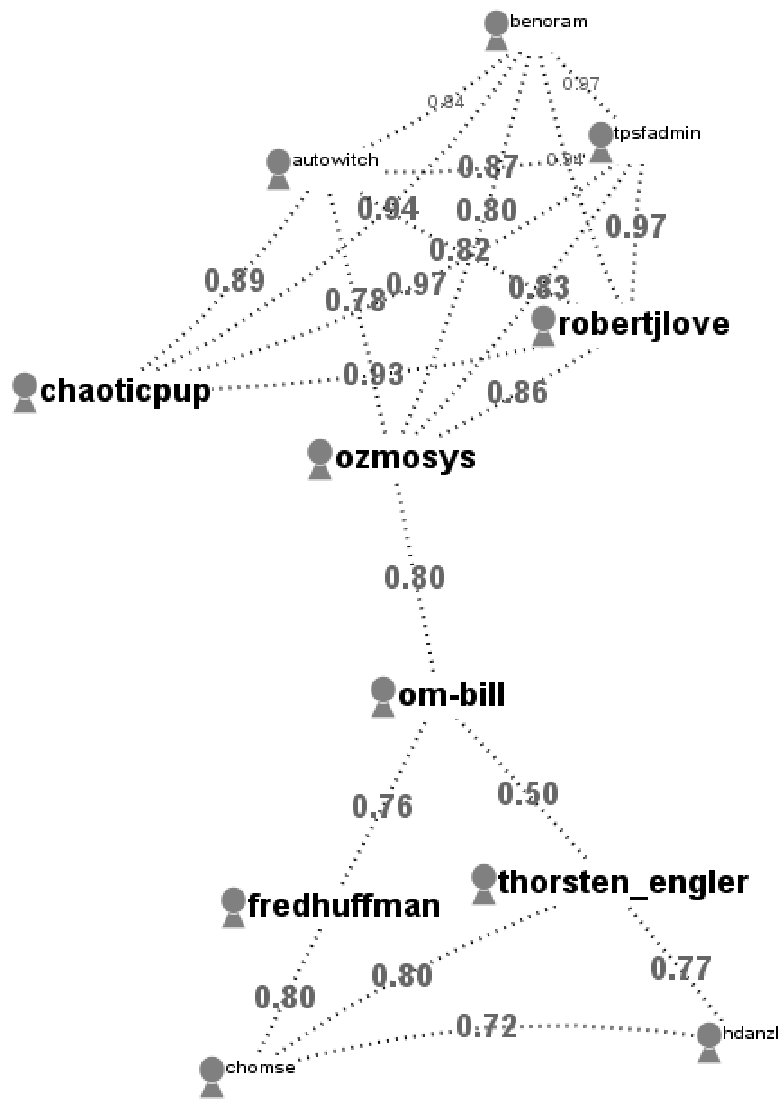 Figure 2: Developers acting as linchpins between two otherwise isolated social networks.
Critical Analysis & Future Outlook
Graphmania represents an early and vital attempt to treat the open-source world as a unified knowledge graph rather than a collection of silos.
Strengths:
- It moves beyond simple "keyword searching" for help.
- The use of hyperbolic geometry effectively handles the visual clutter of 90,000+ nodes.
Limitations & Challenges:
- Sustainability: The study notes the risk of "information overload" for elite developers. If a tool makes it too easy to find an expert, that expert might be overwhelmed with questions (Project "Rich" vs. Project "Poor").
- Temporal Dynamics: Development interests change over time; a developer who was an expert in 2005 might not be active or relevant in 2006.
Conclusion
This work highlights that the "code" is only half of the open-source value proposition; the other half is the social capital of the developers. By visualizing cross-project links, we can turn a fragmented collection of repos into a collaborative global laboratory.