
KisanOne: Revolutionizing Indian Agriculture through a Unified AI and IoT Stack
Accelerating public service delivery in India: application of internet of things and artificial intelligence in agriculture
This paper proposes KisanOne, an open and integrated national-level agriculture stack for India, designed to unify fragmented digital initiatives. It leverages Internet of Things (IoT) for real-time data collection and Artificial Intelligence (AI) for predictive analytics to accelerate public service delivery and double farmers' income.
TL;DR
To solve the chronic issues of low crop yields and information asymmetry in Indian agriculture, researchers have proposed KisanOne. This is an integrated National Agriculture Stack that merges the physical world (via IoT sensors) with "connected intelligence" (via AI) to provide farmers with real-time, actionable insights through a single, API-driven platform.
Perspective: From Digitization to "Connected Intelligence"
While India has launched numerous digital portals like mKisan and Agrimarket, they often function as "information islands." The core motivation behind this research is that datasets have little intrinsic value without the ability to extract meaning. The paper argues that the leap from simple e-governance to empowered farming requires shifting from passive data repositories to active, "connected intelligence" where AI processes real-time data from IoT-enabled fields.
Methodology: The KisanOne Architecture
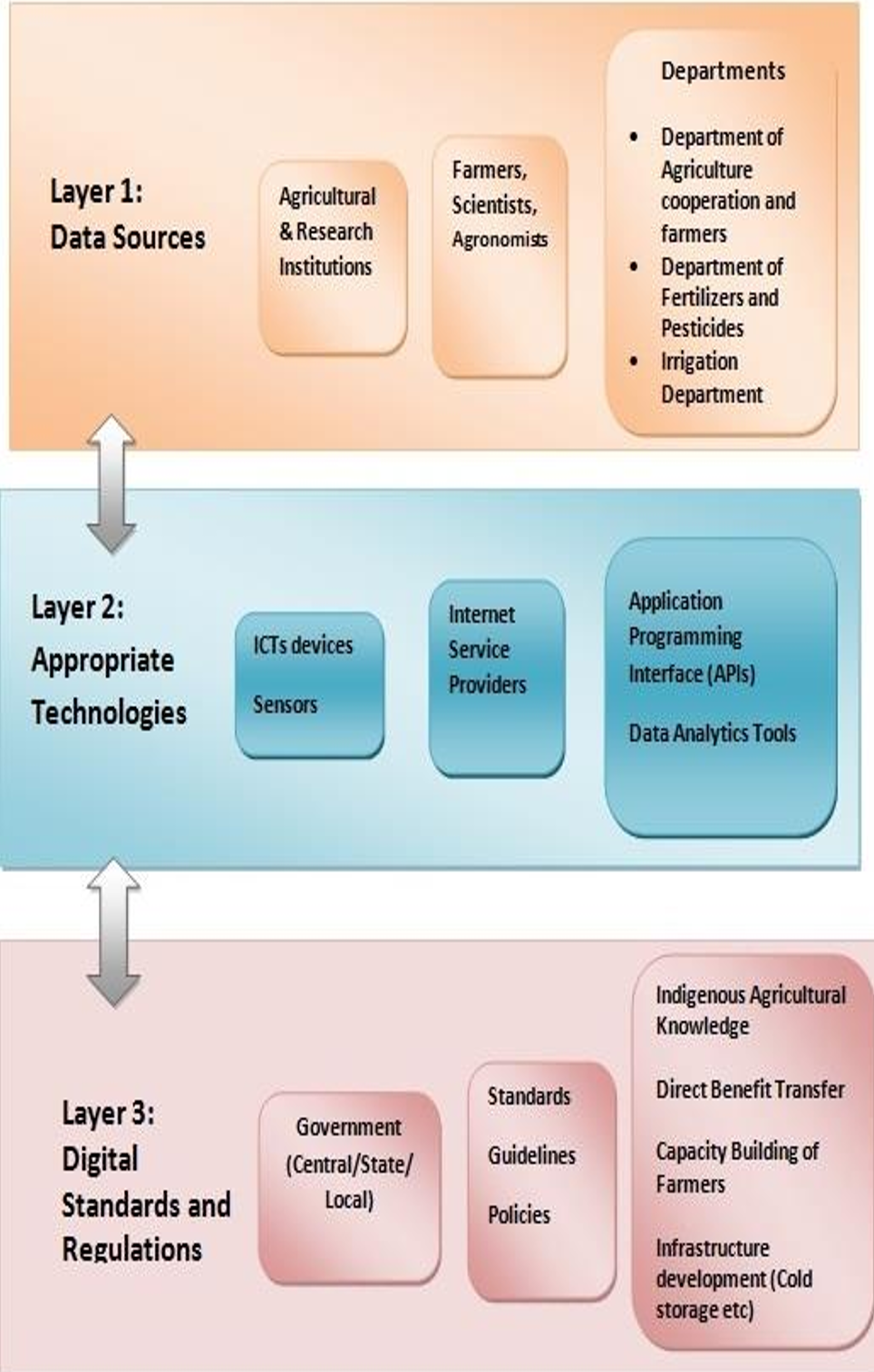
The authors propose a three-layer framework designed to bridge the "AS-IS" (fragmented) and "TO-BE" (unified) scenarios.
1. The Data Source Layer
This layer acts as the "sensory system" of the stack. It ingests data from:
- IoT Devices: Soil moisture, humidity, and leaf wetness sensors.
- Government Portals: Fertilizer Monitoring Systems (FMS) and Soil Health Cards.
- External Sources: Satellite imagery and meteorological reports.
2. The Appropriate Technologies Layer
This is the "brain" where AI/ML algorithms reside.
- Computer Vision: Processing photos of toilets (Swacch Bharat) or crop leaves to detect disease.
- Predictive Analytics: Using Deep Learning to forecast market prices and pest outbreaks.
- Cloud/Fog Computing: Ensuring data is processed securely and accessible via APIs.
3. Digital Standards & Regulations
To avoid the "technological determinism" trap, this layer focuses on cybersecurity, ISO standards, and data sovereignty, ensuring that the system is inclusive and legally robust.
Real-World Impact & Results
The paper cites several successful localized applications that KisanOne aims to scale:
- Smart Irrigation: Using IoT to remotely control water pumps via SMS or missed calls.
- Disease Detection: Systems in Kenya and India using AI to identify potato blight and other viruses early.
- Economic Equity: Startups like Ninja Cart and Fasal are already showing that data-driven links between farmers and retailers can eliminate high-profit middlemen.
- Target Performance: Moving the needle on India's average yield (currently ~3075 kg/ha) by optimizing resource use (water, fertilizer, seeds).
Critical Analysis: Navigating the Challenges
Despite the "utopian" vision, the authors are candid about the risks:
- Data Vulnerability: Large-scale data collection (data-guzzling) increases the surface area for cybercrimes.
- Market Manipulation: There is a risk that large agritech firms could harvest this data to gain unfair competitive advantages or manipulate commodity prices.
- Digital Divide: Without capacity building and local-language interfaces, the "stack" might only benefit literate, wealthy farmers.
Conclusion: A Culture of Hope
The value of KisanOne lies in its holistic integration. By treating agriculture as a unified data ecosystem rather than a series of disconnected problems, India can transition from traditional farming to "Smart Farming." For researchers and policymakers, the takeaway is clear: technology is a powerful tool for public service delivery, but only when supported by a robust, interoperable, and secure national architecture.