
Beyond Solitary Sensing: The Rise of Collaborative Mobile Crowdsourcing (CMC)
ACCEPTED FROM OPEN CALL
The paper introduces Collaborative Mobile Crowdsourcing (CMC), a novel paradigm in IoT that shifts from independent data collection to team-based coordination for complex tasks. It provides a comprehensive taxonomy, discusses team formation strategies (Platform-based, Leader-based, and Hybrid), and evaluates recruitment algorithms like ILP, GA, and PSO.
Executive Summary
TL;DR: This paper explores the evolution of Mobile Crowdsourcing (MC) into Collaborative Mobile Crowdsourcing (CMC). While traditional MC treats workers as independent data points, CMC treats them as cohesive teams. The authors define a new taxonomy for this paradigm, analyze how social connectivity influences task success, and demonstrate that hybrid recruitment strategies—combining platform data with local leadership—provide the best balance between skill acquisition and operational trust.
Context: This work positions itself as a structural bridge between "Mobile Crowd-sensing" (data collection) and "Mobile Crowd-working" (complex task execution), specifically within the Decentralized IoT and Smart City domains.
The Problem: The "Silent Worker" Limitation
Traditional Mobile Crowdsourcing has hit a ceiling. Current SOTA methods excel at "non-cooperative" tasks—like a thousand users independently uploading temperature data. However, if a task requires coordination (e.g., a team of drones and smartphones collaborating to estimate GPS positions in a tunnel), traditional models fail. In these scenarios:
- Inductive Bias of Independence: Systems assume workers don't need to talk to each other.
- Skill Mismatch: Complex tasks require heterogeneous skills (e.g., one person provides a camera, another provides high-speed computing).
- Trust Deficit: Without social ties, decentralized teams often collapse due to a lack of coordination or accountability.
Methodology: Structuring the Crowd
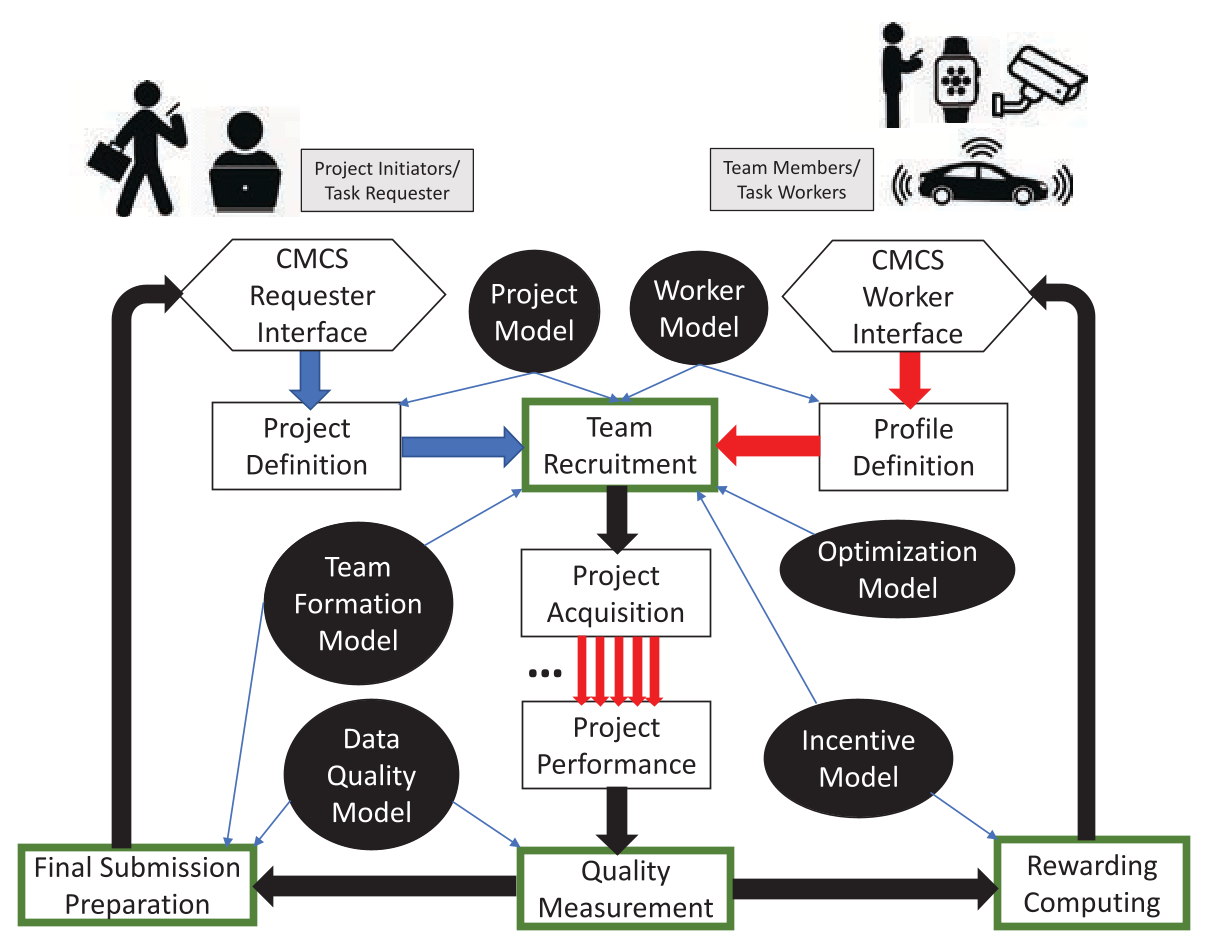
The authors propose a CMC Workflow (see architecture below) that moves the platform from a simple dispatcher to a sophisticated team-building orchestrator.
Three Strategies for Team Formation
The core of the methodology lies in who holds the "Recruitment Power":
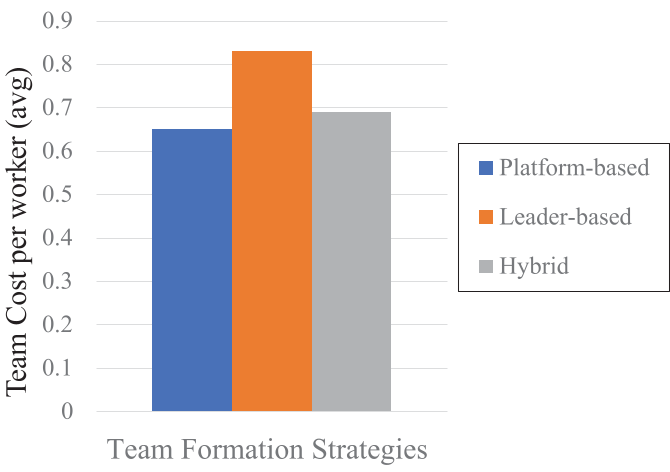
- Platform-based: The central server uses its global database (history, profiles) to pick the best candidates. It optimizes for the highest raw skill but suffers from high "Recruiter Uncertainty" regarding how well These strangers will actually work together.
- Leader-based: The platform picks a team leader, who then recruits from their own social circle. This leverages social trust and local knowledge, drastically reducing uncertainty, though often at the cost of finding the "absolute best" technical experts.
- Hybrid: A two-tier approach where leaders suggest candidates and the platform validates them using global metrics.
Experimental Insights: Skills vs. Social Ties
The researchers conducted Monte Carlo simulations comparing Integer Linear Programming (ILP) (the optimal but slow baseline) with meta-heuristics like Genetic Algorithms (GA) and Particle Swarm Optimization (PSO).
Key Findings:
- The Trade-off: As social relationship strength increases, skill levels in leader-based models tend to be lower than platform-based models. This is because leaders "hire their friends" rather than the global top performers.
- Algorithm Efficiency: While ILP is the gold standard for quality, the Genetic Algorithm (GA) proved to be the most viable for real-time CMC, maintaining an approximation factor of 1.15 relative to ILP while being significantly faster.
Critical Analysis & Conclusion
Takeaway
The shift toward CMC is essential for the next generation of Smart Cities. The paper brilliantly points out that in collaborative environments, social connectivity is a technical asset, not just a human preference. It reduces the "marginal error" that naturally increases when multiple workers' outputs are combined.
Limitations & Future Work
While the paper provides a robust framework, it leaves two major areas open for further exploration:
- Spatial Complexity: Most simulations assume static locations. Real-world CMC (like search and rescue) requires "Spatial-CMC," where team members are constantly moving.
- Privacy: Recruiting based on social networks and real-time location features raises significant privacy concerns that require Edge-based anonymization techniques.
In conclusion, CMC represents the maturation of the IoT crowd, moving from a collection of "individual sensors" to a decentralized "collaborative workforce."