
LBSNS Privacy Audit: Why Your Check-ins Are More Dangerous Than You Think
Analysis of access control mechanisms for users' check-ins in Location-Based Social Network Systems
This paper presents a comprehensive analysis of access control mechanisms in major Location-Based Social Network Systems (LBSNSs), including Facebook Places, Foursquare, Google Latitude, and Yelp. The authors generalize a formal check-in model and an access control policy model to evaluate and compare the privacy-preserving capabilities of these platforms.
TL;DR
While Location-Based Social Network Systems (LBSNSs) like Foursquare and Facebook Places offer social rewards, they often fail to protect users' physical safety. This paper systematically decomposes the check-in mechanism into formal mathematical models to expose critical security gaps. The verdict? Most systems treat your location data as an "all-or-nothing" asset, lacking the granular control needed to prevent serious real-world risks like the "Please Rob Me" phenomenon.
Background & Positioning
In the landscape of cybersecurity research, this work serves as a foundational "Privacy Audit." It moves beyond anecdotal privacy concerns to provide a structured taxonomical analysis of how LBSNSs handle (or mishandle) user data. It sits at the intersection of Access Control Theory and Social Network Analysis, highlighting a lag between rapid feature deployment and robust security engineering.
The Problem: The "All-or-Nothing" Trap
The authors identify a fundamental flaw in current LBSNS logic: Atomicity. When you check in, the system treats your location, your companions, the timestamp, and your comments as a single bundle.
- Prior Work Limitation: Earlier studies focused on what data is collected; this paper focuses on the logic of control.
- The Motivation: Incidents where users were mugged or their homes were invaded because "public" check-ins inadvertently broadcasted their absence from home.
Methodology: The Formal Check-in Framework
To evaluate these systems objectively, the authors propose two formal models:
1. The Check-in Model
A check-in is defined as:
- : The owner.
- : The physical coordinates/place.
- : The temporal dimension (timestamp).
- : Other users (co-location).
- : Attached messages or tips.
2. The Access Control Policy Model
A policy is defined as:
This model evaluates where the data is shared (), who can see it (), what they can do (), for how long (), and whether the access is allowed or denied ().
 Figure 1: Comparison of resource availability across different platforms.
Key Findings & Comparisons
The analysis reveals a startling lack of parity between platforms:
- Facebook Places: Currently the "SOTA" in privacy among the four, allowing for specific friend groups and "Deny" rules.
- Foursquare & Yelp: Highly restrictive. Users often cannot delete or modify a check-in once it's live. This "permanent record" creates a massive trail of historical mobility data.
- The Cross-Platform Leak: A major vulnerability identified is the lack of Policy Consistency. If you set a check-in to "Friends Only" on Foursquare but cross-post it to a public Twitter feed, your Foursquare privacy setting is effectively neutralized.
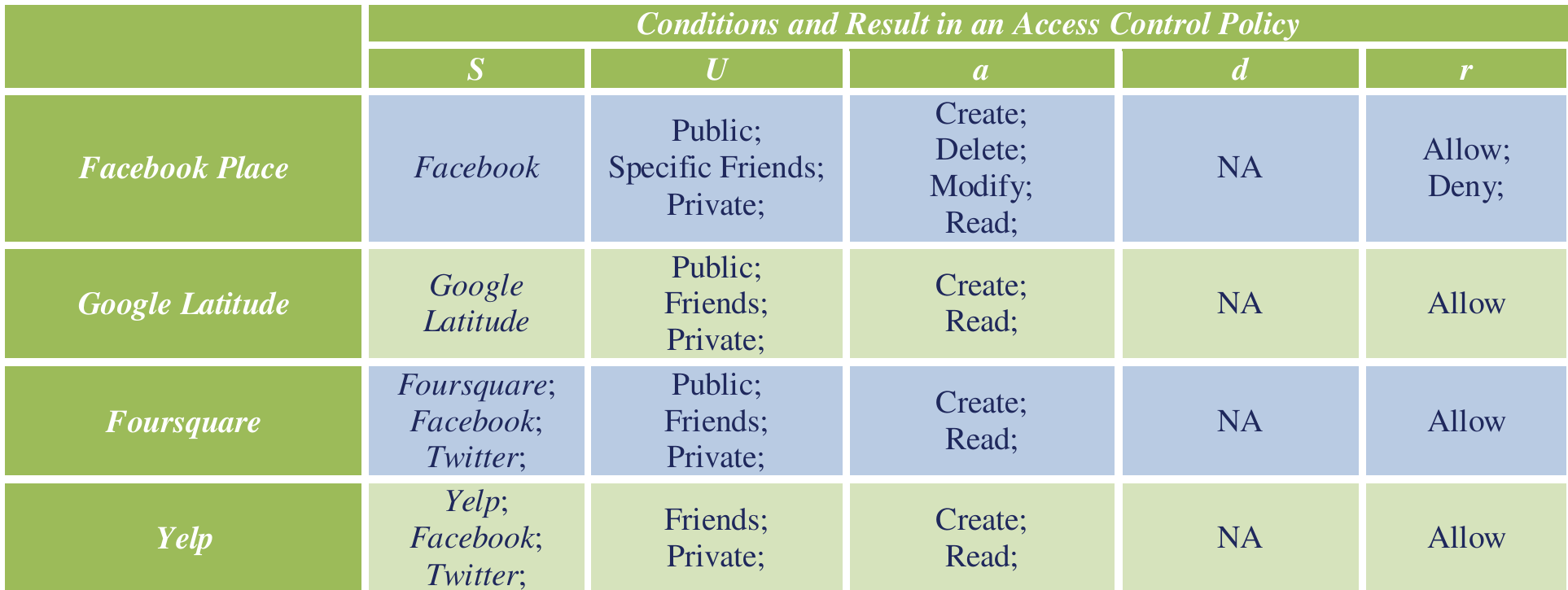 Figure 2: Summary of conditions and results in access control policies.
Critical Insight: The "Secret Friend" Problem
The paper introduces a compelling "Why" regarding fine-grained control. Consider the Co-location Privacy issue: if User A checks in with User B, User A's privacy settings might expose User B's location against their will. Current systems allow a user to "untag" themselves, but only after the damage is done. The authors argue for a Policy Negotiation Mechanism—a proactive handshake before location data is published.
Conclusion & Future Outlook
The study concludes that today’s LBSNSs are built for visibility, not security. For researchers and developers, the takeaways are clear:
- Move away from atomic objects: Allow users to hide the timestamp while sharing the location.
- Implement Duration (): Check-ins should have an expiry date by default.
- Bridge the System Gap: We need universal privacy protocols that follow the data across different social APIs.
As we move toward a world of "Always-on" augmented reality and deeper geo-social integration, the formal models proposed here provide a blueprint for building systems that respect the boundary between social sharing and physical safety.