
The Collaboratorium: Scaling Collective Intelligence for Global Challenges
Achieving Collective Intelligence via Large-Scale On-line Argumentation
The paper explores the transition of argumentation support tools from small-scale facilitated groups to large-scale online environments. It proposes the "Collaboratorium," a system designed to harness collective intelligence for systemic global problems like climate change by structuring deliberations into issues, options, and arguments.
TL;DR
Humanity faces "systemic problems" like climate change that require global deliberation, yet our current tools (wikis, forums, social media) are ill-equipped for complex decision-making. Mark Klein of MIT proposes a shift toward Large-Scale Online Argumentation, moving from chaotic threads to structured "Argument Maps." By separating the acts of contributing ideas from structuring them, we can filter the "wheat from the chaff" and achieve consensus at a global scale.
The "Low Value Density" Crisis
We live in an era of unprecedented connectivity, yet our digital tools for collective intelligence are failing. Wikis are great for facts but break down under controversy. Forums are plagued by repetition and "hot-take" hijacking. The author identifies a core paradox: as more people join a digital discussion, the signal-to-noise ratio typically plummets.
Traditional Argumentation Tools—which break down discussions into Issues, Options, and Arguments—have existed for years, but they typically require a human facilitator to keep things organized. This doesn't scale to thousands of users.
Methodology: From Chaos to Structure
The paper proposes the Collaboratorium, a web-based system designed to handle the "large-scale" problem through several key technical and social shifts:
1. The Structure of Reasoning
Instead of linear threads, the system uses a recursive network of:
- Issues: The core questions (e.g., "How should we reduce carbon emissions?").
- Options: Potential solutions.
- Arguments: Evidence that supports or detracts from those options.
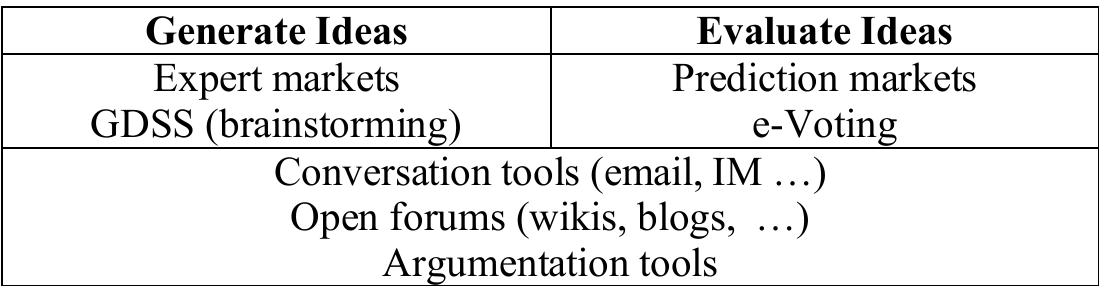 Table 1: Positioning Argumentation Tools against other Collective Intelligence technologies.
2. The "Continuum of Formalization"
One of the most profound insights in the paper is recognize that not everyone is an expert in logic. The system allows a division of labor:
- The Crowd: Posts informal prose and "raw" opinions.
- The Editors: Specialized users (analogous to Wikipedia editors) who restructure that prose into a formal argument map.
3. Solving the Scaling Issues
The author outlines eight design pillars to prevent the system from collapsing, most notably:
- Redundancy Management: Making it easy for users to find if their point has already been made.
- Argument-Based Reputation: A user’s trust score isn't just based on "likes," but on whether their arguments align with known high-quality evidence or expert logic.
Experiments and Insights
While the paper is early-stage (positional), it introduces the Collaboratorium interface (Figure 1).
 Figure 1: A snapshot of the Collaboratorium argument capture system.
The author's core thesis is that argumentation scale is sub-linear. While 10,000 people might comment on a topic, there are rarely 10,000 unique arguments. By capturing the essence of the debate rather than the volume of the noise, the "Collaboratorium" approach actually becomes more valuable as it grows, whereas traditional forums become less usable.
Critical Analysis & Conclusion
Takeaway
The shift from "conversation" to "structured rationale" is the missing link in digital democracy. This paper provides a roadmap for building tools that don't just host talk, but catalyze decisions.
Limitations
- Incentives: Getting people to use a structured tool is harder than getting them to post a tweet. The "editor" role requires significant effort.
- Consensus AI: The paper focuses on human editors, but today’s LLMs (which were not mature when this was written) could potentially automate the "restructuring" phase, solving one of the paper's largest hurdles.
Future Outlook
The concepts in the Collaboratorium are more relevant than ever. In an age of AI, the ability to map "systemic problems" into verifiable argument trees could be the key to aligning human values with global action.