
Honey-Trapping the Cheaters: A New Paradigm for LBSN Security
ACM HotMobile 2013 poster: detecting fake check-ins in location-based social networks through honeypot venues
This paper introduces a novel honey-pot based detection mechanism to identify fake check-ins in Location-Based Social Networks (LBSNs). By deploying "Honeypot Venues" (HVs)—non-existent locations designed to be highly attractive to cheaters—the system can flag users who claim presence at these locations without physical proximity.
TL;DR
Location-based Social Networks (LBSNs) like Foursquare and Yelp face a persistent threat: fake check-ins. While previous solutions required expensive hardware or trusted WiFi points, a team from the University of Pittsburgh has proposed a psychological approach. By creating "Honeypot Venues"—fake locations that look too good for a cheater to pass up—they can catch bad actors red-handed using their own greed against them.
Context & Motivation: The "Gamification" Backfire
LBSNs thrive on gamification. Users earn points, badges, and "Mayorships" for checking into physical locations. However, this creates a strong incentive for "game cheaters" to spoof their GPS coordinates to climb leaderboards or unlock rewards.
The problem is that current defense mechanisms are either:
- Infrastructure Heavy: Requiring specialized sensors or trusted WiFi routers to issue "location proofs."
- Hardware Dependent: Limited by the specific mobile device capabilities.
The authors argue that we don't need to track the user better; we just need to build better traps.
Methodology: Designing the Perfect Trap
The core of the paper is the Honeypot Venue (HV). Since honest users only check into places they actually visit, they should—in theory—never check into a venue that doesn't exist. Cheaters, who scan for high-value targets regardless of physical presence, are easily baited.
The Behavioral Model
The authors define the probability of a cheater checking into a honeypot () as a function of the venue's features (): Where:
- : Number of points earned.
- : Probability of becoming the "Mayor."
The Feedback Loop
The brilliance of this method lies in its evolution. By observing which HVs are most successful at catching cheaters, the system uses a feedback loop (similar to Reinforcement Learning) to refine the "attractiveness" of the fake venues.
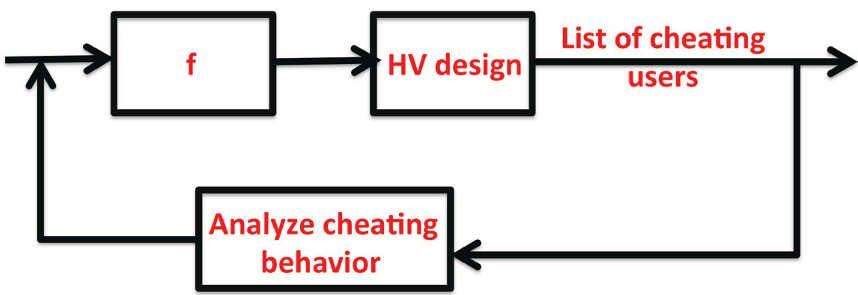 Figure 1: The iterative process of refining honeypot attractiveness based on cheater behavior.
Identifying Cheaters vs. Mistakes
To avoid "false positives" (honest users checking in by mistake), the authors propose a Suspiciousness Level . This is calculated based on:
- : Total check-ins to HVs.
- : Number of distinct HVs visited.
By setting a threshold , the system can confidently flag systematic cheaters while ignoring the occasional accidental click from a legitimate user.
Critical Insight & Results
This approach shifts the battleground from technical verification (Is the GPS signal real?) to intent verification (Why would a user visit this non-existent, high-reward place?).
Preliminary results highlight that:
- Game cheaters exhibit predictable patterns that differ significantly from organic foot traffic.
- The system is far more scalable than previous location-proof protocols (e.g., Saroiu & Wolman) because it lives entirely in the software layer.
Conclusion & Future Outlook
This poster presentation serves as a foundational step toward "psychological security" in LBSNs. While this work focuses on "game cheaters," the authors plan to extend this to monetary cheaters (those seeking real-world discounts).
The takeaway for the industry is clear: When defending a platform, understanding the incentives of the attacker is just as important as securing the technical infrastructure. As location-based services move into the MetaVerse and AR, honeypots might be our best line of defense against virtual trespassing.