
AVEG: Bridging the Semantic Gap in Automatic Music Video Generation
The acousticvisual emotion guassians model for automatic generation of music video
The paper introduces Acousticvisual Emotion Gaussians (AVEG), a content-based machine learning framework designed for automatic music video generation. It bridges the gap between music and video by mapping both modalities into a shared 3D emotion space (Valence, Activation, Potency) and matching them using KL divergence.
TL;DR
The Acousticvisual Emotion Gaussians (AVEG) model is a pioneering framework that uses human emotion as a "bridge" to automatically pair music with video. By mapping both modalities into a shared 3D emotion space, it moves beyond mere signal-level matching to achieve high-level semantic harmony.
Problem & Motivation: The Semantic Gap
Creating a compelling music video is an art form that requires a deep understanding of mood. For years, the industry faced two major hurdles:
- The Semantic Gap: Machines struggle to understand why a specific minor-key melody "matches" a slow-motion sunset. Low-level features like color histograms or audio pitch don't inherently carry emotional weight.
- Manual Labor: Selecting the perfect track from thousands of options is exhaustive and subjective.
The authors hypothesized that if we can model how humans perceive emotion in both audio and video, we can use that shared "emotional language" to find the perfect match algorithmically.
Methodology: The Core Architecture
The AVEG framework operates on a tripartite relationship: Music Emotion Video.
1. Feature Alignment (CFA)
To handle the initial disparity between acoustic features (MFCCs, tempo) and visual features (optical flow, motion boundaries), the system employs Cross-modal Factor Analysis (CFA). This aligns the two distinct feature sets into a more comparable latent space.
2. The Gaussian Emotion Bridge
The heart of the paper is the use of Gaussian Mixture Models (GMMs) in a 3D Emotion Space (3DES) consisting of:
- Valence: Positive vs. Negative.
- Arousal (Activation): High energy vs. Low energy.
- Potency: Dominance vs. Submissiveness.
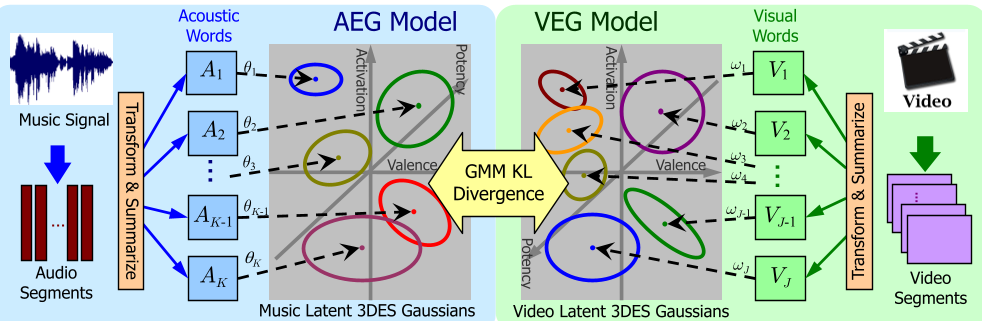
As seen in the figure above, the AEG (Acoustic Emotion Gaussians) and VEG (Visual Emotion Gaussians) models predict the probability distribution of a clip's emotion. Instead of a single "sad" or "happy" label, the model provides a nuanced stochastic profile (a "cloud" of emotion).
Experiments: Matching by Divergence
Matching is performed by calculating the Kullback-Leibler (KL) Divergence between the music's predicted emotion distribution and the video's distribution.
- High Similarity: Smaller KL divergence between the two GMMs indicates an emotional match.
- Efficiency: The authors utilized a variational-based method to approximate KL divergence, making the system fast enough for large databases or mobile deployment.
The model was tested on the DEAP dataset, which includes 1-minute MV segments with extensive human annotations. This allowed the AVEG model to learn precisely how acoustic/visual cues correlate with shifted positions in the Valence-Arousal-Potency space.
Critical Analysis & Conclusion
Takeaway
AVEG successfully shifts the paradigm from "signal matching" to "perception matching." By quantifying emotion using a probabilistic Gaussian approach, the system accounts for the inherent subjectivity and ambiguity of human feelings.
Limitations & Future Work
While revolutionary for its time (2012), the model relies on hand-crafted features. Modern deep learning (CNNs and Transformers) could likely replace the CFA and GMM stages for even higher accuracy. Furthermore, while the 3DES space is robust, it may not capture complex narrative-level transitions (e.g., irony or specific cultural contexts) in music videos.
Future Outlook: The concept of using a latent affective space remains highly relevant today in multi-modal LLMs and generative art, proving that emotion is the ultimate "universal embedding" for creative AI.