
From Reactive to Proactive: Quantifying the ROI of Electronic Prognostics
ACRONYM 1 CALCE Center for Advanced Life Cycle Engineering CBA Cost Benefit Analysis DoD Department of Defense FAA Federal Aviation Administration FMECA Failure Modes, Effects, and Criticality Analysis HM Health Monitoring JSF Joint Strike Fighter LAV Light Armored Vehicle LCOM Logistics Composite Model LRU Line Replaceable Unit MFD Multifunction Display
This paper presents a comprehensive methodology for calculating the Return on Investment (ROI) of Prognostics and Health Management (PHM) systems using a stochastic discrete event simulation model. Focusing on electronics PHM for a Boeing 737 Multifunction Display, it demonstrates how shifting from unscheduled to precursor-to-failure maintenance can achieve significant cost avoidance and a positive ROI (e.g., ~3.46 in the specific case study).
Executive Summary
TL;DR: In the world of high-stakes maintenance, particularly aviation, "if it ain't broke, don't fix it" is a recipe for financial disaster. This paper provides a robust mathematical framework to prove why investing in Prognostics and Health Management (PHM) is economically superior to traditional reactive maintenance. By using stochastic discrete event simulations, the authors demonstrate that even with high implementation costs, a well-tuned PHM system can yield an ROI exceeding 300% by avoiding the catastrophic costs of unscheduled flight cancellations.
Positioning: This work is a foundational contribution to the "Business Case for PHM," moving the needle from qualitative promises of safety to quantitative financial models that handle real-world uncertainty.
The "Point Estimate" Trap
Traditional Cost-Benefit Analysis (CBA) often falls into the trap of using fixed values for variables that are inherently chaotic. Labor costs, part lead times, and—most importantly—the actual time to failure (TTF) of electronics are not constants.
The authors argue that the value of PHM isn't just a single number; it's a distribution. By ignoring the "tails" of these distributions (the rare but extremely expensive engine failures or flight diversions), previous models failed to provide a persuasive case for the initial high NRE (Non-Recurring Engineering) and infrastructure costs required for PHM.
Methodology: Simulating the Maintenance Lifecycle
The heart of the paper is a Stochastic Discrete Event Simulation. Instead of asking "when will the part fail?", the model creates thousands of virtual lifecycles for a "socket" (the slot where a component lives).
1. Precursor to Failure
The study focuses on a "precursor to failure" approach. Imagine a built-in "fuse" or sensor designed to fail slightly before the main system. The gap between the precursor warning and the actual failure is the Prognostic Distance ().
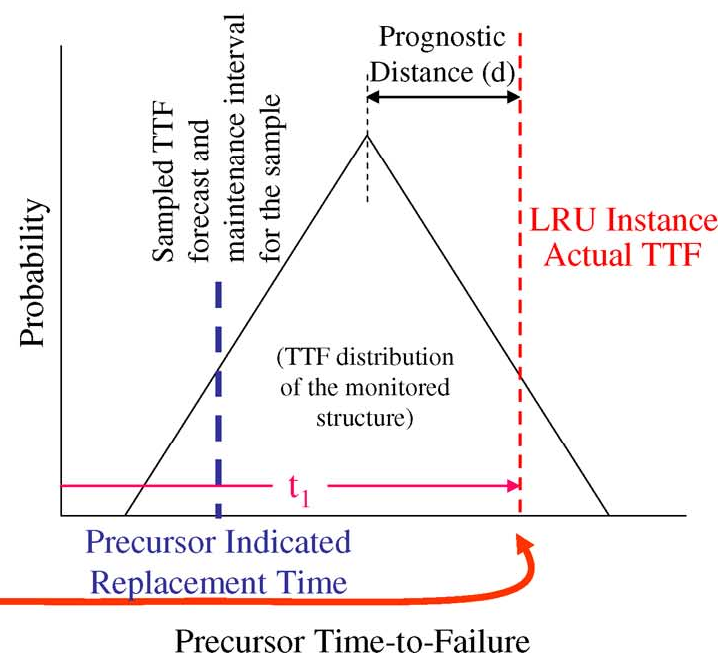 Fig 1: The model compares the TTF of the actual component against the warning distribution of the PHM system. The overlap determines if a maintenance event is successfully scheduled or becomes a failure.
2. The ROI Calculation
The authors redefine ROI specifically for the maintenance domain: Where is the cost of the status quo (unscheduled maintenance) and is the specialized investment in PHM.
Case Study: Boeing 737 Multifunction Display
To validate the theory, the authors analyzed a fleet of 502 aircraft. They compared three strategies:
- Unscheduled Maintenance: Run to failure.
- Fixed-Interval Maintenance: Replace every hours regardless of condition.
- PHM (Precursor to Failure): Replace when the system warns of impending failure.
Key Insights from Experiments
- The Optimal Distance: PHM is a balancing act. If your prognostic distance is too short, you miss failures. If it's too long, you throw away perfectly good parts too early. The study found an "optimal" point (around 470-500 hours) that minimizes total life-cycle cost.
- The Impact of Spares: One of the most critical findings was the role of the supply chain. When part lead times are long (e.g., 12 months), unscheduled failures aren't just expensive—they kill availability. PHM acts as a buffer, allowing the supply chain to react before the plane is grounded.
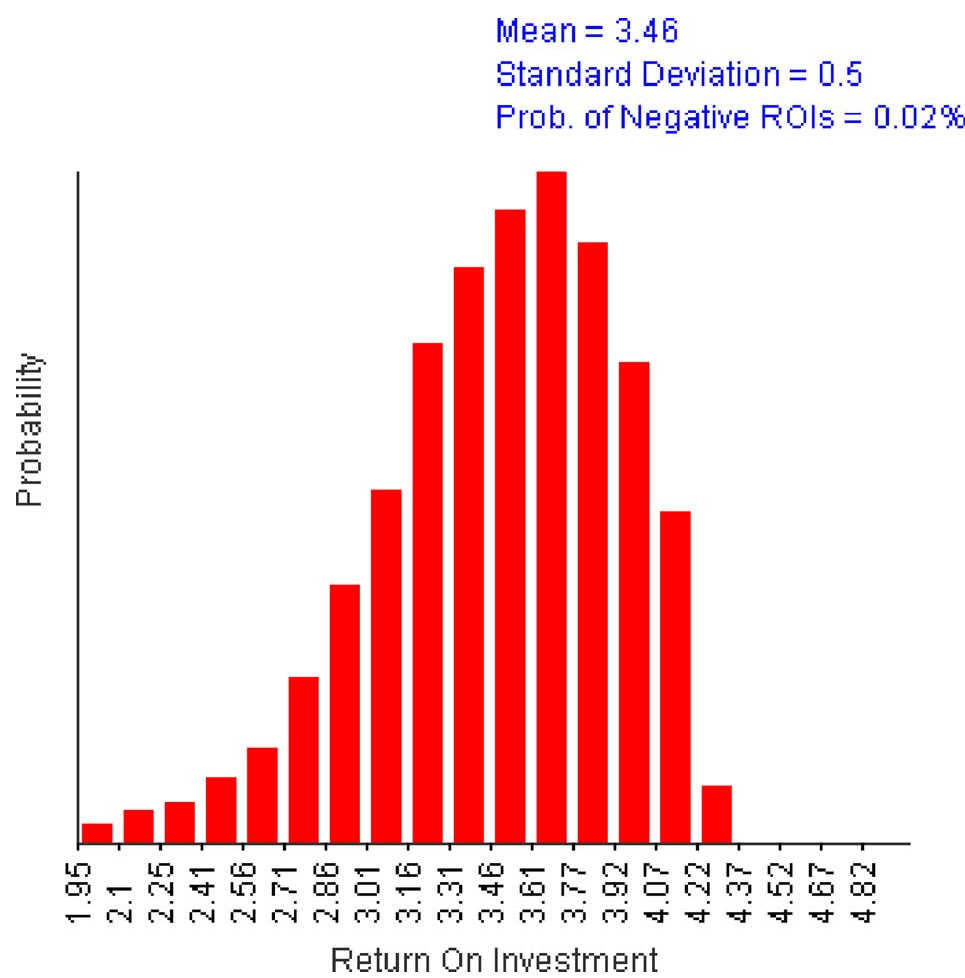 Fig 2: A histogram of ROI across 5,000 simulated sockets. Note the heavy right-tail, indicating that while most cases provide steady returns, PHM is a massive "insurance policy" against extreme failure scenarios.
Critical Analysis & Conclusion
This paper is a masterclass in Value-Based Engineering. It moves PHM out of the lab and into the boardroom.
Takeaways:
- Weibull Matters: PHM is most effective when failure distributions have a large "spread" (TTF 2 in the paper). If failures are highly predictable (TTF 1), traditional fixed-interval maintenance might actually be cheaper.
- Infrastructure is the Hurdle: The $450/year/socket infrastructure cost is the primary barrier. Reducing data management and decision-support costs is key to wider adoption.
Limitations: The model assumes a relatively "pure" world. In reality, false alarms can erode trust in PHM systems, leading human operators to ignore warnings—a factor not fully explored in this specific simulation.
Future Work: The next frontier is "System-level PHM," where ROI is calculated not for a single display, but for the entire aircraft, accounting for labor synergies where multiple parts are fixed during a single scheduled downtime.