
ActiveDBC: Leveraging Mobility Intelligence for Rapid Information Propagation in Mobile Social Networks
ActiveDBC: learning Knowledge-based Information propagation in mobile social networks
ActiveDBC is a novel information propagation framework for Mobile Social Networks (MSNs) that integrates Markov Chain modeling with DBSCAN clustering to identify top-k influential nodes. By learning movement patterns from real-world trace data (NCCU dataset), it achieves significantly faster information spreading compared to Naïve and K-means baselines.
TL;DR
In the world of Mobile Social Networks (MSNs), finding the right "starting point" for a message is half the battle. ActiveDBC is a sophisticated framework that uses a Markov Chain-based prediction engine and DBSCAN clustering to identify "key players" in the network. By shifting from random selection to "knowledge-based" propagation, the method drastically reduces spreading time in complex urban environments.
Background: The Challenge of Opportunistic Links
Mobile Social Networks are essentially Delay Tolerant Networks (DTNs) driven by human movement. Unlike stable fiber-optics, links in MSNs are "opportunistic"—they only exist when two people are within Bluetooth or Wi-Fi range.
The core problem is Influence Maximization: Which nodes should we start with to ensure the message hits the whole network in the shortest time? Conventional methods like K-means or simple Degree-centrality often fail because they don't account for the fact that people are "creatures of habit" with predictable movement paths.
Methodology: Predictive Intelligence meets Density Clustering
The ActiveDBC workflow is a three-stage pipeline designed to turn raw contact logs into a high-speed propagation map.
1. Markov Chain Mobility Modeling
The authors treat user movement between virtual regions as a stochastic process. By constructing a Transition Matrix , the system calculates a Steady-State Vector . This vector represents the long-term probability of a user visiting specific areas.
- Physical Intuition: If two users have similar steady-state vectors, they are likely to encounter the same people and visit similar "social hubs," making them redundant if both are chosen as seeds.
2. DBSCAN Clustering for Social Grouping
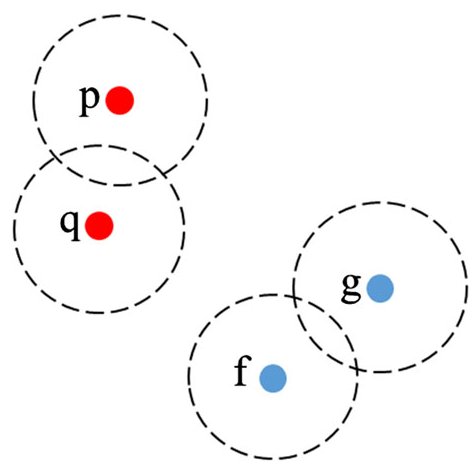
Unlike K-means, which forces every node into a cluster, DBSCAN (Density-Based Spatial Clustering of Applications with Noise) is used to identify dense groups of people while filtering out outliers (noise).
- The Insight: Information needs to be sent only once to a "delegate" within a dense cluster. That delegate will naturally spread it to their tight-knit neighbors through frequent local encounters.
3. Active Learning Score
Instead of picking clusters randomly, ActiveDBC calculates a score(d) for each node:
This formula rewards nodes that have high internal cluster degrees () and strong encounter histories, ensuring the selected top-k nodes are the true "hubs" of their respective patterns.
Experimental Validation: Real-World Performance
The researchers tested ActiveDBC against the NCCU Trace, a dataset of 115 students tracked via GPS across National Cheng-Chi University.
SOTA Comparison
In sparse network conditions (small communication range), ActiveDBC showed a clear lead. While Naïve and Degree methods struggled to penetrate isolated parts of the campus, ActiveDBC’s awareness of mobility patterns allowed it to bridge gaps efficiently.
Key Findings
- Density Matters: DBSCAN is superior for real-world data because university campuses are naturally "clumpy." K-means tries to create artificial boundaries, whereas DBSCAN finds the natural social structures.
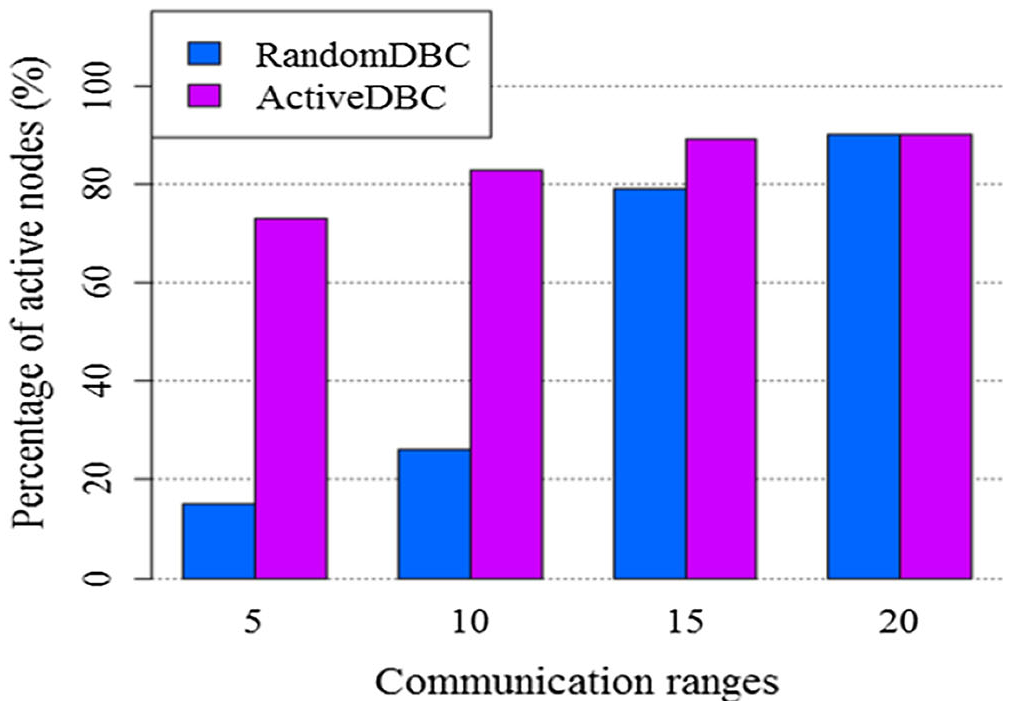
- Active vs. Random: The comparison between "ActiveDBC" and "RandomDBC" (where seeds are picked randomly within DBSCAN clusters) proved that the specific scoring rule is vital. Simply being in a cluster isn't enough; you must be the most "active" member of that cluster.
Critical Analysis & Conclusion
ActiveDBC successfully bridges the gap between statistical modeling (Markov) and spatial geometry (DBSCAN). Its biggest strength is its inductive bias: it assumes human movement is purposeful and repetitive, which is a highly accurate reflection of reality.
Limitations:
- The performance gap narrows as communication ranges increase (e.g., 20m). In dense mesh-like scenarios, complex selection algorithms provide diminishing returns.
- The system requires an "initialization period" to learn patterns, which might delay propagation in highly dynamic or one-off event scenarios.
Future Outlook: Applying this logic to 5G Device-to-Device (D2D) communication could revolutionize how emergency alerts or viral marketing content is cached and distributed in smart cities.