
QBEC: Revolutionizing Conversational AI in Healthcare through Efficient Active Learning
Active Learning for Conversational Interfaces in Healthcare Applications
The paper introduces Query by Embedded Committee (QBEC), an efficient Active Learning (AL) algorithm for training text classifiers in healthcare conversational interfaces. It specifically targets behavior change interventions (e.g., substance abuse) and achieves SOTA performance in sampling efficiency compared to traditional QBC methods.
TL;DR
Researchers have developed Query by Embedded Committee (QBEC), a streamlined Active Learning algorithm designed for healthcare chatbots. Instead of retraining multiple heavy neural networks to find "difficult" data points, QBEC looks at the class likelihood space, making it light enough to run on a smartphone while matching the performance of much heavier SOTA methods.
Problem & Motivation: The Data Bottleneck in Digital Health
Automated therapeutic agents (e.g., those using Cognitive Behavioral Therapy) are vital for managing substance abuse at scale. However, two major hurdles persist:
- Data Sensitivity: Patients' personal health talk shouldn't always be uploaded to a cloud for labeling due to privacy concerns.
- Model Evolution: Language is non-stationary. "Sustain talk" and "Change talk" regarding addiction vary wildly by individual and over time (e.g., during "Stoptober" campaigns).
Traditional Active Learning (AL) helps by picking only the most "confusing" data for humans to label. But the gold-standard method, Query-by-Committee (QBC), is a computational nightmare—it requires training multiple versions of the model (a "committee") to see where they disagree.
Methodology: Shifting the Battleground to Latent Space
The core insight of QBEC is that we don't need a committee of entire neural networks. We can project the data into a class likelihood space spanned by the outputs of our primary model.
How it works:
- The Embedding: The main model (a Bi-LSTM with Attention) processes the text and produces a vector of class likelihoods.
- The Committee: Inside this low-dimensional likelihood space (3 dimensions for 3 classes), the authors train a committee of simple, lightweight classifiers (like Random Forests).
- The Query: Disagreement is measured here. If the simple committee is confused about where a point sits in this probability space, it indicates a high-value sample for human labeling.
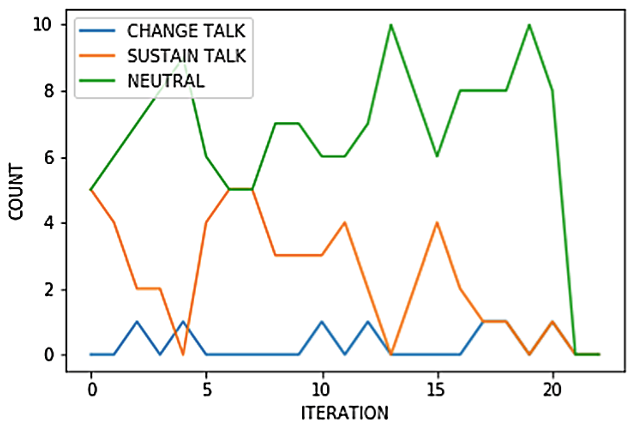 Figure 1: Visualization of the 3D latent variable space showing the separation of Sustain Talk, Change Talk, and Neutral classes.
Experiments & Results
The authors tested QBEC against standard QBC and Random Sampling using real-world Twitter data related to smoking cessation.
Key Findings:
- Discovering Rare Labels: Random sampling missed "Change Talk" (the most important category for therapy) almost entirely. Both QBEC and QBC were highly effective at spotting these rare gems.
- Computational Efficiency: QBEC is mathematically proven to be faster. Its complexity is tied to the number of classes (small), whereas QBC is tied to the high-dimensional feature space.
- Accuracy Boost: Both AL methods significantly outperformed random selection, with QBEC showing a slight lead in long-term accuracy saturation over standard QBC in synthetic tests.
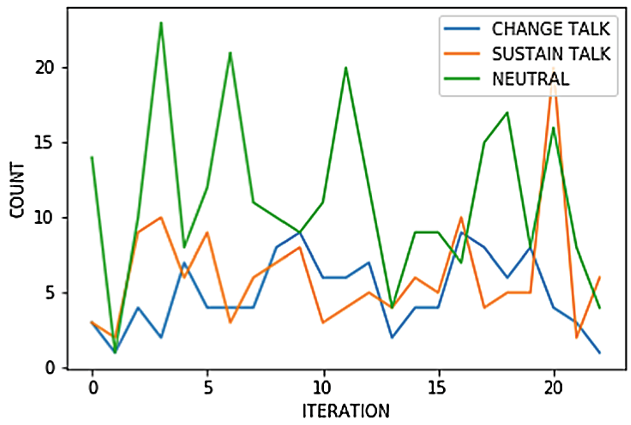 Figure 2: Accuracy trends and sample selection counts over 23 iterations. Note how QBEC (Method C) maintains steady growth.
Critical Analysis & Conclusion
Takeaway
QBEC bridges the gap between Deep Learning and Edge Computing. By reducing the hypothesis space for sample selection, it allows for "Local Active Learning." This means a healthcare app could theoretically learn a user's unique slang and personal therapy progress entirely on the device.
Limitations
While efficient, QBEC relies on the "Main Model" to provide a meaningful latent space. If the initial model is extremely poorly trained, the class space might be too distorted for the embedded committee to provide useful signals.
Future Outlook
This work sets the stage for Private AI in healthcare. By keeping the AL loop local, we respect patient privacy while ensuring the conversational agent evolves with the user. The next logical step would be applying this to Large Language Model (LLM) fine-tuning where the cost of committee-based AL is even more astronomical.