
DTSE: Bridging the Semantic Gap in Hyperspectral Imagery via Deep Mapping and Salient Active Learning
Active-Learning-Incorporated Deep Transfer Learning for Hyperspectral Image Classification
2018-11-01
Summary
Problem
Method
Results
Takeaways
Abstract
This paper introduces DTSE (Deep-mapping Heterogeneous Transfer Learning via Querying Salient Examples), a novel framework for Hyperspectral Image (HSI) classification. It integrates an active learning-based Salient Sample Querying (SSQ) process with Deep Mapping (DM) using Stacked Autoencoders and Canonical Correlation Analysis (CCA) to achieve state-of-the-art accuracy in heterogeneous transfer tasks.
## TL;DR
Classifying Hyperspectral Images (HSI) often feels like a "small data" problem in a "big data" ocean—we have millions of pixels but few labels. The DTSE framework solves this by intelligently selecting "salient" samples from a source domain and mapping them to a target domain through a deep correlation network. By aligning features layer-by-layer using CCA, it achieves SOTA performance even when sensors and environments differ drastically.
## The Core Challenge: Data is Plenty, Labels are Scarce
In remote sensing, a single HSI cube contains hundreds of spectral bands. However, labeling these pixels requires field experts or expensive ground truth surveys. Transfer Learning (TL) offers a way out by leveraging existing labeled datasets.
**The catch?** "Negative Transfer." If the source and target domains have different distributions (caused by different sensors, lighting, or atmospheric conditions), blindly transferring knowledge can actually *degrade* performance. Current methods often miss two points:
1. **What to transfer**: They use random samples instead of informative ones.
2. **How to bridge the gap**: They use shallow linear mappings that can't handle complex, non-linear feature shifts.
## Methodology: The DTSE Innovation
The DTSE framework (Deep-mapping Heterogeneous Transfer Learning via Querying Salient Examples) introduces a robust pipeline focused on **Informativeness** and **Commonality**.
### 1. Salient Sample Querying (SSQ)
Instead of random sampling, the authors look for "Density Peaks." These are pixels that are highly representative of their cluster but also unique enough to provide new information. By combining these with a "min-max" uncertainty criterion, the model identifies the most valuable "co-occurrence" points to build the bridge between domains.
### 2. Deep Mapping (DM) Mechanism
The model employs two domain-specific Stacked Autoencoders (SAEs).
- **Forward Pass**: The co-occurrence samples pass through both networks.
- **CCA Correlation**: At each hidden layer, Canonical Correlation Analysis (CCA) is used to find a projection that maximizes the correlation between the two domains.
- **Backpropagation**: The networks are fine-tuned based on this correlation, forcing the deep features to converge into a shared semantic subspace.
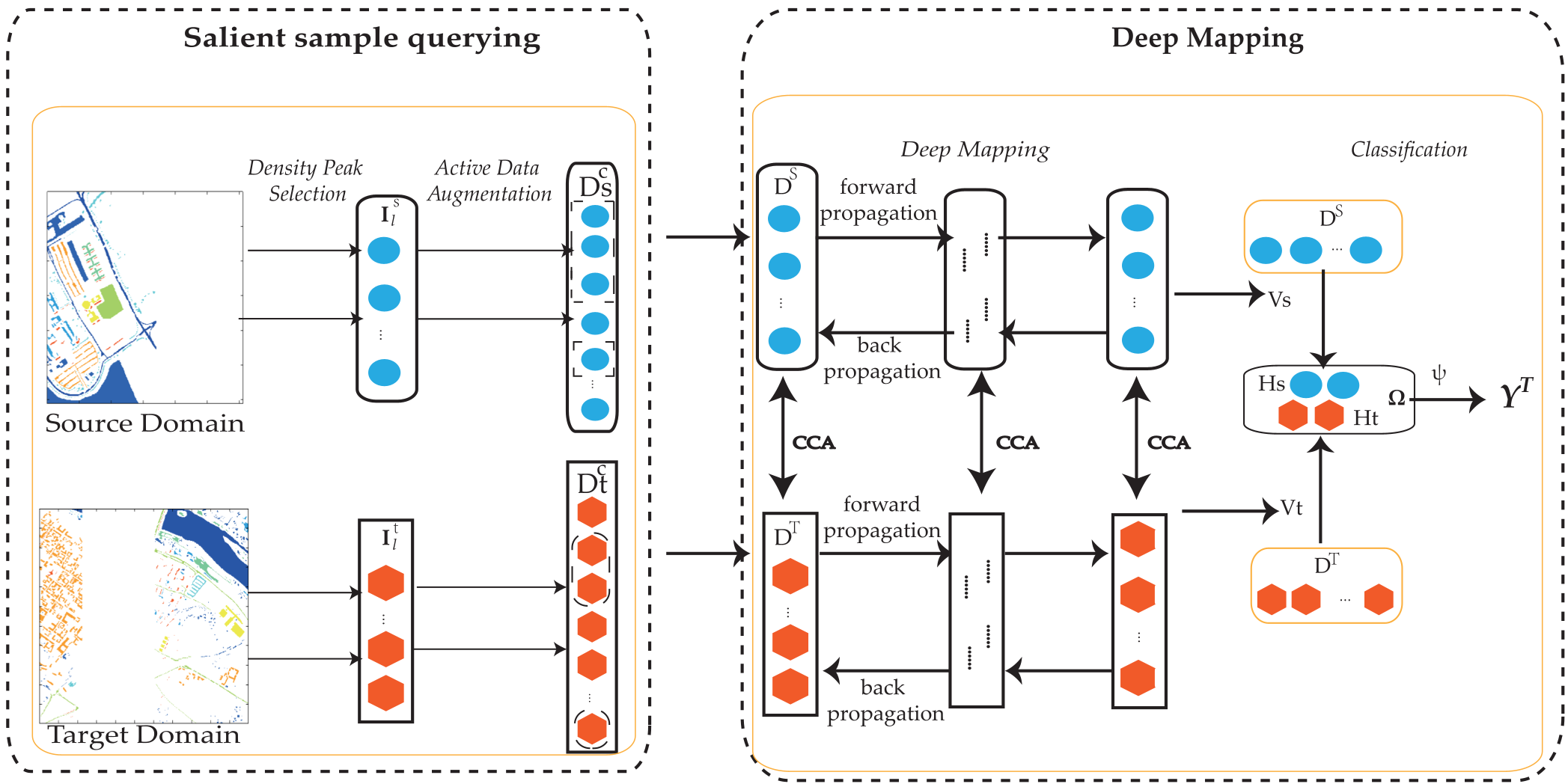
*Fig 1. Overall architecture of the DTSE framework, showcasing the interaction between Active Learning and Deep Mapping.*
## Experimental Evidence: SOTA Stability
The authors tested DTSE on combinations of the **Urban**, **Washington DC Mall**, and **Pavia** datasets.
**Key Findings:**
- **Robustness to "Tough" Classes**: In Experiment 1 (Urban vs. DC Mall), DTSE maintained over 93% accuracy for "Roofs" and "Trails," where the previous leader (IRHTL) dropped to as low as 72% or failed entirely (18.6% on certain tasks).
- **Deep vs. Shallow**: Comparing DTSE to CCA-SVM showed a consistent 3-4% accuracy boost, proving that the non-linear transformations in deep autoencoders are essential for capturing high-level spectral relationships.
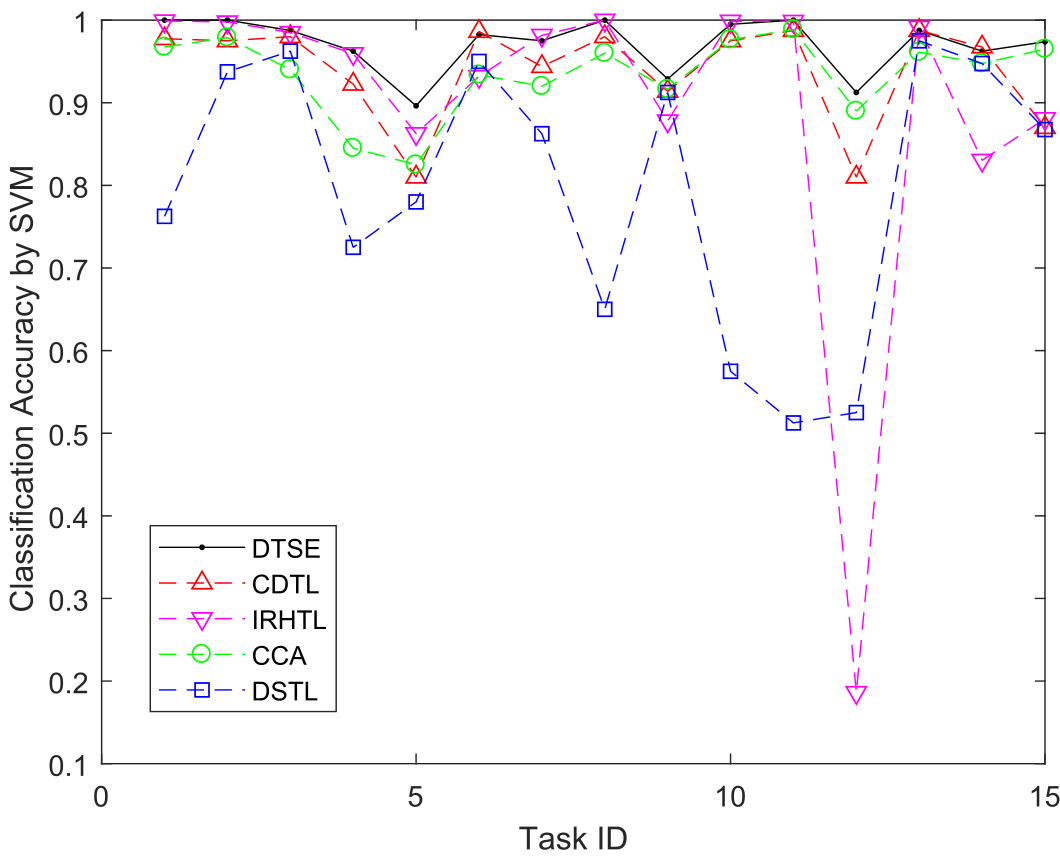
*Fig 2. Comparative performance across 15 binary classification tasks. DTSE (bottom curve) shows the highest and most stable accuracy.*
## Why It Works: The Intuition
The physical intuition here is that while "Red Roofs" might look different to two different sensors at the raw pixel level, their *latent* characteristics (material property, structure) are invariant. By using **Active Learning**, the model ensures it is learning from the most distinctive "Red Roof" pixels. By using **Deep CCA-fine-tuned SAEs**, the model reshapes the feature space until the "Red Roof" in Domain A aligns perfectly with Domain B.
## Critical Analysis & Conclusion
### Takeaway
The integration of active sample selection ("what to transfer") and layer-wise correlation ("how to transfer") allows DTSE to handle heterogeneous datasets with no prior knowledge of the target domain labels.
### Limitations & Future Work
- **Computation**: Training dual SAEs with iterative CCA is computationally heavier than shallow methods.
- **Binary vs. Multiclass**: The current framework is optimized for binary tasks; scaling to complex multiclass scene segmentation is the next frontier.
- **Hyperparameters**: Accuracy is sensitive to the number of layers (4 is optimal, 5 causes overfitting) and neurons per layer.
In conclusion, DTSE represents a significant step toward practical, unsupervised-in-target transfer learning for Earth Observation, making it possible to deploy models on new satellite data with minimal manual intervention.