
Active Online Learning: Mapping Hidden Trusts via Stubborn Influence
Active online learning of trusts in social networks
This paper introduces an online optimization algorithm for active learning of trust parameters in social networks. By leveraging a DeGroot model with "stubborn agents," the authors formulate a Stochastic Proximal Gradient (SPG) framework to identify network structure and trust weights from noisy, streaming opinion data, achieving almost sure convergence.
TL;DR
How do you map the web of trust in a social network when you can't observe every interaction? This paper proposes using stubborn agents—individuals who refuse to change their minds—as a probe to reveal the underlying trust structure of the entire group. By applying a Stochastic Proximal Gradient (SPG) algorithm to streaming opinion data, the authors demonstrate an online method that reconstructs the social trust matrix with high accuracy, even when the data is noisy and sampled irregularly.
The Problem: The Invisibility of Social Trust
Traditional social network analysis often relies on "passive sensing"—recording who talks to whom. However, in the digital age, seeing a connection doesn't tell you its strength or "trust value."
Current SOTA methods for learning these weights typically require:
- Perfect Timing: Knowledge of exactly when every social interaction occurs.
- Continuous Tracking: Watching the entire evolution of an opinion from start to finish.
In reality, we only get snapshots of opinions (digital traces). Mathematically, the steady-state of a standard DeGroot opinion model is "rank-deficient," meaning there are infinite trust configurations that could lead to the same result. The system is non-identifiable.
The Insight: Stubbornness as a Tool
The authors’ core intuition is that stubborn agents (e.g., politicians, brand ambassadors, or bots) act as an "input signal" to the system. Because their opinions never change, they force the rest of the network into a specific steady state that is directly proportional to the trust weights.
By injecting these agents, the dimension of the observable steady-state space expands from 1 to (the number of stubborn agents). This transforms the problem into a "System Identification" task similar to radar or control theory.
Methodology: Active Online Learning
The paper formulates the learning task as a LASSO-style convex optimization problem. Since real-world data arrives in streams, they adapt the Stochastic Proximal Gradient (SPG) method.
1. The Model
Opinions evolve as: Where is the trust matrix. The goal is to estimate the expected trust matrix given only noisy observations .
2. The SPG Algorithm
Instead of waiting for an infinite number of samples to calculate a perfect gradient, the algorithm updates its estimate of the trust matrix and on-the-fly:
- Gradient Step: Calculate a noisy gradient based on current opinion estimates.
- Proximal Step: Apply a soft-thresholding operator to enforce sparsity (since people only trust a few friends) and non-negativity.
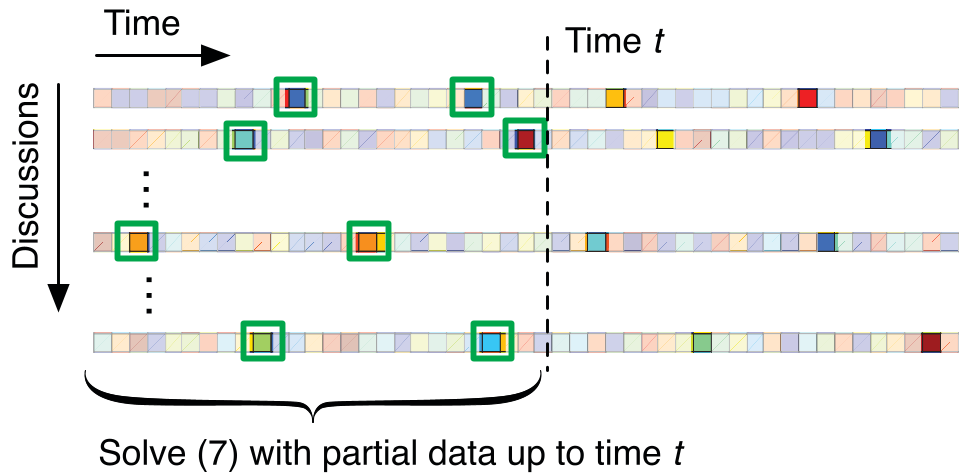 Fig 1: Opinions arrive as streaming "dots" from different topics. The estimator uses these scattered points to refine the trust matrix progressively.
Experimental Results
The authors tested their algorithm on 100 agents with 36 stubborn "probes."
- Convergence: The algorithm demonstrates "almost sure" convergence. As shown in the figures, the Squared Error in opinion estimation and the NMSE of the trust matrix decay consistently as iterations increase.
- Active vs. Passive: A critical comparison showed that the passive method (without stubborn agents and with non-uniform sampling) resulted in a "dense mess" of errors. The active method clearly reconstructed the sparse trust structure.
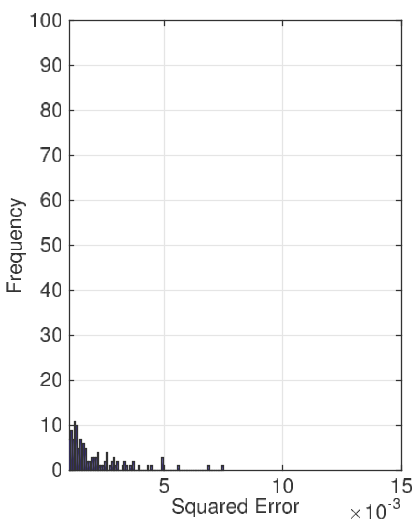 Fig 2: Learning curves showing the drop in NMSE and estimation error over time.
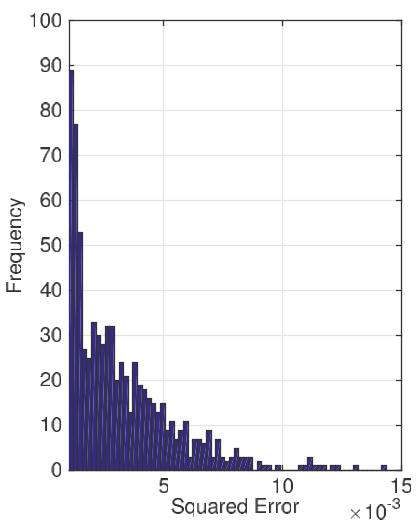 Fig 3: Histograms of error distribution. Note how the active learning approach (left) concentrates error near zero compared to the passive approach.
Critical Insight & Conclusion
Takeaway
This work shifts social network analysis from a passive observation task to an active engineering problem. It proves that by strategically placing stubborn agents in a network, we can "extract" the hidden trust parameters using mathematically rigorous online optimization.
Limitations
The current model assumes the network structure is static. In real social networks, trust is dynamic—it grows and decays. Applying this to a "quasi-static" or "evolving" graph remains a significant hurdle for future research.
Future Outlook
This framework has massive implications for influencer marketing and misinformation detection. If you can identify the trust weights of a target community by observing their reaction to stubborn influencers, you can predict how any future information will spread through that crowd.