
Social RADAR: How Stubborn Agents Help Map the Hidden Geometry of Networks
Active Sensing of Social Networks
This paper introduces an active sensing framework, termed "Social RADAR," to infer trust matrices and topology in social networks using the DeGroot model. By leveraging "stubborn agents" (zealots) to excite the system, the authors transform network identification into a sparse recovery problem, achieving State-of-the-Art (SOTA) results in reconstructing large-scale networks like Facebook's ReedCollege dataset with high accuracy.
TL;DR
Reconstructing a social network's trust structure usually requires watching every interaction in real-time. This paper proposes a "Social RADAR" that uses stubborn agents (zealots) to effectively "ping" the network. By observing only the final steady-state opinions, researchers can solve a sparse recovery problem to reconstruct the entire hidden network topology with high precision.
Background: The Consensus Vanishing Act
In a standard DeGroot model, agents update their opinions by taking a weighted average of their neighbors. Mathematically, this is a Markov chain that eventually collapses into consensus—a state where everyone holds the same opinion. For a network scientist, consensus is a nightmare: once everyone agrees, the information about who influenced whom (the trust matrix ) disappears.
The Insight: Stubbornness as an Excitation Source
The authors propose a shift from passive observation to active sensing. By introducing a small set of "stubborn agents" who never change their minds, they prevent the system from reaching a trivial consensus.
Instead, the ordinary agents reach a steady state that is a direct function of the network's structure: Where is the internal trust among ordinary agents and is the trust placed in stubborn agents. This equation acts as a "reverberation" of the stubborn agents' influence, allowing the network to be estimated via regression.
Methodology: From Graphs to Compressed Sensing
The core challenge is that the system is often underdetermined (fewer observations than possible edges). The paper frames this as a sparse recovery problem, making the realistic assumption that social networks are sparse (most people don't trust everyone).
Architecture: The Social RADAR Framework
The sensing process follows a structured pipeline:
- System Excitation: Stubborn agents initiate discussions with fixed opinions.
- Steady-State Collection: High-layer opinions are gathered after the "reverberation" settles.
- Optimization: A fast proximal gradient method (FISTA) is used to solve the -minimization problem.
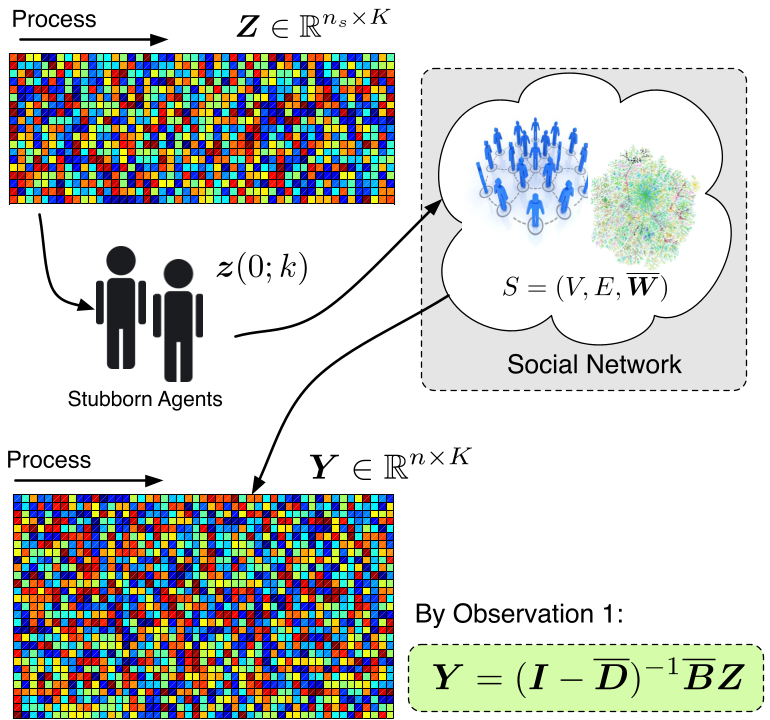 Figure 1: Relationship between the stubborn agent inputs (Z) and the observed ordinary agent steady states (Y).
Theoretical Breakthrough: Expander Graphs
A major contribution is Theorem 1, which uses Unbalanced Expander Graph theory to provide recovery guarantees. The authors prove that if stubborn agents are connected to ordinary agents in a -regular fashion, the network structure is identifiable even if (the number of agents) is very large relative to the number of stubborn agents.
Experiments and Results
The authors validated the model on both synthetic (ER, BA, SW) and real-world networks.
Synthetic Performance
In Watts-Strogatz (Small World) networks, the structure was recovered with near-zero error using significantly fewer stubborn agents than required for Erdos-Renyi graphs, highlighting how "regular" degree distributions aid identification.
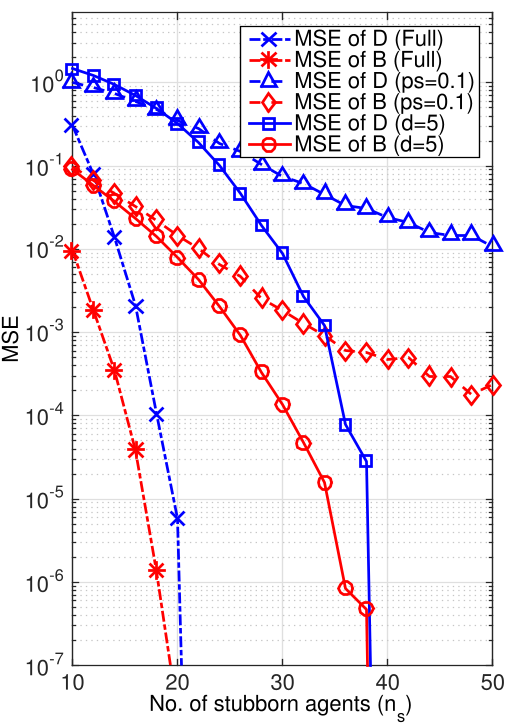 Figure 2: Normalized Mean Square Error (NMSE) decreases sharply as the number of stubborn agents (ns) increases, particularly with d-regular connections.
Real-World Case Study: Facebook ReedCollege
Using the facebook100 dataset, they successfully reconstructed a network of 666 agents. Even with noisy, randomized interactions, the "Social RADAR" captured the macroscopic cluster structures of the actual college social network.
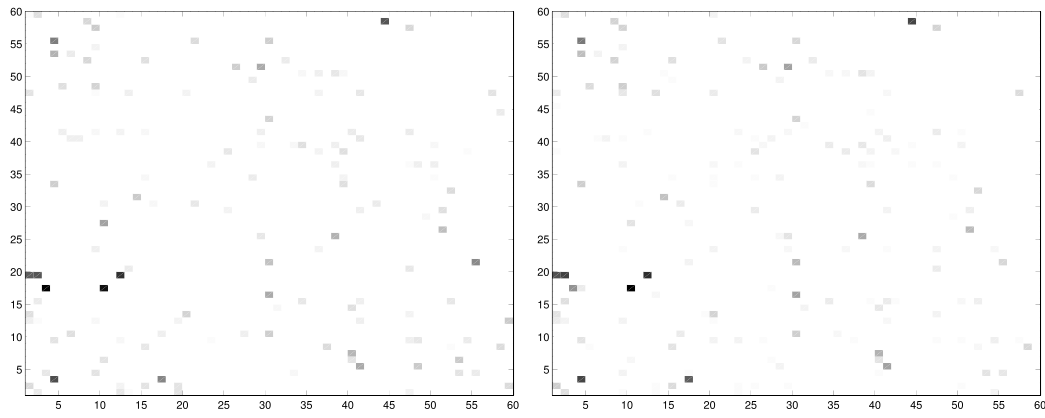 Figure 3: Comparison between the original ReedCollege network (Left) and the reconstructed version (Right), showing identical cluster topology.
Critical Analysis & Conclusion
This paper effectively bridges the gap between Control Theory and Signal Processing. By treating a social network like a physical system to be probed, it bypasses the need for high-frequency data collection.
Limitations:
- The model assumes a Linear DeGroot process. In reality, human opinion dynamics are often non-linear (e.g., confirmation bias/bounded confidence).
- The requirement for discussions might be difficult to satisfy in fast-changing environments.
Future Outlook: The "Synthetic Aperture RADAR" analogy for social networks—where a few agents move across different network positions to mimic many agents—is a brilliant concept that could lead to highly efficient community detection tools in cybersecurity and marketing.