
From Static Graphs to Dynamic Flows: The Rise of Activity-Driven Influence Maximization
Activity-Driven Influence Maximization in Social Networks
This paper presents a model-independent, activity-driven approach to Influence Maximization (IM) by identifying "information channels" and influence reachability sets directly from interaction data. The authors propose scalable algorithms leveraging HyperLogLog sketches to efficiently find optimal seed sets in both social networks and location-based social networks (LBSNs).
TL;DR
Researchers have moved beyond static social graphs to look at the actual pulses of interaction. This paper proposes a model-independent framework that defines influence based on "Information Channels"—sequences of interactions that respect time. By using advanced sketching techniques (HyperLogLog), they’ve made it possible to find the most influential nodes or locations in massive, streaming datasets in almost real-time.
The Problem with Static Influence
For years, Influence Maximization (IM) was treated as a graph theory problem. You had nodes (people) and edges (friendships). You chose a model (like a virus spreading), guessed the "probability" of one person influencing another, and ran thousands of Monte Carlo simulations to find the best seeds.
The catch? Predicting these probabilities is incredibly hard, and static "friendship" doesn't mean "interaction." Just because you follow someone doesn't mean you see their posts or act on them. Furthermore, these simulations are computationally expensive and don't scale to the billions of interactions happening on platforms like Twitter or Foursquare.
Methodology: The "How" and its Logic
The authors propose a radical shift: Forget the model; follow the data.
1. Information Channels and Reachability
Instead of assuming how information spread might happen, the authors look at how it actually can happen through Information Channels (IC). An IC exists between User A and User C only if there is a time-ordered path (e.g., A interacts with B at 9:00 AM, then B interacts with C at 9:05 AM).
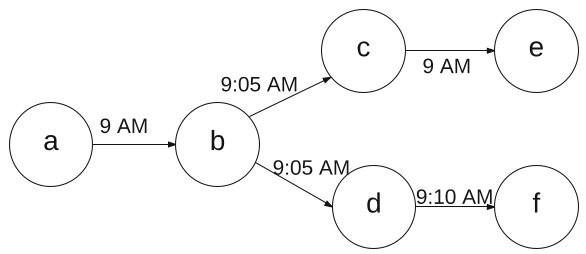
The Influence Reachability Set (IRS) of a node consists of all nodes it can reach through these temporal paths. A node with a massive IRS is naturally a high-influence seed.
2. Location-Based Influence
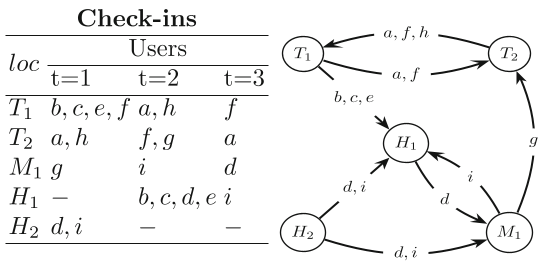
In the context of Location-Based Social Networks (LBSN), the logic flips to geography. A location is influential if its visitors tend to disperse to many other distinct locations. This "visitor spread" is vital for outdoor marketing—like choosing which subway station to hand out samples at to ensure they travel across the whole city.
3. Scalability via HyperLogLog
Tracking every possible path in a network is a memory nightmare. The authors solve this using HyperLogLog (HLL) sketches. Instead of storing a list of every reachable node, they store a compact "fingerprint" that allows them to estimate the cardinality (size) of the reachability set with high accuracy but minimal memory.
Experiments and Results
By applying a greedy algorithm on top of these HLL sketches, the researchers achieved several breakthroughs:
- Accuracy: The data-driven approach matched or outperformed traditional models by capturing real interaction patterns that static graphs miss.
- Efficiency: The sketching technique allowed the algorithm to process data in a single pass, making it suitable for streaming environments.
- Versatility: The framework proved equally effective for digital social networks and physical location movements.
Critical Insight & Future Outlook
The core genius of this work lies in its Inductive Bias: it assumes that past temporal paths are the best predictors of future influence. While this "purely data-driven" approach avoids the pitfalls of over-parameterized models, it does assume that interaction patterns are somewhat stable over time.
As we move toward an era of hyper-local and hyper-fast marketing, the ability to derive influence from activity streams rather than static profiles will be the differentiator. Future work could likely integrate these "Information Channels" with Graph Neural Networks (GNNs) to create even more predictive, time-aware influence models.
Conclusion: This research proves that in the world of social influence, what we do matters far more than who we know.