
The Actors of History: Mapping 150 Years of British Power through AI
The Actors of History: Narrative Network Analysis Reveals the Institutions of Power in British Society Between 1800-1950
The paper presents a large-scale Narrative Network Analysis (NNA) of 35.9 million British newspaper articles (1800-1950). By extracting 140 million subject-verb-object (SVO) triplets, the authors reconstruct "macro-communities" of power—such as the Monarchy, Church, and Government—to track the evolution of institutional influence and the fusion of executive and legislative powers in the UK.
TL;DR
Researchers from the University of Bristol have processed 35.9 million local newspaper articles from 1800 to 1950 to map the "narrative network" of British society. By shifting the focus from what was said to who did what to whom, they have mathematically visualized the rise of local government, the resilience of the Monarchy's soft power, and the blurred lines between UK legislative and executive branches.
Beyond Word Clouds: The Search for Structure
For years, the Digital Humanities have been criticized for "counting words." While knowing that the word "King" appears 10,000 times is useful, it tells us nothing about the King's actual agency. Does the King act, or is he acted upon?
The authors argue that power is best understood through Narrative Network Analysis (NNA). By extracting Subject-Verb-Object (SVO) triplets, they move beyond frequency to centrality. Their motivation was to see if AI could detect the subtle shifts in "soft power" and institutional boundaries that traditional historians have debated for decades.
Methodology: Turning Text into Topology
The pipeline involves shifting massive amounts of unstructured text into a structured network:
- NLP Pre-processing: Using co-reference and anaphora resolution to ensure "The Queen," "Her Majesty," and "Queen Victoria" are recognized as the same node.
- Triplet Extraction: Using a dependency parser to find the "actors" (subjects/objects) and their "interactions" (transitive verbs).
- Community Detection: Using the Blondel/Louvain algorithm to group actors who interact frequently.
- Macro-Network Mapping: Correlating these groups across 29 overlapping decade-long windows to find persistent structures.
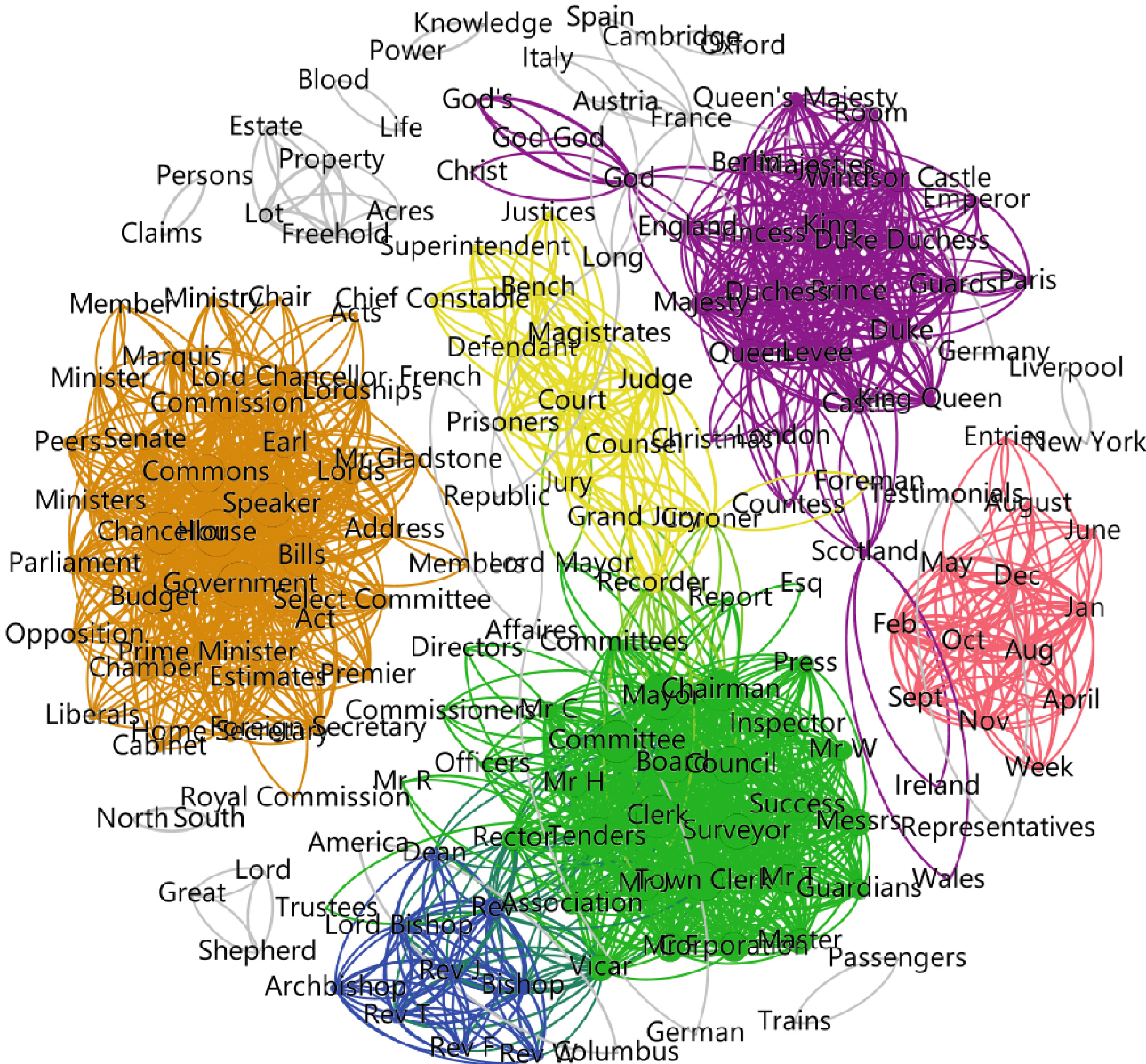 Fig 1. Macro-communities discovered for the 1000 most central actors, showing distinct clusters for the Church, Royalty, and Central Government.
Key Insights: Where the Real Power Lies
1. The Myth of Separated Powers
In constitutional theory, the Executive and Legislature are distinct. However, the AI discovered that in the British narrative, these two are inseparable. Actors like "Prime Minister" and "Parliament" occupy the same "Macro-community" (the orange cluster in Fig 1), validating Walter Bagehot’s 19th-century observation that the British Cabinet is a "hyphen which joins" the legislative and executive arms.
2. The Visibility of the Monarchy
The data shows a fascinating divergence: while the Monarchy’s legal power waned, its narrative centrality remained massive. Interestingly, the "Royalty" community received the most "positive" sentiment scores in the corpus, suggesting a deliberate and successful transition from political rule to cultural prestige—a "branding" success tracked by AI.
3. The Rise of the "Board"
A specific success of this data-driven approach is identifying the impact of legislation. After the Public Health Act of 1848, the actor "Board" (as in Local Boards of Health) skyrocketed in centrality, marking the moment the State began to intervene directly in the daily lives of citizens.
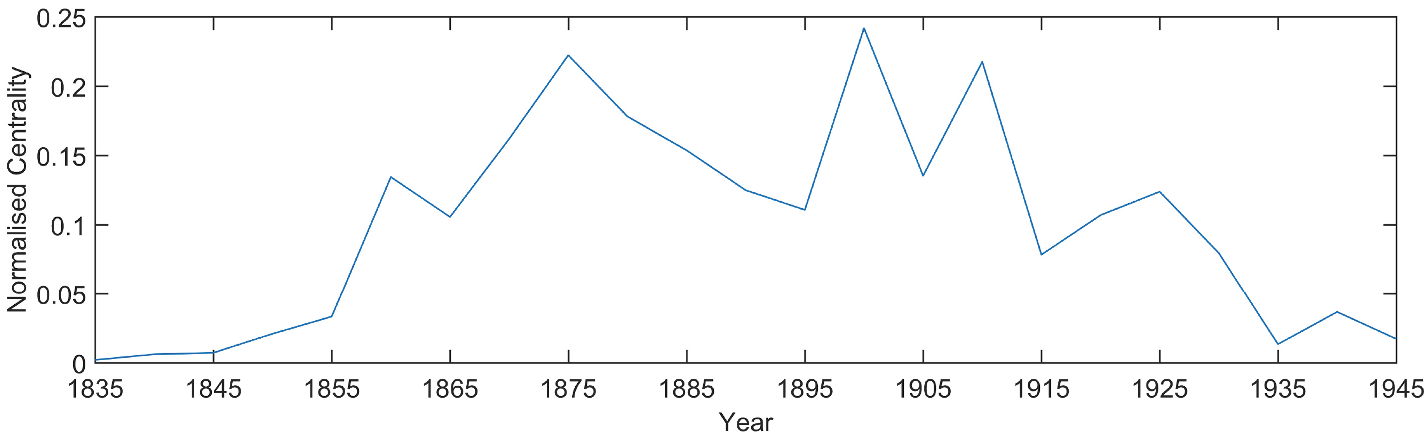 Fig 2. The normalized centrality of "Board" shows a sharp rise post-1848, reflecting the growth of local administrative power.
Critical Analysis & Conclusion
This paper is a landmark in Intelligent Data Analysis (IDA). It proves that with enough scale, AI doesn't just "summarize"—it unearths sociological structures.
Takeaways:
- Centrality > Frequency: In the news, "Bills" are more central than "People." Politics, not personality, drove the 19th-century narrative.
- Institutional Evolution: The Church of England’s gradual drift to the periphery of the network provides a mathematical timestamp for the secularization of Britain.
Limitations: The study relies on 19th-century OCR, which is notoriously "noisy." While the authors pruned the network to reduce noise, some nuances in sentiment may be lost to translation errors in the digitization process.
Future Work: Moving forward, applying these narrative networks to modern social media or real-time news streams could allow us to watch the "Institutions of Power" deform and reform in real-time.