
Social Network Theory: The Missing Link in Realistic Ad Hoc Mobility
An ad hoc mobility model founded on social network theory
This paper introduces a novel ad hoc mobility model founded on Social Network Theory, moving beyond simplistic random movement patterns. It utilizes an Interaction Matrix and Sociability Factors to mathematically model human relationships, which in turn dictate the geographic grouping and movement of nodes in mobile ad hoc network (MANET) simulations.
TL;DR
Most wireless network simulations rely on "Random Way-Point" models that are, quite frankly, unhuman. This paper proposes a paradigm shift: an ad hoc mobility model founded on Social Network Theory. By modeling human relationships via an Interaction Matrix, the researchers create a simulation environment where nodes move based on social attraction rather than random dice rolls, leading to more realistic network topologies.
The "Random" Problem in Mobility
In the world of Mobile Ad Hoc Networks (MANETs), movement is everything. However, for decades, researchers have relied on Brownian-motion-style models. While easy to implement, these models ignore the fundamental reason humans move: socialization.
The authors argue that it is "lazy" to assume all models are equally invalid just because real-world trace data is scarce. Since mobile devices are carried by humans, their movement is dictated by social ties—moving between colleagues, friends, and family. Existing group mobility models were too static; they couldn't handle an individual leaving one group to join another.
Methodology: Mapping Social Ties to Physical Space
The researchers introduce a two-level framework to bridge sociology and physics.
1. The Interaction Matrix
The foundation is a weighted graph represented by an Interaction Matrix (M). Each value (between 0 and 1) represents the strength of the social tie between node and node .
- High Value (e.g., 0.9): Colleagues or close friends who are frequently colocated.
- Low Value (e.g., 0.1): Strangers with little geographical affinity.
From this, they derive a Sociability Factor (SF) for each host, quantifying how likely a node is to seek out others versus moving solo.
2. Group Attraction & Dynamics
Movement is not just about who you like, but where they are. The model calculates Group Attraction (GA), which combines the social strength of a group with the physical distance () to that group:
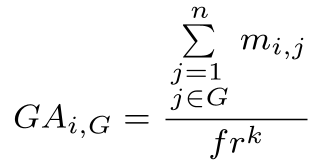
Nodes periodically reach "decision points" where they evaluate their Current Group vs. other groups. If their SF is high, they might stay social; if a random threshold exceeds their SF, they might "break away" to wander independently.
 Figure 1: Conceptual visualization of social-based grouping.
Experiments: Emergent Network Properties
The authors implemented the model in OmNet++ to see if social ties actually changed the "shape" of the network. They tested scenarios with 30 and 60 hosts across 5 social groups.
Key Findings:
- Connectivity Clusters: Unlike random models where nodes spread out uniformly, this model created dense "islands" of connectivity.
- Node Degree Distribution: The average number of neighbors () followed a Poisson-like distribution, but the peaks were significantly shifted by the social grouping mechanism.
- Dynamic Reconfiguration: Nodes successfully transitioned between groups, mimicking real-world behavior like moving from a workplace group to a social gathering.
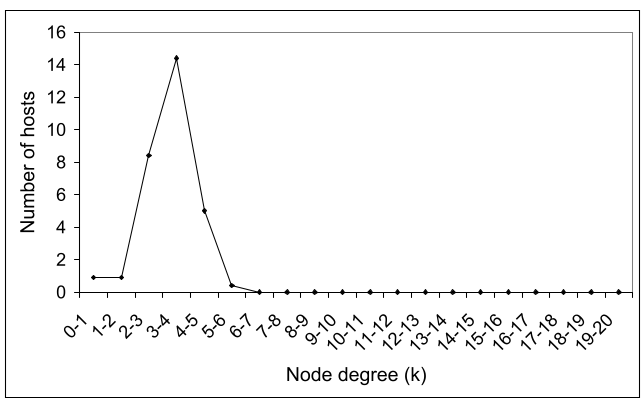 Figure 2: Distribution of the average degree of connectivity in a 30-host scenario.
Critical Insight & Future Outlook
The genius of this work lies in treating social interaction as a proxy for colocation. By identifying that "attraction" is a function of relationship strength and distance, we can build MANET protocols (like routing or data caching) that are far more efficient.
Limitations: The current model uses fixed "cloud areas" for groups and doesn't yet account for physical obstacles like walls or streets.
The Takeaway: If you are designing an epidemic routing protocol or a messaging middleware for mobile users, testing it on a Random Way-Point model is no longer enough. The future of mobile systems research must account for the social fabric of the users carrying the hardware.