
Beyond Hype: Why Skill-Aware Networks Outperform Scale-Free Structures in Team Formation
Adapting to Changing Resource Requirements for Coalition Formation in Self-Organized Social Networks
The paper introduces an Agent Organized Network (AON) framework for coalition formation, comparing "Inventory agents" (who rewire connections based on skill gaps) against "Structural agents" (who follow scale-free network principles). It demonstrates that skill-aware self-organization significantly outperforms purely topological strategies in dynamic social networks.
TL;DR
In decentralized multi-agent systems, "who you know" matters less than "what they know." This paper explores Agent Organized Networks (AONs) and proves that Inventory Agents—those who actively seek out missing skills—drastically outperform Structural Agents who merely try to become popular "hubs." By focusing on skill-supply and demand matches, these agents create more resilient coalitions in the face of changing environments.
Background: The Limits of Popularity
In social network theory, we often celebrate the "scale-free" network, where a few high-degree hubs facilitate communication. This is exactly what Structural agents aim for: they rewire their connections to link with the most connected peers. However, in a task-oriented environment (like a coalition of drones, software agents, or researchers), being well-connected is useless if your neighbors don't have the specific tools you need to finish a job.
The authors argue that real-world problems suffer from Non-Uniform Skill Distribution. If everyone has the same basic skills, popularity-based networking works fine. But when tasks require rare, specific skill clusters, the network must organize based on Inventory—the actual resources available.
Methodology: The Inventory vs. Structural Tug-of-War
The researchers compared two distinct philosophies of self-organization:
- Structural Rewiring: Based on the preferential attachment model. Agents want to connect to the "cool kids" (hubs).
- Inventory Rewiring: Agents act like strategic recruiters. They look at their neighborhood (up to 3 links away), identify which skills are causing tasks to fail, and go find an agent who has those specific skills.
The Skill Clusters
The study defined three patterns of skill distribution:
- Congregate: Highly specialized, localized skills.
- Overlapping: Some shared skills between groups.
- Uniform: Everyone has a random mix (the easy mode).
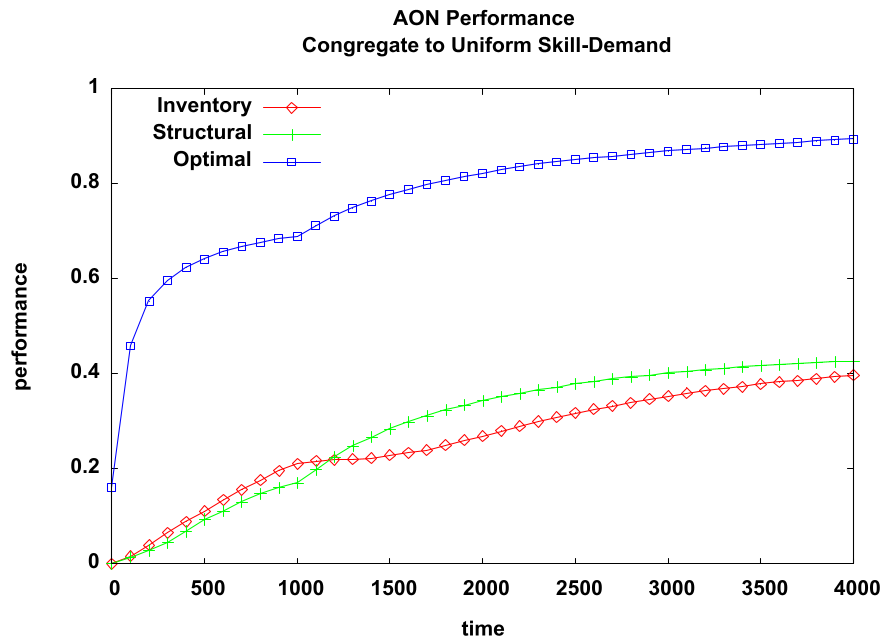 Figure: The dynamics of skill-demand over time in an Agent Organized Network.
Why Inventory Wins: Key Results
The experiments focused on two scenarios: Static Demand (where skills needed don't change) and Changing Demand (where the "market" shifts mid-experiment).
1. Superior Efficiency in Diversity
In the static tests, Inventory agents dominated. While Structural agents only performed well when the skill supply was uniform (easy conditions), Inventory agents were able to achieve high performance (above 0.5) in nearly all "Congregate" and "Overlapping" scenarios.
2. Adaptation to "Market" Shifts
The most impressive finding came from the changing demand tests. When the required skills suddenly shifted from one congregate cluster to another, Inventory agents took a temporary hit but quickly recalculated their neighbors to fill the new gaps.
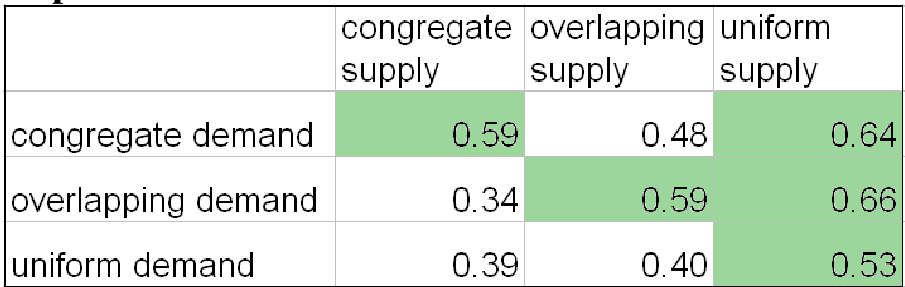 Table 1: Performance of Inventory agents under varying supply/demand conditions.
Critical Insight: The Weakness of the Smart Agent
Interestingly, Inventory agents have an "Achilles' heel": Uniformity. When the environment becomes completely uniform (all skills equally likely), the "Inventory" signal becomes noisy. Since no specific skill is "missing" more than others, the agents struggle to decide who to connect to. In these specific, bland environments, simple Structural agents sometimes perform just as well because specialized recruiting isn't necessary.
Conclusion and Future Outlook
This research highlights a fundamental shift in how we should design decentralized systems. Instead of optimizing for connectivity (Network Science view), we should optimize for resource coverage (Optimization view).
The takeaway for researchers is clear: if you are building an autonomous system (like a robotic swarm or a decentralized DAO), don't just aim for a "highly connected" network. Build agents that "know what they don't know" and seek out diversity to bridge their local resource gaps.
Limitations: The study currently operates with a fixed "knowledge radius." Future work would benefit from exploring how dynamic search depths (looking 4 or 5 links away) might impact the speed of reorganization at the cost of higher communication overhead.