
Decoupling Security: Using Aspect Weaving for Adaptive Social Network Access Control
Adaptive Access Control Enforcement in Social Network Using Aspect Weaving
This paper introduces an adaptive access control framework for social networks by combining the Organization-Based Access Control (OrBAC) model with Aspect-Oriented Programming (AOP). By leveraging "Aspect Weaving," the authors demonstrate how to externalize and dynamically inject complex, context-aware security policies into existing platforms like Elgg without invasive code modification.
TL;DR
Modern social networks demand complex, context-aware privacy settings that traditional hard-coded security cannot handle. This paper presents a methodology to externalize these policies using OrBAC (Organization-Based Access Control) and inject them into running applications via Aspect-Oriented Programming (AOP). The result is a system where security rules can be updated on-the-fly without touching a single line of the original application logic.
The Architect's Dilemma: Hard-Coded Security
In the early days of a social network, a simple "friends-only" rule suffices. However, as networks grow, users demand "Limited Friends," "Work Colleagues," and rules that change based on the time of day or geographic location.
The authors point out three critical failures in current systems:
- Lack of User Control: Users are stuck with whatever predefined privacy toggles developers provide.
- Scattered Enforcement: Security is often an afterthought, leading to "spaghetti code" where access checks are manually inserted into hundreds of locations.
- Maintenance Nightmares: Changing a security model requires a complete audit of the codebase, which is prone to human error and logic leaks.
The Core Insight: Security as a Cross-Cutting Concern
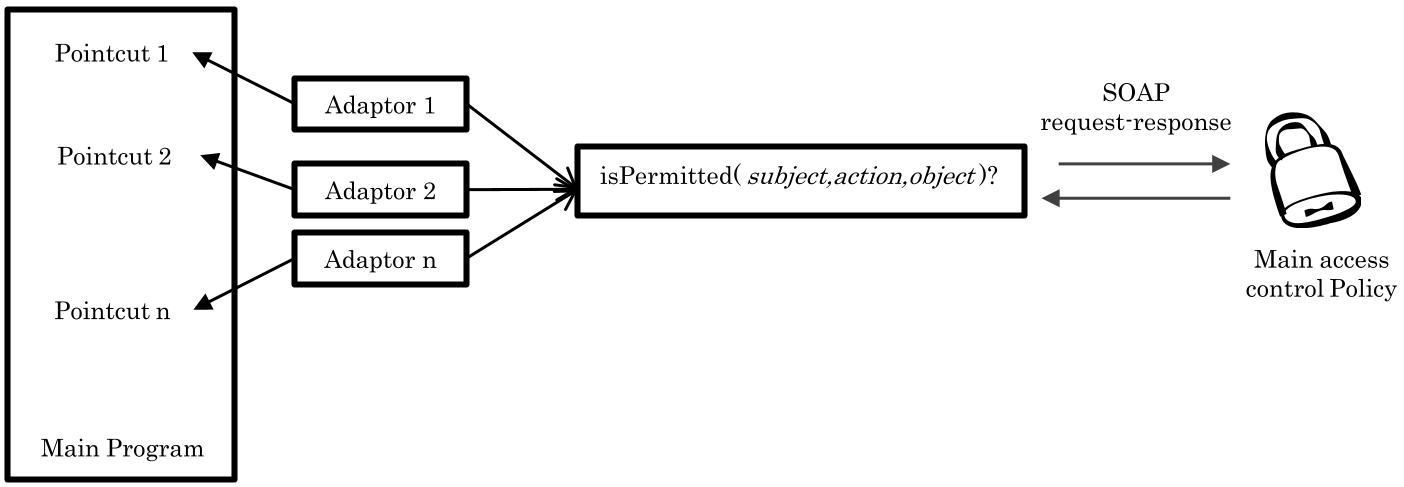
The paper treats security not as a feature of a specific function, but as a cross-cutting concern. Using AOP, they define Pointcuts (specific moments in a program's execution, like a database call) and Advices (the security logic to run at those moments).
To make this reusable, they split the implementation into two parts:
- The Adaptor: Gathers context from the specific application (Subject, Action, Object).
- The Middleware: A program-independent component that queries a formal OrBAC engine to decide if an action is permitted.
Why OrBAC?
While Role-Based Access Control (RBAC) is common, it struggles in social networks. In RBAC, if Alice is a "Friend," she is a friend to everyone. OrBAC solves this by introducing the concept of an Organization. In this framework, each user is treated as their own organization.
This allows for logic like: “In Alice's organization, Bob holds the role of Close Friend.” This hierarchical structure allows users to inherit global network rules while defining their own specific exceptions and custom roles (e.g., "Office Friends").
Methodology & Real-World Application
The authors tested their approach on Elgg, a popular open-source social network. They identified key "sink" methods—the last links in the execution chain before data is sent to the user (e.g., elgg_view). By weaving security aspects here, they effectively created a "security perimeter" around the data.
The "Direct URL" Challenge (Ablation/Validation)
A critical takeaway from their experiment was the "security through obscurity" bug. Even if a profile page is hidden via AOP, a user might guess the direct URL of a picture. The authors demonstrated that the AOP approach is only as strong as its Pointcut selection. To truly secure the system, one must intercept the lowest-level data-retrieval methods to prevent unauthorized direct access.
Critical Insight & Conclusion
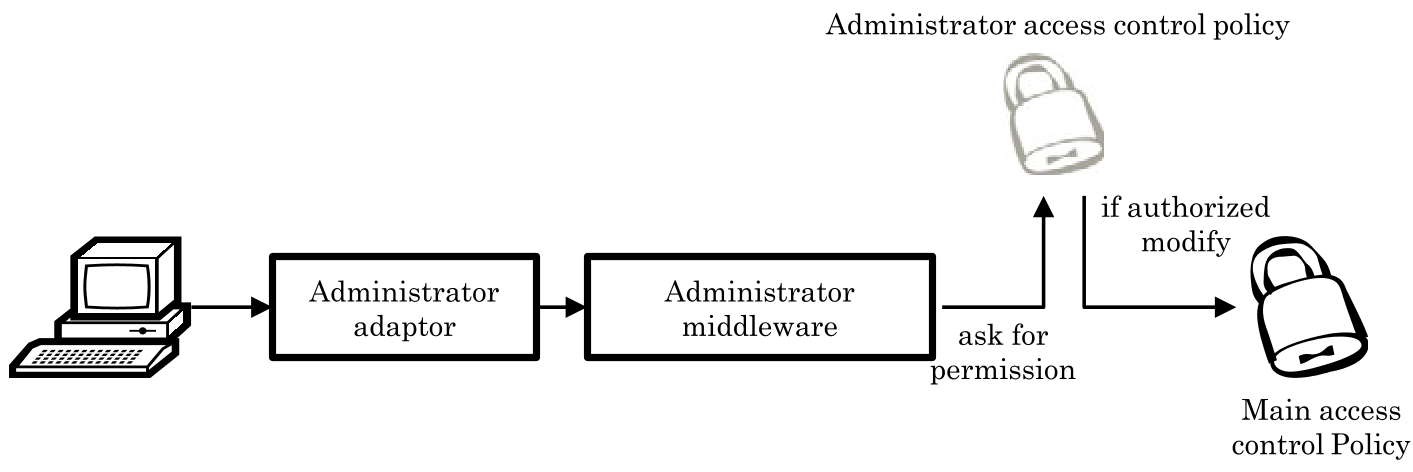
This work shifts the paradigm of social network security from procedural enforcement to declarative policy. By using AOP, developers can focus on features while security experts manage policies in a centralized OrBAC engine.
Limitations: The primary bottleneck is the AOP framework's compatibility with the host language (PHP in this case) and the potential latency introduced by making SOAP calls for every access request.
Future Outlook: As we move toward decentralized social networks (Web3), the idea of users owning their own "Organization-based" security policies—independent of the platform provider—becomes increasingly relevant. This paper provides the early blueprint for that architectural separation.