
Metric Social Networks: Scaling Similarity Search through the Law of Generalization
Adaptive Approximate Similarity Searching through Metric Social Networks
This paper introduces an enhanced Metric Social Network (mSN) framework for approximate similarity searching in P2P environments. It leverages an adaptive query forwarding algorithm and a history management mechanism based on the "universal law of generalization" to achieve high recall with minimal network overhead.
TL;DR
Searching for similar images or complex data in massive, unstructured Peer-to-Peer (P2P) networks has traditionally been a choice between high costs (flooding) or poor accuracy. This paper solves this by treating P2P nodes like a social network. By using a "Confusability" metric to decide how to route queries and "Replaceability" to prune old data, the authors achieved a 95% recall with only 7% network traffic.
Problem & Motivation: Beyond the Search Bar
In the world of multimedia (images, video, bio-chemistry), "exact matches" don't exist; we look for "similarity" within a Metric Space. In a distributed P2P world, finding these neighbors is hard because:
- Inefficient Navigation: Without a central index, queries often drift aimlessly through the network.
- Growth Fatigue: As a peer asks more queries, its "knowledge" (history) grows indefinitely, slowing down local processing.
- Cold Start: When a new, unique query arrives, the network doesn't know where to "socialize" it.
The authors' insight is brilliant: Querying is a social act. If Peer A returned a good result for Query X, it is likely a "friend" for similar queries.
Methodology: Social Dynamics and Mathematics
The core of the Metric Social Network (mSN) lies in two types of relationships: Acquaintances (weak ties that provide the best single result) and Friends (strong ties that consistently contribute to answers).
1. Adaptive Navigation (The Confusability Measure)
When a peer initiates a query , it looks for a template in its history. If is very different from anything seen before, the system "floods" the network to find new leads. If it’s similar, it targets known friends.
This decision is governed by Confusability: It combines distance (), spatial overlap (), and time () to calculate how "confused" the system is about the new query.
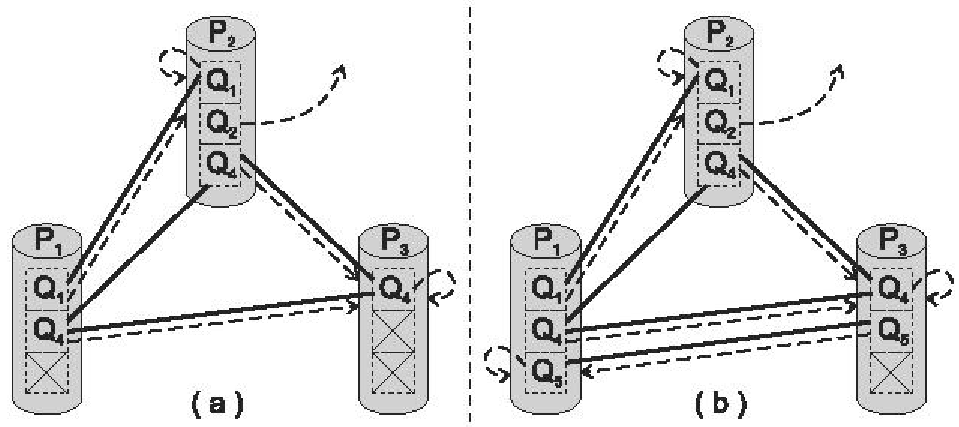 Fig 1: How ties are formed and strengthened after processing a query (Q5).
2. History Pruning (Replaceability)
To prevent memory bloat, the authors introduced a Replaceability function. It works like human memory: if a new query provides better or more recent coverage than an old query , is evicted. This ensures the history remains a "compact summary" of the network's capabilities.
Experiments & Results
The authors tested their algorithms on a real-world dataset of 200,000 image feature vectors.
- Efficiency: Initially, the system is "dumb" and contacts 40% of the peers. As the "social ties" settle, costs drop to 7% while recall jumps to 95%.
- Compression: Even with a hard cap of 100 history items per peer (Min100/Max100), the search quality remained high. This proves that "intelligent forgetting" is just as important as "learning."
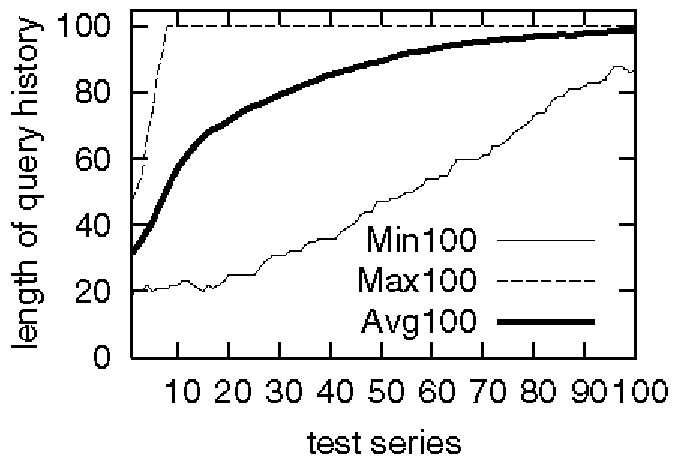 Fig 2: The convergence of recall vs. cost (left) and the stability of query history length (right).
Critical Analysis & Conclusion
Takeaway: This work proves that we don't need global knowledge to search effectively. Local interactions, governed by cognitive principles like the Law of Generalization, can self-organize into a highly efficient global search structure.
Limitations:
- The current study focuses on static data. In dynamic environments where peers frequently join/leave (churn) or data is updated, the "social ties" might break too quickly.
- The scale tested (network of computers) is relatively small compared to modern internet-scale applications.
Future Outlook: This approach is a precursor to modern "Vector Databases" and "Decentralized Search." Integrating these metric social concepts into blockchain-based data storage or edge-computing clusters could be the next frontier for truly private, decentralized information retrieval.