
Adaptive Budgeting: Solving the Sequential Quality Bottleneck in Crowdsourcing
Adaptive Budget Allocation for Sequential Tasks in Crowdsourcing
This paper introduces an adaptive budget allocation method for sequential crowdsourcing tasks (e.g., Find-Fix-Verify) using a Partially Observable Markov Decision Process (POMDP). By formalizing the workflow as a stochastic control problem, the system dynamically decides whether to continue improving a current subtask, move to the next, or invest in quality evaluation based on intermediate results and remaining funds.
TL;DR
In multi-stage crowdsourcing (like translation or software debugging), the final output is only as good as its weakest link. This paper introduces a POMDP-based adaptive allocation strategy that dynamically shifts budget between "doing work" and "evaluating work" based on the evolving state of the project, significantly outperforming static allocation baselines.
Background: The Sequential Dependency Trap
Crowdsourcing complex tasks often follows a sequential pipeline (e.g., Find-Fix-Verify). If the "Find" stage fails to identify errors, the subsequent "Fix" stage is useless, regardless of how much budget is thrown at it.
Current industry standards typically use:
- Fixed Allocation: Spend every time. (Inefficient: wastes money on already-perfect tasks).
- Difficulty-Based: Spend more on harder tasks. (Inflexible: can't react if a worker delivers a surprise "Home Run" early on).
The authors argue that the requester acts under Partial Observability: they don't really know the quality of a subtask until they pay another worker to verify it.
Methodology: Crowdsourcing as a POMDP
The researchers transform the workflow into a sequential decision-making process under uncertainty.
1. The POMDP Model
The state is defined by , tracking the current subtask index (), current quality (), remaining budget (), and the previous stage's quality ().
2. Available Actions
The "Agent" (the requester) can choose:
- CURRENT(): Higher one more worker for the current task.
- NEXT(): Move to the next stage.
- EVAL(): Pay a small amount to get a "noisy" observation of the current quality.
3. The Quality Function
The artifact quality is modeled as: This captures the multiplicative penalty of sequential tasks: a poor throttles any future potential quality .
 Figure 1: Conceptual sequential workflow where subsequent quality depends on preceding outputs.
Computational Insight: Discretization
Solving a POMDP with continuous budget and quality values is computationally intractable ("The Curse of Dimensionality"). The authors solve this by discretizing the budget () and ability levels (), making the policy reachable in a "reasonable time."
Experimental Analysis
The authors tested their agent (P-Agent) against two baselines:
- E-Agent: Equal split of budget.
- D-Agent: Split based on perceived difficulty.
Performance Comparisons
Whether the task difficulty was increasing (getting harder) or decreasing (starting hard), the P-Agent consistently found the optimal path.
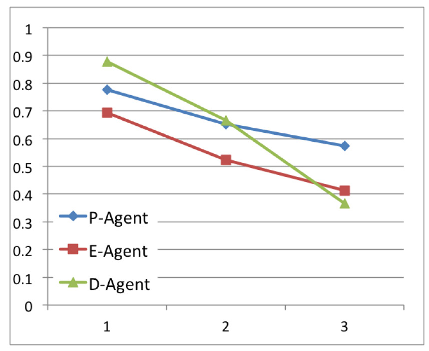 Figure 2: Performance comparison across different scenarios. P-Agent (solid line) approaches the theoretical optimal more closely than static agents.
Key Findings:
- Adaptability: When a high-ability worker appears early (convex distribution), P-Agent saves the surplus budget for the final, most critical stages.
- Evaluation Value: The agent learned to use the
EVALaction selectively—only when the uncertainty of the current state outweighed the cost of the evaluation hit.
Critical Insight & Conclusion
The real breakthrough here isn't just "using a POMDP," but the realization that evaluation itself is a budget item. Most frameworks treat verification as a post-hoc metadata step. Here, it is an strategic action.
Limitations
- Prior Knowledge: The model requires knowing the distribution of worker abilities () beforehand, which is difficult in open-world crowdsourcing.
- Scalability: For tasks with dozens of subtasks, the discretized state space might still explode.
Future Outlook: Integrating Multi-Armed Bandits (MAB) with this POMDP framework could allow the system to learn worker qualities on-the-fly, creating a truly autonomous "Crowd Project Manager."