
Beyond Benchmarking: Navigating the Shifting Tides of Temporal Crowds
Adaptive crowdsourcing for temporal crowds
This paper introduces a Multi-Armed Bandit (MAB) framework to optimize crowd platform selection in "temporal crowds"—environments where performance metrics like accuracy and response time shift over time. The authors propose the ε-smart algorithm, which outperforms traditional static selection methods by adaptively exploring only potentially optimal platforms.
TL;DR
Crowdsourcing platforms are not static utilities; they are dynamic ecosystems where performance (accuracy, speed) drifts over time. This paper argues that the common industry practice of "pick a platform and stick with it" is fundamentally flawed. By framing platform selection as a Multi-Armed Bandit (MAB) problem and introducing the ε-smart algorithm, the authors demonstrate a way to adaptively switch between platforms to maximize quality and minimize latency.
The "Folklore" of Crowd Variability
For years, researchers suspected that crowdsourcing performance was inconsistent. However, most attributed this to "noise." This paper provides empirical evidence that it isn't just noise—the underlying probability distribution of reward (performance) actually changes.
The authors tracked two major platforms over a week, injecting 10,000 digitization tasks. The data revealed a startling reality: the "best" platform for response time switched 26 times in just 84 time steps. If you benchmarked at the start of the week and never checked again, you would be using the wrong platform nearly a third of the time.
Methodology: The Logic of ε-smart
The core challenge is the Exploration-Exploitation trade-off. If you only use the platform that worked yesterday (Exploit), you miss out when another platform improves. But if you constantly test every platform (Explore), you waste money on low-quality results.
The authors' contribution, ε-smart, improves upon the classic ε-greedy algorithm with a simple physical intuition: Gradual Change. Since platform performance evolves like a random walk, a platform that was terrible 10 minutes ago is highly unlikely to be the best right now.
The Inactivity Filter
The algorithm marks a platform as "inactive" if: Essentially, if the gap between the current champion and a candidate is larger than the maximum plausible "drift" the candidate could have made since it was last checked, the algorithm refuses to waste resources exploring it.
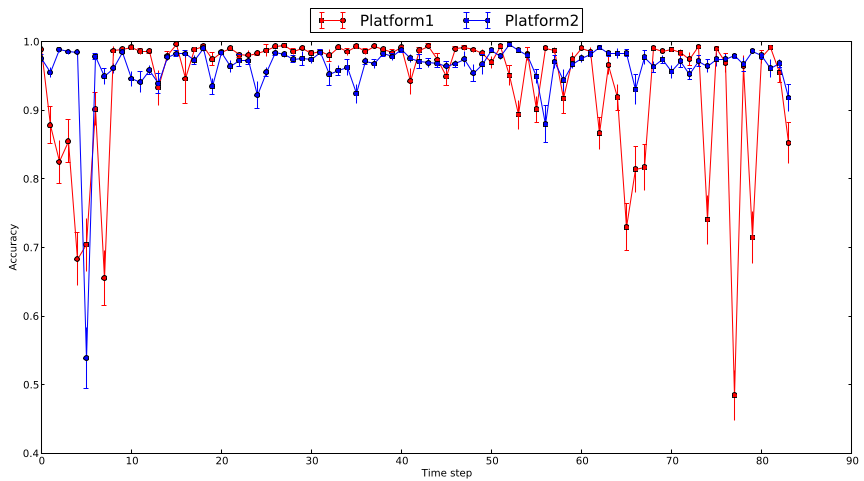 Figure 1: Comparison of Accuracy and Response Time over time, illustrating the crossing of performance lines between Platform 1 and Platform 2.
Experiments: Beating the Static Strategy
The authors tested five algorithms:
- Random: Pure chance.
- Bootstrap: Test once at the start, then lock in (Current Industry Standard).
- ε-greedy: Fixed percentage of random exploration.
- EXP3m: A state-of-the-art adversarial bandit algorithm.
- ε-smart: The proposed adaptive filter.
Key Findings
- Accuracy: ε-smart achieved the lowest strong regret, proving it identifies quality shifts faster than its peers.
- Scalability: As the number of "arms" (different task configurations or platforms) increased to 40, only ε-smart maintained positive Weak Regret. This means it didn't just "lose less"—it actually performed better than if a human had perfectly guessed the best static platform.
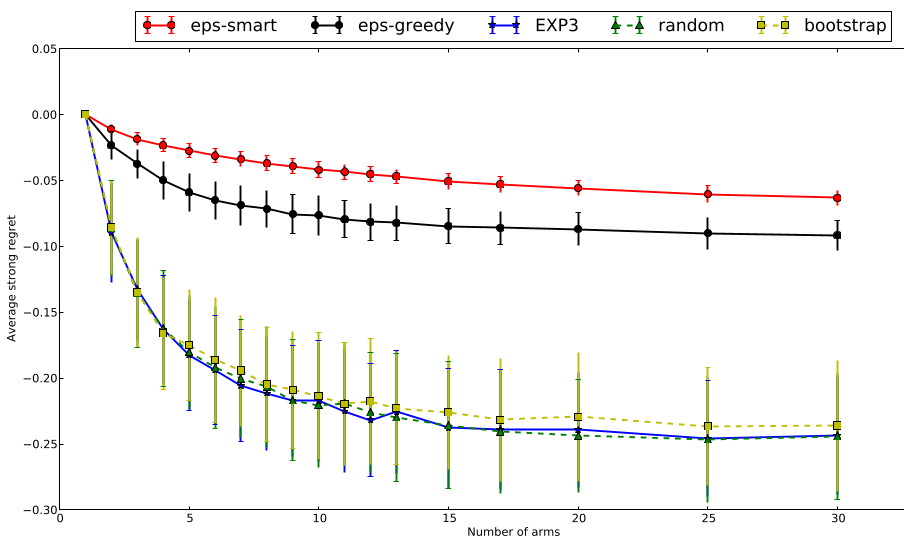 Figure 2: Regret as a function of the number of arms. ε-smart (red line) consistently stays above the competition in weak regret benchmarks.
Critical Insight & Future Outlook
The beauty of this work lies in its pragmatism. It acknowledges that platforms like Amazon Mechanical Turk and CrowdFlower are influenced by time-of-day effects, worker fatigue, and shifting demographics.
Limitations: The current model uses a window size of 1 (), which makes it sensitive to extreme outliers. In highly noisy environments (like the response time data), this caused ε-smart to occasionally "ignore" a platform for too long.
The Takeaway: For any enterprise relying on distributed human intelligence, adaptive routing is no longer optional. As the crowdsourcing market becomes more fragmented, algorithms that "know when to look elsewhere" will be the primary drivers of cost-efficiency.