
Beyond One-Size-Fits-All: Scaling Adaptive E-Learning with Big Data and Swarm Intelligence
A novel adaptive e-learning model based on Big Data by using competence-based knowledge and social learner activities
The paper introduces a novel adaptive e-learning model integrated into a Big Data environment using the MapReduce framework. It leverages a MapReduce-based Genetic Algorithm (GA) for prerequisite assessment, a MapReduce-based Ant Colony Optimization (ACO) for personalized learning path (PLP) generation, and Social Network Analysis (SNA) to assign tailored learning rhythms.
TL;DR
This study presents a robust, two-level adaptive e-learning architecture designed for the Big Data era. By combining Genetic Algorithms (GA) for knowledge assessment, Ant Colony Optimization (ACO) for pathfinding, and Social Network Analysis (SNA) for psychological profiling—all running on MapReduce—it creates a system that evolves with the learner's prerequisites and social drive.
The "Static Content" Bottleneck
Despite the digital revolution, most e-learning systems remain "digital textbooks"—static, linear, and indifferent to the reader's background. Learners often waste time on mastered concepts or hit walls when prerequisites are missing. In the age of Big Data, the challenge isn't just delivering content, but processing massive streams of learner activity to provide a Personalized Learning Path (PLP) in real-time.
Methodology: The Two Levels of Adaptation
Level 1: Content Optimization (GA + ACO)
The first step involves a deep scan of what the learner already knows.
- MapReduce-based GA: The system treats educational objectives as "chromosomes." By using a specialized fitness function based on e-assessment results, it filters out "Prerequisites" and isolates Future Educational Objectives (FEO). This reduces cognitive overload by ensuring students only see what they don't know.
- MapReduce-based ACO: Once the FEOs are identified, the system simulates "ants" traversing a graph of these objectives. The path with the optimal balance of pheromone intensity (relevance) and distance (efficiency) becomes the student's PLP.
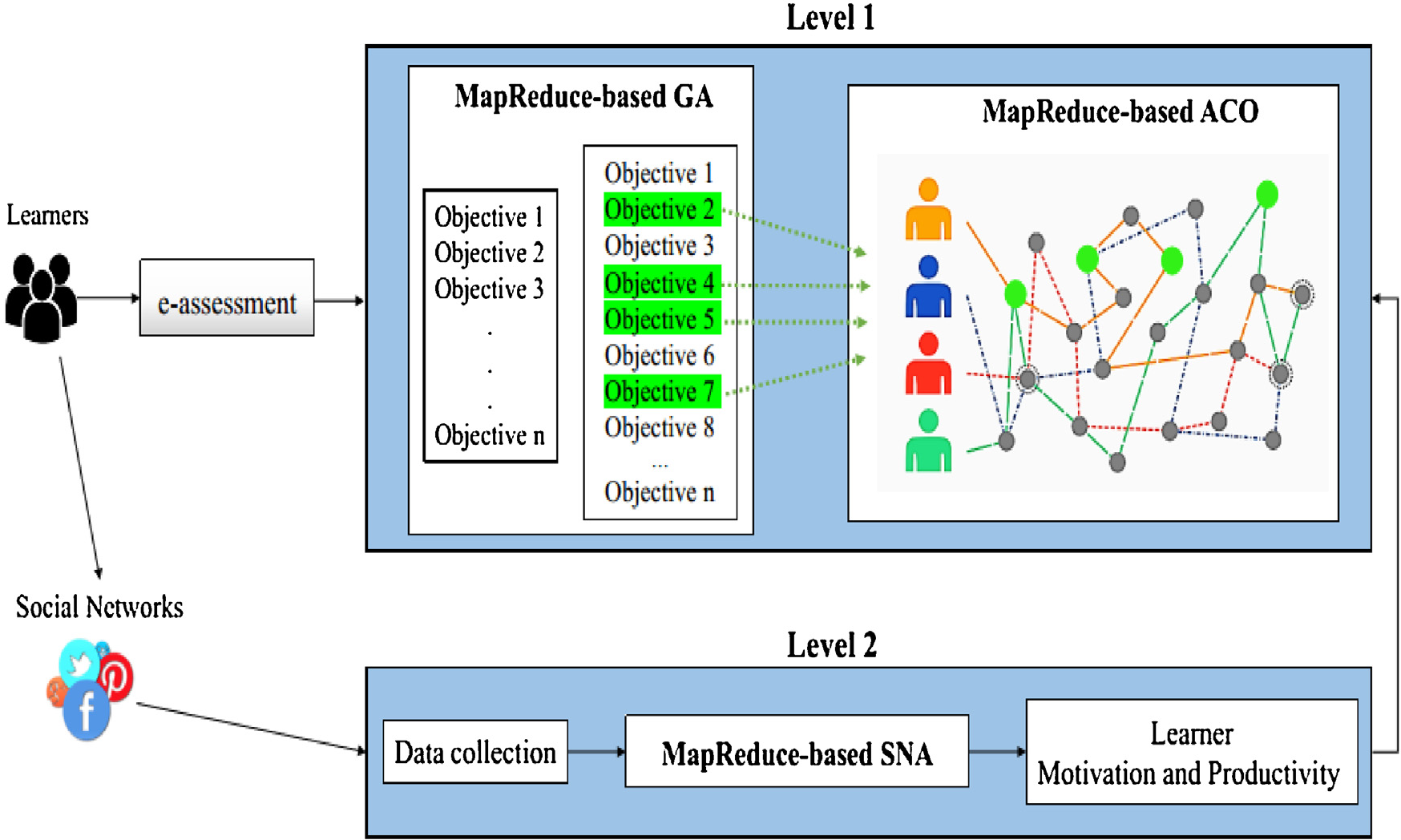 Figure 1: The proposed adaptive e-learning architecture leveraging Hadoop MapReduce for GA, ACO, and SNA.
Level 2: The Social Heartbeat (SNA)
Learning isn't just cognitive; it's emotional. The authors use Apache Flume to ingest social media data (Twitter, Facebook) and apply sentiment analysis via the AFINN dictionary.
- Motivation vs. Productivity: By tracking positive/negative sentiments and the frequency of social interactions, the system determines the learner's "Social Rhythm."
- Dynamic Rhythms: A highly motivated and productive learner might receive a "Level 3" rhythm (concise, concept-focused), whereas a demotivated learner receives "Level 1" (detailed definitions and high scaffolding).
Experimental Results & SOTA Comparison
The authors validated their MapReduce-based GA against well-known IR baselines. The performance gains in average precision were staggering:
- CACM Collection: +107.78% improvement.
- Medline Collection: +51.45% improvement.
Beyond accuracy, the scalability tests proved that as the number of cluster nodes increases, the time to generate a PLP decreases linearly, making it viable for MOOCs with millions of users.
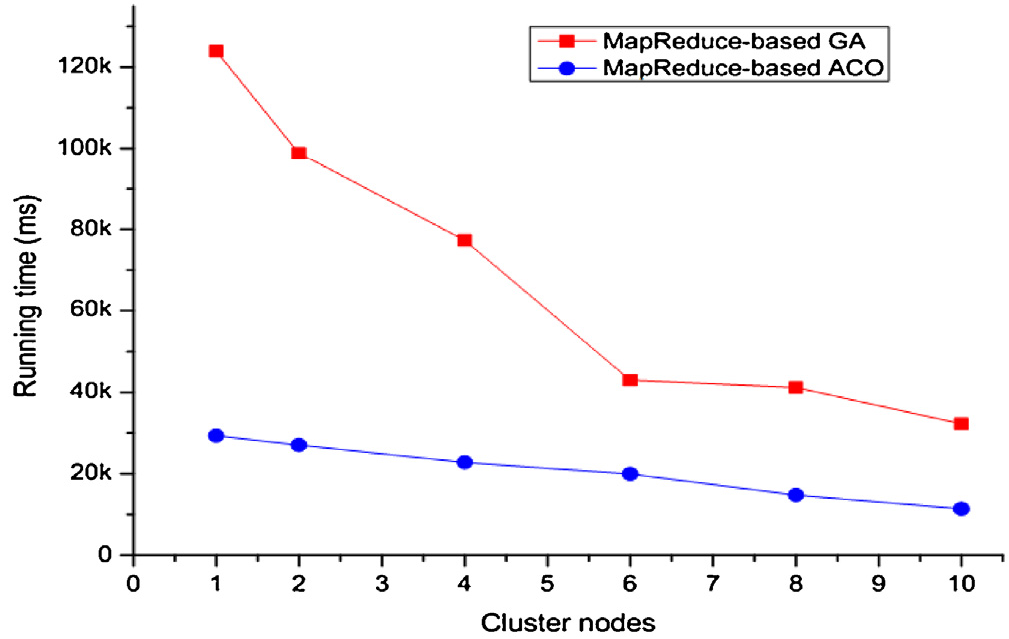 Figure 2: Impact of cluster size on the running time of GA and ACO algorithms.
Critical Insight: Why This Works
The brilliance of this model lies in its Inductive Bias. It assumes that the "shortest path" to knowledge isn't just about the shortest sequence of videos, but the one that aligns with the learner's current psychological and social state. Using MapReduce solves the "Velocity" and "Volume" problems of Big Data, ensuring that the personalization happens at a scale traditional SQL-based LMS systems could never handle.
Conclusion & Future Outlook
This paper serves as a blueprint for the next generation of "Smart Learning." While the reliance on social media data (SNA) raises interesting privacy and data-access questions in 2026, the technical framework of using swarm intelligence on a distributed Big Data backbone remains the gold standard for adaptive systems. Future work might replace the GA/ACO components with Deep Reinforcement Learning, but the core philosophy of multi-level adaptation will likely persist.