
EBPR: Not All Social Links are Created Equal—Refining Recommendations via Adaptive Embeddings
Not All Links Are Created Equal: An Adaptive Embedding Approach for Social Personalized Ranking
This paper introduces EBPR (Adaptive Embedding for Social Personalized Ranking), a graph-based recommendation framework that jointly learns user interest and social embeddings. By treating social links as non-equal and adaptive, it achieves SOTA performance on LastFM and Delicious datasets, outperforming established baselines like BPR-MF and MR-BPR.
TL;DR
Social recommendation systems often fail because they blindly trust that "friends share interests." EBPR (Adaptive Embedding for Social Personalized Ranking) breaks this assumption. It treats social links as noisy and sparse signals, using an adaptive embedding framework that propagates interests only through relevant neighbors. By combining first-order and second-order graph proximities with interest-aware weighting, it delivers a massive boost in ranking accuracy.
Problem & Motivation: The "Social Myth" in Collaborative Filtering
Most social recommendation models rely on a fundamental Inductive Bias: if User A follows User B, their latent preference vectors should be close (Social Regularization).
The authors of this paper challenge this. Based on analysis of datasets like LastFM and Delicious, they highlight two debilitating issues:
- Noisy Social Links: Many social connections are formed due to family, work, or casual acquaintance rather than shared product interests. Correlation coefficients show that proximity in a social graph does not always equal proximity in interest space.
- Sparse Social Links: The social graph is often too thin to provide meaningful signal, and attempting to "fill in the blanks" through simple transitivity often introduces more noise.
The authors' insight? Jointly solve sparsity and noise. Use interest data to filter social links, and use the filtered social graph to enrich the sparse interest data.
Methodology: The Core of EBPR
Instead of traditional global Matrix Factorization, EBPR adopts an embedding-based perspective inspired by the equivalence between Word2Vec and MF.
1. Unified Embedding Objective
The model maximizes a posterior that joins two components:
- Interest Embedding: Optimizes the ranking-based AUC loss using the BPR-opt criterion.
- Social Embedding: Learns structural representations of the network.
2. Adaptive Interest Propagation
This is the "secret sauce." To model second-order proximity (friends of friends), EBPR doesn't just average neighbor vectors. It uses a transition probability based on cosine similarity in the interest space:
p(v|u) ∝ similarity(Interest_u, Interest_v)
This ensures that "interest-relevant" neighbors have a higher impact on a user's representation than "noisy" neighbors.
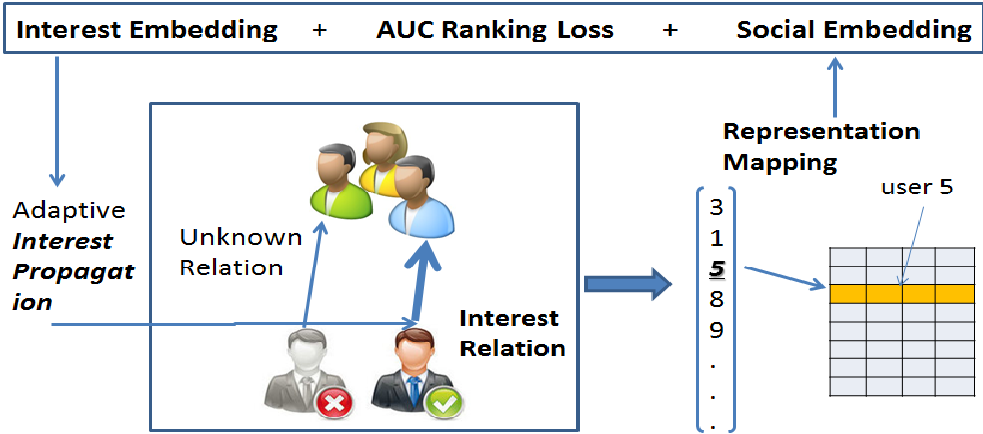 Figure 1: The EBPR Framework—Jointly learning interest and social embeddings with adaptive propagation.
Experiments & Results
EBPR was tested against strong baselines including WRMF, BPR-MF, and the state-of-the-art multi-relational BPR (MR-BPR).
Key Findings:
- Consistent SOTA: On both LastFM and Delicious, EBPR outperformed all baselines.
- Metric Gains: On the Delicious dataset, which is notably sparse (0.08%), EBPR saw a significant jump in NDCG@30 (0.1814 vs. MR-BPR's 0.1419).
- Ablation Study: The comparison with
EBPR-U(using uniform distribution instead of adaptive weighting) proves that the interest-aware propagation is essential for filtering noise.
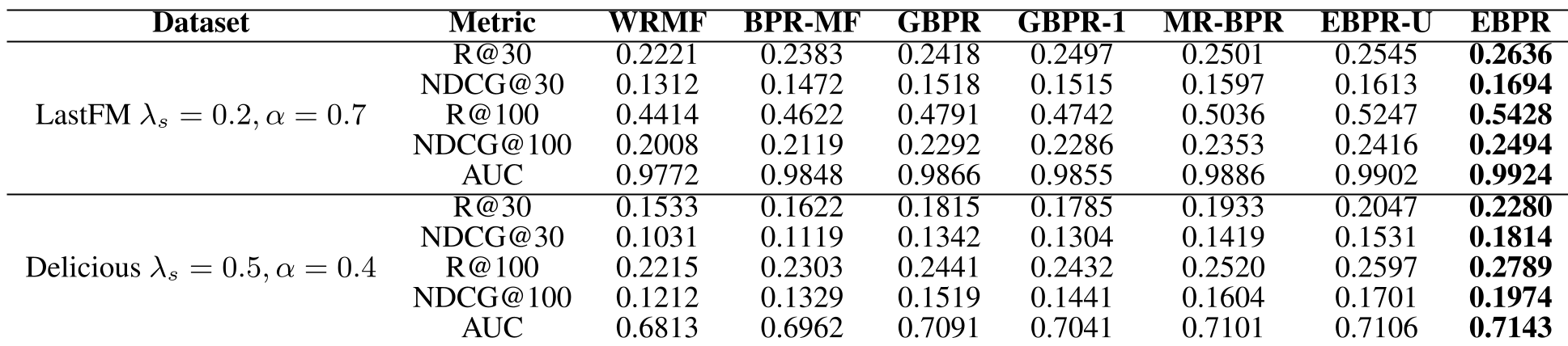 Table 1: Performance comparison. Note the consistent lead of EBPR across R@K, NDCG@K, and AUC.
Critical Analysis & Conclusion
Takeaway
EBPR demonstrates that social networks are not monolithic. By moving from static regularization to adaptive embedding, the model becomes robust to the "social noise" that plagues real-world datasets. This approach provides a flexible avenue for incorporating complex user interactions beyond simple binary links.
Limitations & Future Work
While EBPR solves noise within the social graph, it still relies on a linear combination of interest and social embeddings. Future iterations could explore Graph Attention Networks (GATs) to learn these weights more dynamically across different layers of the graph or investigate the temporal dynamics of how social links evolve alongside interests.