
Adaptive SIoT: Bridging the Gap Between Smart Objects and Social Intelligence
An Adaptive Formal Metamodel for Semantic Complex Event Processing-Driven Social Internet of Things Network
The paper proposes an adaptive formal metamodel for Social Internet of Things (SIoT) networks, integrating Semantic Complex Event Processing (CEP) and Fuzzy Logic. The core method, CaSIoTNM, enables smart objects to autonomously establish social relationships and execute actions based on user habits and context, demonstrated through a Smart Home prototype.
TL;DR
This research presents a novel Social Internet of Things (SIoT) metamodel that doesn't just connect devices, but allows them to "socialize" and adapt to human life. By combining Semantic Complex Event Processing (CEP) with Fuzzy Logic, the system transitions from rigid binary commands to nuanced, context-aware actions that mirror human habits, particularly within Smart Home environments.
Context: The Socialization of Things
As the IoT ecosystem expands, we face a "discovery" crisis. With billions of devices, how do we efficiently find and trust the right service at the right time? The Social Internet of Things (SIoT) paradigm suggests a solution: let objects build social relationships—similar to human friendship or parental bonds—to improve network navigability and service trustworthiness.
However, the "Internet of Things" is traditionally built on sharp thresholds. For example, "If temperature > 25°C, turn on AC." Yet, human comfort is subjective. This paper identifies the lack of adaptation and semantic depth in current IoT models as a major roadblock.
Methodology: The CaSIoTNM Framework
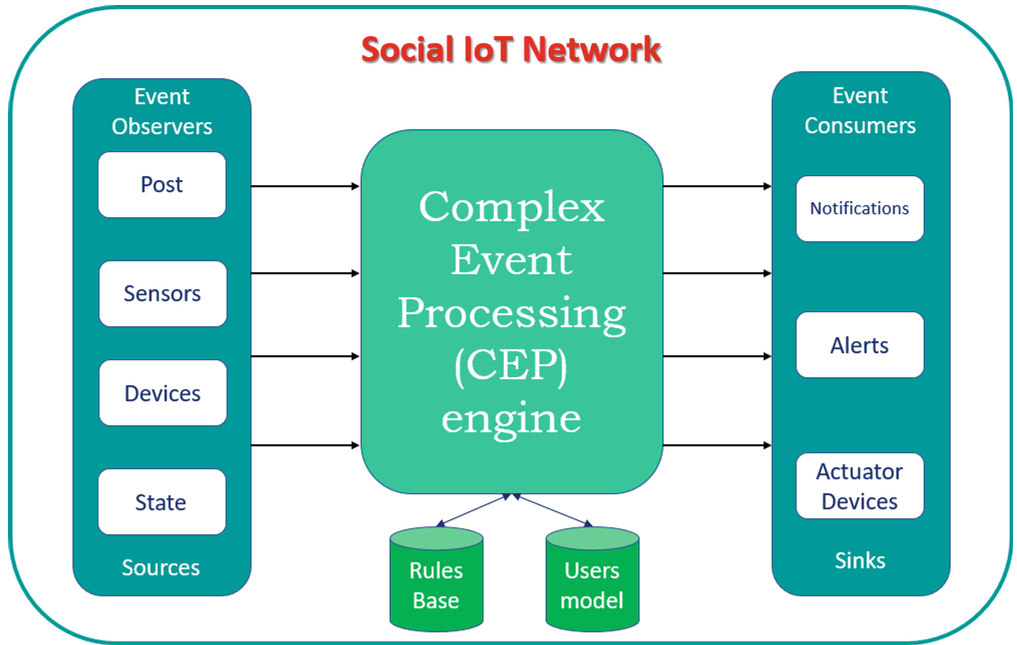
The authors propose the Context-aware SIoTN Metamodel (CaSIoTNM). Unlike traditional databases that store then process, their Complex Event Processing (CEP) engine processes data "on the fly."
1. The Formal Ontology
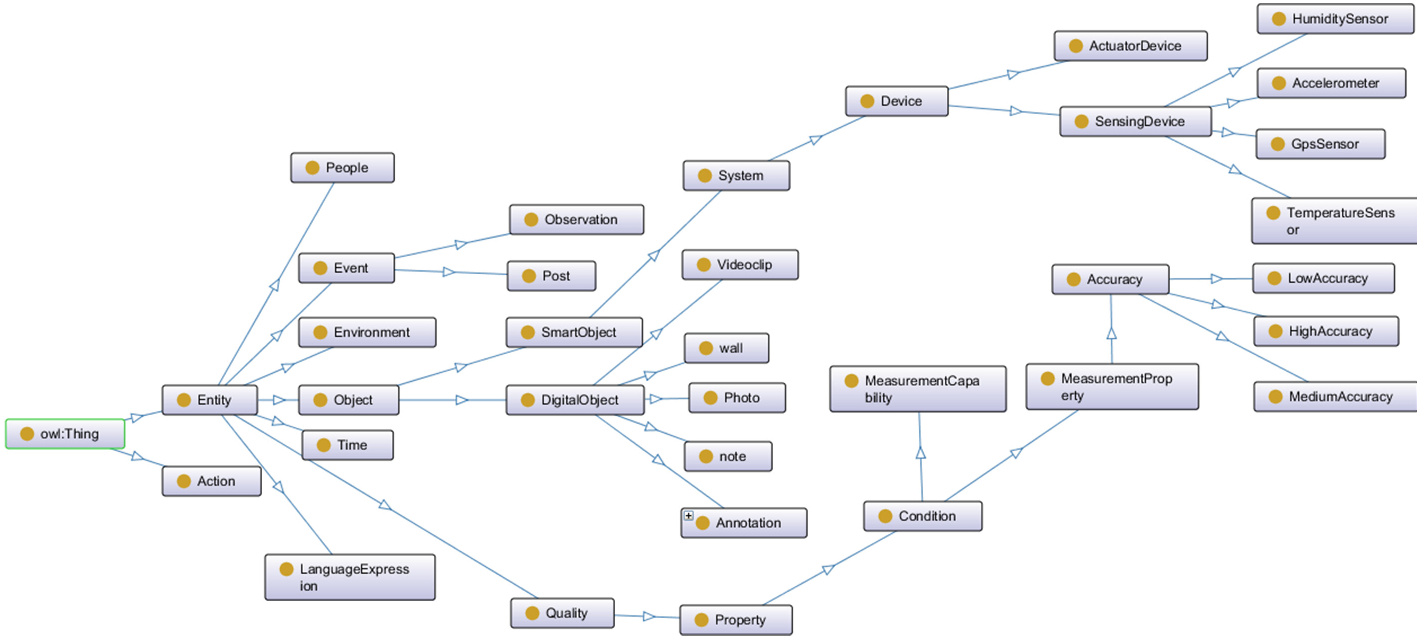
The system relies on a formal SIoTN Ontology that defines entity classes, instances, and relationships (parent-child, causal, following). This allows the system to reason about why an action should happen based on the identity of the "social object."
2. Fuzzy ECA Rules: The "Secret Sauce"
This is where the paper innovates. Most systems use "Crisp Sets" (True/False). The authors argue that a state is rarely a perfect match for a condition. They introduce Fuzzy Logic to the Event-Condition-Action (ECA) rules.
Instead of: Time = 13:30
They use: Time is "around" 13:30 (modeled via a Triangular Membership Function).
This allows the system to calculate a degree of membership (between 0 and 1). The Rule Manager then selects the action with the highest "truth value" that exceeds a specific threshold .
Prototype Instantiation: The Smart Home
The researchers tested their model in a Smart Home scenario.
- Sensors (Sources): GPS, temperature sensors, and social media posts.
- Logic: Using Fuzzy ECA rules to recommend apps or trigger home heating.
- Implementation: They utilized OWL 2 for knowledge representation and Protégé for managing the ontology.
Key Experimental Rules
| Event | Condition (Fuzzy) | Action |
|---|---|---|
| Fire Alarm | Temperature & Duration > Threshold | Post alert to Social Network |
| Smart Recommendation | GPS Proximity < AND Time 19:00 | Display Facebook/Netflix/Meteo |
Critical Insight & Future Outlook
The primary contribution of this work is the mathematical formalization of fuzziness in SIoT. By allowing variables like "radius" or "time" to be interpreted within intervals rather than fixed points, the system accommodates the natural variability of human behavior.
Limitations: While the formal model is robust, the current prototype relies on manually set fuzzy parameters (x, y, z, t). The authors note that the next step is automatic learning of these parameters by observing user behavior over time.
The Future: The integration of wearable sensors for health monitoring is planned. This could transform SIoT from a convenience tool into a life-saving social agent that understands when a user's health metrics are "slightly off" even before a critical threshold is reached.
Conclusion
This paper serves as a bridge for the "Socio-Technical" network. By treating "things" as social actors and using fuzzy interpretations of our environment, we move closer to a world where our technology feels less like a series of gadgets and more like an intuitive extension of our social fabric.