
Adaptive Autonomic Systems: Harmonizing Q-Routing and Intelligent Scheduling
Adaptive job routing and scheduling
This paper introduces a top-down approach to autonomic computing using Reinforcement Learning (RL) to manage job routing and CPU scheduling. The authors propose a novel vertical network simulator and demonstrate that a combination of Q-routing and a new "Insertion Scheduler" achieves SOTA-level utility maximization by adapting to dynamic network conditions and non-linear utility functions.
TL;DR
As enterprise computer systems explode in complexity, the "manual configuration" era is reaching its breaking point. This paper moves beyond simple "bottom-up" fixes by introducing a top-down framework where machines learn to route jobs and schedule CPU cycles autonomously. By combining Q-routing with a novel Insertion Scheduler, the authors demonstrate a system that not only recovers from "catastrophic" hardware slowdowns but also prioritizes tasks to maximize real-world user utility.
Problem & Motivation: The Complexity Wall
Modern enterprise systems—clusters of web servers, mail servers, and databases—are typically static. If a link goes down or a server slows, human intervention is usually required.
The authors argue that existing "Autonomic Computing" research focuses too much on individual components. The real challenge is System-Wide Interaction:
- Myopic Routing: Heuristics like "route to the fastest neighbor" fail when the actual bottleneck is three hops away.
- Utility Blindness: Most schedulers treat every job equally, but in reality, a 1-second delay for a VIP user is more costly than a 10-second delay for a background task.
Methodology: The Core Architecture
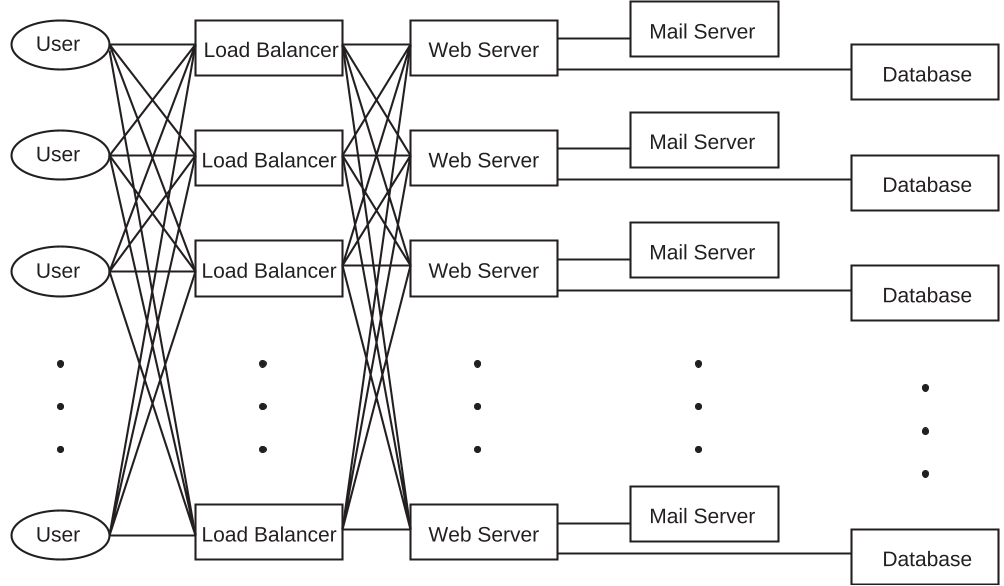
The researchers developed a custom high-level simulator to model these interactions. The brain of the system resides in two coupled agents:
1. The Q-Router (Where to go?)
Instead of following fixed paths, each node maintains a Q-table. When a node forwards a job, it receives a "time-to-go" estimate from its neighbor. Over time, it learns the fastest paths for different job types through experience. Update Rule: Where is queue time, is travel time, and is the neighbor's estimated remaining time.
2. The Insertion Scheduler (What to do first?)
Standard FIFO (First-In-First-Out) is inefficient when utility functions are non-linear. The authors propose the Insertion Scheduler. When a new job arrives, it calculates where to "insert" it into the current queue to maximize the total estimated utility. It uses the Q-router’s learned values to predict how long a job will take once it leaves the current machine—a brilliant example of cross-layer information sharing.
Experiments & Results: Thriving in Chaos
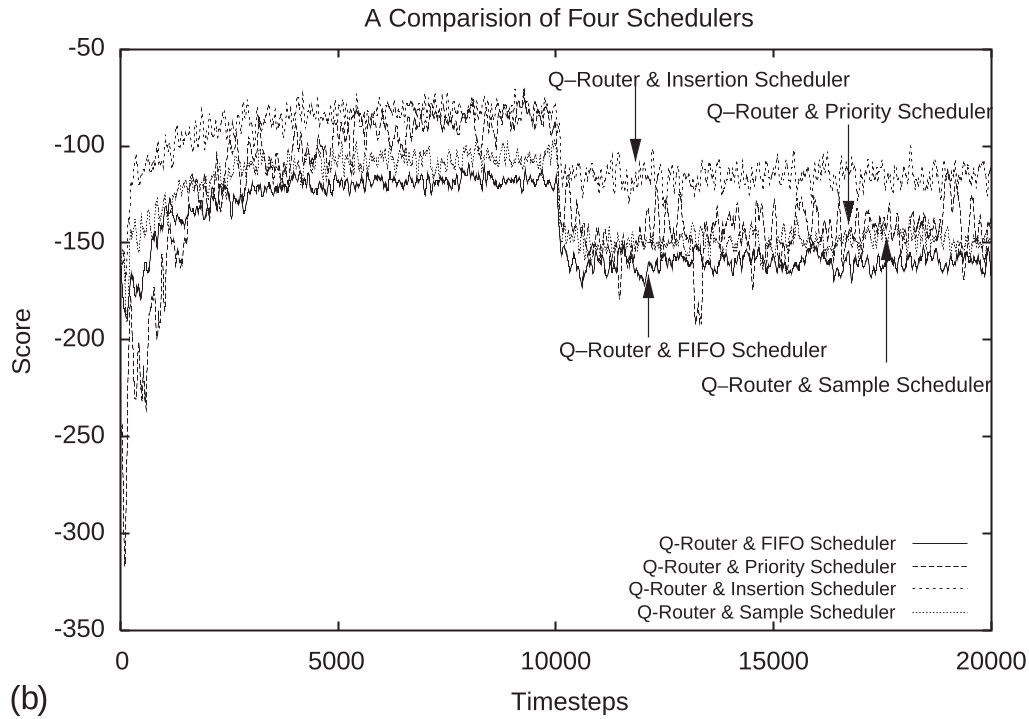
The authors tested three networks, including a large-scale enterprise model. They simulated "catastrophes" at by slashing the CPU speed of critical servers.
- Adaptability: While fixed heuristics collapsed after the catastrophe, the Q-router re-learned the network topology on-the-fly, redirecting traffic to healthier nodes.
- Bottleneck Navigation: In Network #2, where bottlenecks were not adjacent to routers, Q-routing was the only method that maintained high utility, proving it could "see" distant congestion through Q-value propagation.
- Scheduler Synergy: The Insertion Scheduler consistently outperformed simpler "Priority" schedulers, proving that using learned time-estimates is superior to hand-coded priority levels.
Critical Analysis & Conclusion
Takeaway
The paper’s greatest contribution is the synergy between routing and scheduling. By allowing the scheduler to "peek" into the routing table's learned knowledge, the system makes globally-aware decisions using only local data.
Limitations
- Computational Overhead: While the update rules are simple, rearranging queues on every arrival (the Insertion Scheduler) might be expensive for high-frequency packet switching.
- Deterministic Simulation: The simulator assumes deterministic workloads, whereas real systems face "jitter" from cache misses or disk I/O interference.
Future Outlook
This work lays the groundwork for self-healing data centers. Integration with modern State Space Models (SSMs) or more advanced MARL (Multi-Agent RL) could further reduce the exploration time required for the agents to reach peak performance.